
Table of Contents
- The Update Most Dubai Founders Missed
- What BOI Reporting Was and Why It Mattered
- What the FinCEN Rule Change Actually Says
- What This Means for a US LLC Owned by a UAE Free Zone Company
- What Has Not Changed: Form 5472 Is Still Mandatory
- The Full Annual Compliance Picture After the BOI Change
- The Withholding Tax Trap Nobody Mentions
- YouTube, AdSense and Affiliate Income: The 30% Problem
- How to Check Your Own Position
- Frequently Asked Questions
- Final Thoughts
US LLC BOI reporting was one of the most discussed compliance topics among internationally mobile founders in 2024 and 2025. Under the Corporate Transparency Act, the Financial Crimes Enforcement Network (FinCEN) required most US companies to file a Beneficial Ownership Information report disclosing who ultimately owns and controls them. For Dubai founders running a US LLC alongside a UAE free zone company, the question of whether and how to comply was a genuine source of confusion.
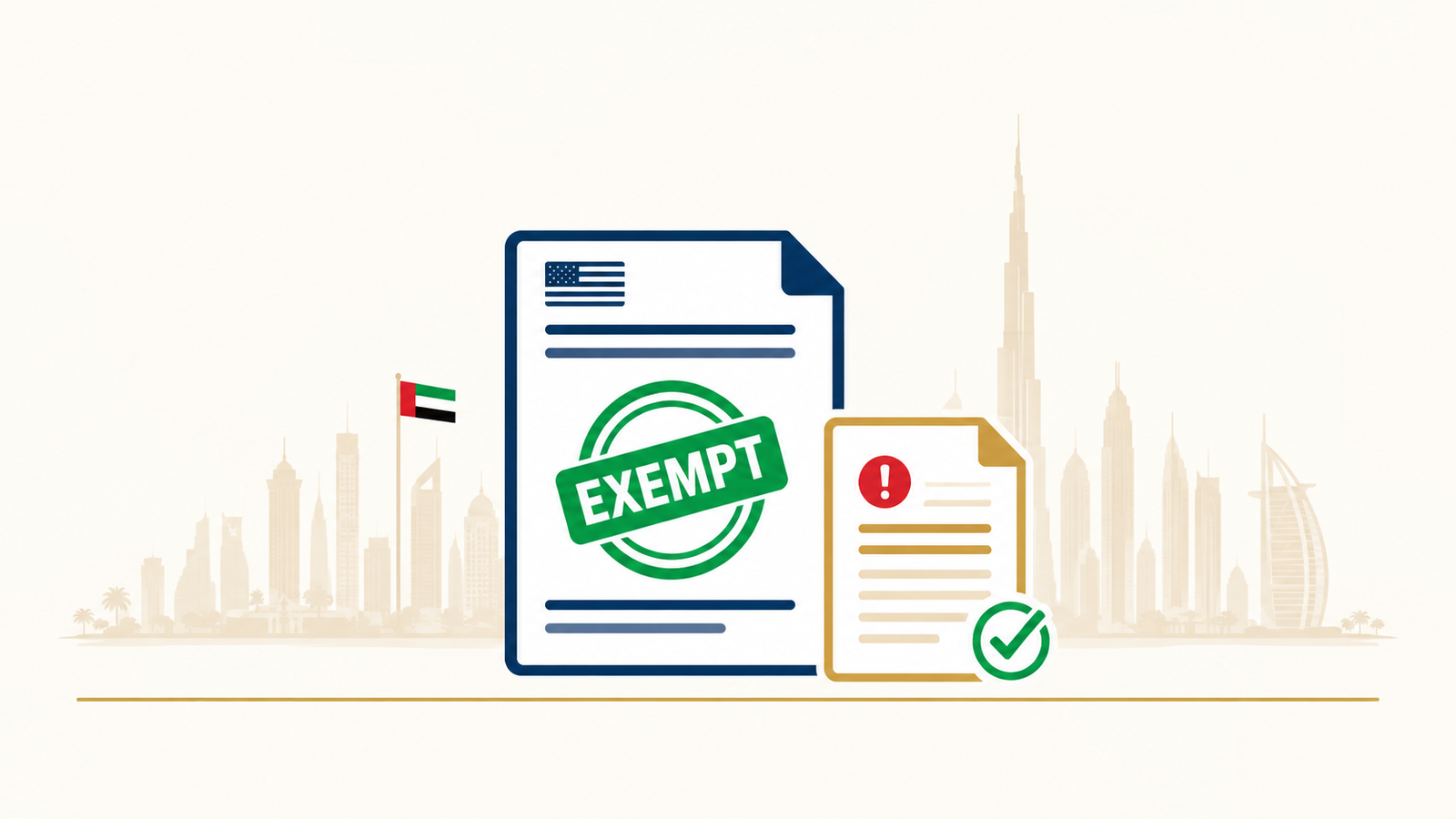
In August 2026, that question was answered definitively: under a FinCEN rule made permanent on 14 August 2026, entities formed under US law — including US LLCs — are exempt from filing a BOI report. The filing obligation that applied under the 2024 framework no longer applies to a standard US LLC owned by a UAE company. This guide explains exactly what changed, what it means for your compliance position, and — critically — what has not changed and still needs to be managed.
1. The Update Most Dubai Founders Missed
The BOI story has had more reversals than most compliance updates, which is why many founders are either still preparing a filing they no longer need to make, or assuming the exemption means their US LLC has no US obligations at all. Both positions are wrong.
The short version: a US LLC formed in Wyoming, Delaware, or any other US state, owned by a UAE free zone company, is now permanently exempt from filing a BOI report with FinCEN. That obligation is gone.
What remains: Form 5472 with a pro forma Form 1120 is still mandatory, annually, with a $25,000 penalty for missing it. The Wyoming annual report is still due. And if your US LLC receives certain categories of US-source income — including YouTube AdSense revenue from US viewers and some US affiliate commissions — a 30% withholding tax applies that the BOI exemption does nothing to change.
The exemption removed one compliance item. It did not remove the others. This guide covers all of them.
2. What BOI Reporting Was and Why It Mattered
The Corporate Transparency Act (CTA), enacted in 2021 and implemented by FinCEN from January 2024, required most US companies to file a Beneficial Ownership Information report. The report disclosed the individuals who ultimately own or control the company — name, date of birth, address, and a government-issued ID number.
For a US LLC owned by a UAE free zone company, which is in turn owned by a foreign individual, the question was who counted as the beneficial owner for reporting purposes and whether the LLC or the UAE entity bore the filing obligation. The answer shifted multiple times between January 2024 and August 2026 as FinCEN revised its rules, courts issued injunctions, and Congress considered legislative responses.
The final outcome — a permanent domestic entity exemption — resolved the question cleanly for the standard dual structure that Dubai founders use.
3. What the FinCEN Rule Change Actually Says
Under the FinCEN rule finalised in 2025 and made permanent on 14 August 2026, the definition of a “reporting company” under the CTA was narrowed. The current framework distinguishes between:
Domestic reporting companies: entities created by filing a document with a US secretary of state — which includes US LLCs. Under the permanent exemption, these are no longer required to file a BOI report.
Foreign reporting companies: entities formed under the law of a foreign country that are registered to do business in a US state. These entities remain subject to BOI reporting requirements.
The practical implication for the standard dual structure:
| Entity | BOI Reporting Required? |
|---|---|
| US LLC (formed under Wyoming/Delaware law) | No — domestic entity, permanently exempt |
| UAE free zone company registered to do business in a US state | Yes — foreign entity registered in US |
| UAE free zone company with no US state registration | No — not a foreign reporting company |
For most Dubai founders, the UAE free zone company is not registered to do business in any US state — it simply owns the US LLC as a foreign member. That means neither entity in the standard dual structure currently requires a BOI filing.
One important caveat: FinCEN retains the authority to revise its rules again. This guide reflects the position as of September 2026. Confirm current FinCEN guidance at fincen.gov before relying on any exemption, particularly if significant time has passed since this was published.
4. What This Means for a US LLC Owned by a UAE Free Zone Company
For the typical structure — a Dubai free zone company owning a Wyoming or Delaware LLC — the BOI exemption means:
- No BOI report was required to be filed by the 2024 or 2025 deadlines under the current rules
- No ongoing annual BOI filing obligation exists
- No disclosure of beneficial owners to FinCEN is required under the current framework
Founders who filed a BOI report during 2024 or early 2025 when the rules were different are not penalised for having done so — the filing was not harmful, simply unnecessary in hindsight given the subsequent rule changes.
Founders who did not file because of the injunctions and rule reversals are not in breach of a filing obligation under the current framework.
The position is now stable rather than in flux — but given the history of reversals in this area, monitoring FinCEN’s published guidance annually is the correct approach rather than treating the August 2026 rule as permanently settled without review.
5. What Has Not Changed: Form 5472 Is Still Mandatory
This is the section that matters most for ongoing compliance. The BOI exemption removed one filing. It did not affect the IRS annual filing requirements for foreign-owned single-member LLCs, which remain fully in force.
A foreign-owned single-member US LLC — including one owned by a UAE free zone company — must file:
Form 5472 together with a pro forma Form 1120, annually, regardless of whether the LLC had any revenue, any expenses, or any US tax liability during the year.
Form 5472 is an information return. It reports transactions between the LLC and its foreign owner (the UAE company) — contributions, distributions, loans, payments for services, and any other reportable transactions. Its purpose is to give the IRS visibility into the relationship between the US entity and its foreign parent, not to calculate or collect tax.
The penalty for missing Form 5472: $25,000 per failure, per year. This is not a graduated penalty — it is a fixed amount that applies from the first missed filing. The IRS enforces it. Founders who assume that zero revenue or zero tax means zero filing requirement discover this penalty at the worst possible moment.
The due date: 15 April, aligned with the pro forma Form 1120 filing. An extension can be requested, pushing the deadline to 15 October.
There is no revenue threshold below which Form 5472 is not required. There is no minimum transaction value below which the filing is waived. If your UAE free zone company owns a US LLC, Form 5472 is due every year.
6. The Full Annual Compliance Picture After the BOI Change
With the BOI obligation removed, here is the complete annual compliance picture for a Dubai founder running a standard dual structure:
| Obligation | Who It Applies To | Deadline | Penalty for Missing |
|---|---|---|---|
| Form 5472 + pro forma 1120 | All foreign-owned single-member LLCs | 15 April (extendable to 15 Oct) | $25,000 per failure |
| Wyoming annual report | Wyoming LLCs | 1 December | Administrative — LLC dissolution risk |
| Delaware franchise tax | Delaware LLCs | 1 June | $200 penalty + interest |
| BOI report | Domestic US entities | Exempt — not required | N/A |
| UAE corporate tax registration | UAE free zone company | Within 9 months of financial year end | AED 10,000 |
| UAE trade licence renewal | UAE free zone company | Annual | Residency visa risk |
| UAE audited accounts | UAE free zone company | Annual (most zones) | Free zone compliance risk |
The removal of the BOI obligation simplifies the picture by one line. Everything else on this table remains active.
7. The Withholding Tax Trap Nobody Mentions
The BOI exemption update has a shadow: in the same period that FinCEN was revising its beneficial ownership rules, many founders became aware of a separate and entirely unrelated issue that the BOI news tends to overshadow.
The UAE has no income tax treaty with the United States. This means that certain categories of US-source income paid to UAE-resident beneficial owners are subject to a 30% US withholding tax — the default rate that applies in the absence of a treaty reduction.
The withholding applies at source: the US payer (a platform, an affiliate network, an ad revenue provider) withholds 30% before sending any payment. The LLC’s bank account receives 70 cents for every dollar earned on those streams. The withheld 30% goes to the IRS. There is no mechanism for a UAE-resident beneficial owner to reclaim it in the absence of a treaty.
This withholding applies regardless of:
- Whether the LLC is exempt from BOI reporting
- Whether the LLC owes any US federal income tax
- Whether the UAE company qualifies for 0% UAE corporate tax
- Whether the founder pays 0% UAE personal income tax
The BOI exemption and the UAE’s favourable tax position are silent on this point because they address different things. The withholding is a US-side issue, determined by US domestic law and the absence of a treaty, not by UAE tax rules or FinCEN reporting frameworks.
8. YouTube, AdSense and Affiliate Income: The 30% Problem
The most commonly encountered application of the 30% withholding for Dubai founders is YouTube AdSense revenue from US viewers and certain US affiliate commission payments.
YouTube/Google AdSense: Google applies US withholding tax to AdSense revenue attributable to US viewers. For a UAE-resident beneficial owner with no treaty protection, the withholding rate is 30% on the US-source portion. Founders who set up their AdSense account under a W-8BEN-E as a foreign entity receive the US-sourced portion net of 30% withholding before any payment reaches their US LLC’s bank account.
US affiliate networks: many US affiliate networks treat commissions as US-source income and apply withholding to non-treaty-country recipients. The applicable rate for UAE-resident beneficial owners is 30% on the affected income streams.
What the W-8BEN-E does: filing a W-8BEN-E with a platform or payer confirms foreign status and triggers the withholding mechanism. It does not reduce the withholding rate where no treaty applies — it simply directs the platform to apply the correct foreign rate rather than treating the entity as a US person subject to backup withholding.
What the LLC structure does not change: the withholding follows where the beneficial owner is tax-resident, not where the LLC is registered. Forming a US LLC does not convert US-source income from YouTube or US affiliate networks into domestic income free of withholding. The LLC is a pass-through — the beneficial owner is still the UAE company and its UAE-resident owner, and the withholding treatment follows them.
Practical implication: for founders whose revenue is primarily US-source passive income — YouTube ad revenue, US affiliate commissions — the 30% withholding on that specific income stream is a real cost that the dual structure does not eliminate. For founders whose revenue comes from selling products or services to US customers (e-commerce, SaaS, digital products, consulting), the position is different — that business income is generally not subject to US withholding in the same way and the dual structure works cleanly.
Understanding which category your income falls into before building the structure is the correct sequence. UAE VAT and tax advisory support from 360bizs can help map your specific income streams against both the UAE corporate tax and US withholding positions before the structure is put in place.
9. How to Check Your Own Position
Three questions establish your current compliance and tax position as a Dubai founder with a US LLC:
Question one: is your US LLC formed under US state law (e.g. Wyoming or Delaware)? If yes — it is exempt from BOI reporting under the current FinCEN framework. No BOI filing is required or pending.
Question two: does your UAE free zone company own the US LLC (rather than you personally)? If yes — Form 5472 is required annually, filed by the LLC with a pro forma Form 1120, due 15 April. This applies regardless of revenue and regardless of the BOI exemption.
Question three: does your US LLC receive US-source passive income — specifically YouTube AdSense from US viewers, or US affiliate commissions? If yes — a 30% US withholding tax applies to those specific income streams for UAE-resident beneficial owners, because the UAE has no income tax treaty with the US. This is separate from and unaffected by the BOI exemption.
If you answered yes to question two and have not been filing Form 5472, addressing that gap is the most urgent compliance action — the $25,000 annual penalty accumulates per year and does not reset on discovery. A qualified US tax professional or CPA familiar with foreign-owned LLCs can prepare the required filings and advise on penalty abatement options where applicable.
10. Frequently Asked Questions
Does a US LLC owned by a Dubai company need to file a BOI report? No. Under the FinCEN rule made permanent on 14 August 2026, entities formed under US state law — including Wyoming and Delaware LLCs — are exempt from filing a Beneficial Ownership Information report. Only foreign entities registered to do business in a US state remain subject to BOI reporting.
What changed about BOI reporting for US LLCs in 2026? FinCEN made permanent a domestic entity exemption that removes the BOI filing obligation for entities formed under US law. Previously, the rules required most US companies to file BOI reports disclosing their beneficial owners. The permanent exemption ended that obligation for domestically formed entities including US LLCs.
Does the BOI exemption mean a US LLC has no US reporting obligations? No. The BOI exemption removes one specific FinCEN filing. It does not affect IRS obligations. A foreign-owned single-member US LLC must still file Form 5472 with a pro forma Form 1120 annually by 15 April, regardless of revenue or tax owed. The $25,000 penalty for missing this filing remains fully in force.
What is Form 5472 and does it still apply after the BOI change? Form 5472 is an IRS information return reporting transactions between a US entity and its foreign owner. It remains mandatory annually for all foreign-owned single-member LLCs — including those owned by UAE free zone companies — regardless of the BOI exemption, revenue level, or US tax liability.
Does a Dubai founder owe US withholding tax on YouTube or affiliate income? Yes, on US-source streams. YouTube AdSense revenue from US viewers and certain US affiliate commissions are subject to 30% US withholding tax for UAE-resident beneficial owners, because the UAE has no income tax treaty with the US. This is unaffected by the BOI exemption and unaffected by the UAE’s favourable corporate and personal tax position.
Does the Corporate Transparency Act still apply to a US LLC owned by a UAE company? The CTA remains law. What changed is FinCEN’s implementation rule, which now exempts domestically formed entities (including US LLCs) from the BOI filing requirement. The CTA itself has not been repealed, and FinCEN retains the authority to revise its rules again. Monitor fincen.gov for updates.
Does the BOI exemption change the UAE corporate tax position of a dual structure? No. UAE corporate tax applies to the UAE free zone company on its income according to UAE corporate tax law. The BOI exemption is a US regulatory matter with no effect on how income is taxed in the UAE.
What is the due date for Form 5472? 15 April, aligned with the pro forma Form 1120. An extension request can push this to 15 October. The filing is required even where the LLC had zero revenue and zero transactions during the year — confirm with a qualified US CPA whether a nil return is appropriate for your specific position.