

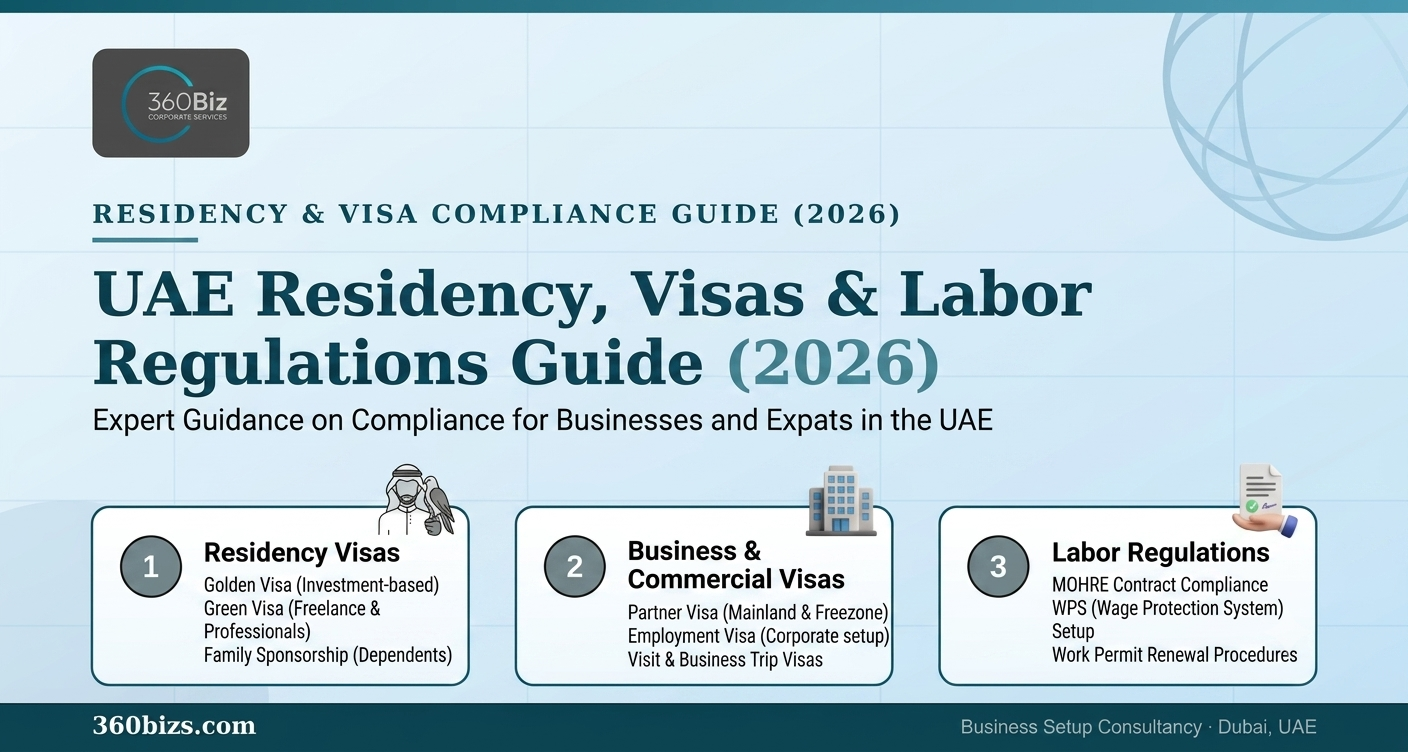
UAE Residency, Visas & Labor Regulations: The Complete 2026 Guide for Business Owners
Setting up a company in Dubai is only half the equation. The other half the part that determines whether you can actually live here, sponsor your family, and legally hire staff is residency, visas, and labor law. For foreign entrepreneurs and South Asian investors especially, this is where most of the real confusion happens: which visa fits your situation, how much it actually costs, and what MOHRE expects from you the moment you hire your first employee.
This guide breaks down every major UAE residency route available in 2026, the Golden Visa in detail, and the labor regulations every employer needs to follow from Wage Protection System (WPS) registration to end-of-service gratuity calculations.
UAE Residency Visas: The Main Categories at a Glance
Every UAE residence visa is stamped in your passport and linked to your Emirates ID, and every one of them requires a sponsor an employer, a family member, or yourself if you qualify as an investor or property owner. Validity ranges from 2 years for standard categories up to 10 years for the Golden Visa.
| Visa Type | Who It’s For | Validity | Approx. Government Fee |
|---|---|---|---|
| Employment Visa | Staff hired under a UAE trade license | 2 years | From AED 2,050 |
| Investor / Partner Visa | Business owners, shareholders | 2 years | AED 12,000 |
| Property Investor Visa | Real estate owners (AED 750,000+) | 2 years | Varies by emirate |
| Freelance Permit Visa | Self-employed / freelance license holders | 2–3 years | From AED 5,700 (free zone packages) |
| Green Visa | Skilled workers, freelancers, investors below Golden Visa thresholds | 5 years | Varies |
| Golden Visa | Investors, entrepreneurs, professionals, talent | 10 years (property/skilled route: 5 years in some categories) | AED 2M+ investment threshold |
| Retirement Visa | Residents 55+ meeting financial criteria | 5 years | Varies |
If you’re deciding between a mainland or free zone structure before you apply for any of these, it’s worth reviewing our mainland company formation in Dubai and free zone business setup services pages first your visa quota and sponsorship route depend directly on which structure you choose.
The Investor / Partner Visa: What It Actually Costs
The standard 2-year investor residence visa carries a government fee of AED 12,000 and is renewable as long as your investment stays active. Total cost including trade license, establishment card, and visa processing typically runs AED 15,000–30,000 for a mainland setup, while free zone packages can start from around AED 5,700 for basic freelance structures.
This visa is tied directly to your company. If you’re weighing mainland versus offshore for this reason, note that offshore company formation structures generally do not carry UAE residency rights, since offshore entities aren’t licensed to operate or sponsor visas inside the UAE an important distinction many first-time investors miss.
The UAE Golden Visa: 2026 Rules
The Golden Visa is a renewable, self-sponsored 10-year residency that doesn’t require an employer or local sponsor. It’s issued under the Executive Regulations of Federal Decree-Law No. (29) of 2021, through ICP or GDRFA depending on the emirate. In 2026, there are four main pathways:
- Real estate investment: Property valued at AED 2 million or more. As of February 2026, the previous 50% down-payment requirement for property investors was removed, and both completed and off-plan properties qualify if DLD-certified valuation meets the threshold.
- Bank deposit / investment fund: A minimum AED 2,000,000 placed in an accredited UAE investment fund, registered with the Central Bank or the Securities and Commodities Authority, held for at least two years.
- Business ownership: Capital of AED 2 million or more in a licensed commercial or industrial company.
- Skilled professional / salary route: Qualifying employees earning above a set monthly salary threshold, or individuals nominated for exceptional talent or academic achievement.
Processing typically takes 2–5 working days once a complete file is submitted, though property and fund-based applications can run 2–3 weeks due to additional authority verification. A key protection for real estate investors: the law states the Golden Visa remains valid even if your property’s market value later drops, provided the original investment recorded at issuance met the AED 2 million threshold.
UAE Labor Law: What Employers Must Know Before Hiring
Once you start hiring, you fall under Federal Decree-Law No. 33 of 2021 the law that replaced the old 1980 labor code and abolished unlimited employment contracts. Every contract must now be fixed-term and registered with MOHRE within 60 days of the hire date.
Core rules every employer needs to follow:
- Working hours: 8-hour workdays, 48 hours per week as the standard structure.
- Annual leave: 30 calendar days after one year of continuous service, plus paid public holidays.
- Maternity leave: 60 days.
- Notice periods: 1 month for employees with under 5 years of service, 3 months for 5+ years binding on both employer and employee.
- Termination payments: Gratuity and any outstanding wages must be settled within 14 days of contract termination. Delays can trigger MOHRE complaints and fines.
- Fines for violations: Range from AED 5,000 up to AED 1,000,000 per violation, and under Federal Decree-Law No. 9/2024, penalty multipliers apply based on the number of workers affected up to AED 10 million in aggregate for larger violations.
If managing this alongside your company registration feels like a lot, this is exactly where our corporate PRO services team steps in handling MOHRE registration, labor card processing, and visa paperwork so you’re not navigating it solo.
Wages Protection System (WPS): Non-Negotiable Above 5 Employees
WPS requires every private-sector salary to be paid electronically through an MOHRE-approved bank or exchange house, using a standardized Salary Information File. It becomes mandatory once you have 5 or more employees, and it applies even inside most free zones DMCC, IFZA, JAFZA, and the majority of others all fall under MOHRE’s WPS rules. Only DIFC and ADGM are exempt, since they run their own separate employment frameworks.
A WPS compliance update effective 1 June 2026 raised the required on-time payment threshold to 85%, with a unified due date on or before the first day of each Gregorian month. Missing this window repeatedly puts your company at risk of MOHRE penalties and can even affect future work permit approvals.
End-of-Service Gratuity: How It’s Actually Calculated
Every foreign employee who completes at least one year of continuous service is entitled to end-of-service gratuity under Article 51 of Federal Decree-Law No. 33 of 2021. The calculation is based on basic salary only housing, transport, and other allowances are excluded, which trips up a lot of new employers who structure packages with heavy allowances.
| Years of Service | Gratuity Entitlement |
|---|---|
| Years 1–5 | 21 days of basic salary per full year |
| Year 6 onward | 30 days of basic salary per full year |
| Cap | Total gratuity cannot exceed 2 years of wages |
Since Cabinet Resolution No. 96 of 2023, employers can also opt into the voluntary Alternative End of Service Benefits Scheme, contributing 5.83% of basic monthly salary (under 5 years’ service) or 8.33% (5+ years) into an approved investment fund instead of accruing a lump-sum liability.
Emiratisation Requirements for Private Employers
UAE nationals now come with quota obligations for many private-sector companies. Non-compliant employers pay a monthly contribution of AED 9,000 per unfilled Emiratisation role as of 2026, alongside a minimum Emirati private-sector wage floor of AED 6,000/month effective January 2026. If you’re scaling your team, it’s worth mapping your headcount against MOHRE thresholds quarterly rather than waiting for a year-end review that can catch you with an unexpected shortfall.
Where Business Setup Meets Visa & Labor Compliance
Every stage of company formation touches your visa and labor obligations in some way:
- Your business centre or office space determines your visa quota under most mainland and free zone authorities more Ejari-registered space generally means more visa allocations.
- If you’re operating as a solo seller under an e-trader license, you won’t need WPS or Emiratisation compliance until you actually hire staff, but your own residency still needs to be sorted through the freelance or investor route.
- Opening a corporate bank account is required before WPS can be activated, since salary transfers must run through a UAE-licensed bank or exchange house.
- If you’re closing a company, all visas including your own investor visa and any staff visas must be formally cancelled through MOHRE and immigration before company closure and liquidation can be completed. Skipping this step is one of the most common reasons liquidation applications get delayed.
Common Mistakes Foreign Entrepreneurs Make
- Assuming a tourist or visit visa lets them operate a business. It doesn’t you need a properly sponsored residence visa tied to your license.
- Confusing residency with tax residency. A UAE residence visa does not automatically make you a UAE tax resident; a separate Tax Residency Certificate requires 183 days of physical presence and is applied for independently.
- Underestimating gratuity liability by loading salary packages with allowances instead of basic pay, then facing disputes at termination.
- Missing the 60-day MOHRE contract registration window for new hires, which can trigger fines.
- Letting a standard visa lapse by staying outside the UAE for more than 6 months, which automatically cancels most non-Golden Visa residency permits.
FAQs
What is the difference between an investor visa and a Golden Visa in the UAE? The investor visa is a 2-year residency tied to an active business or property investment, renewable while the investment remains active. The Golden Visa is a 10-year, self-sponsored residency requiring a higher AED 2 million threshold, with more flexibility around physical presence and no employer dependency.
Do free zone companies need to follow MOHRE labor law? Yes, in almost all cases. The majority of UAE free zones, including DMCC, IFZA, and JAFZA, fall under MOHRE’s labor law and WPS requirements. Only DIFC and ADGM operate independent employment frameworks.
How much does a UAE investor visa cost in 2026? The government fee for the standard 2-year investor visa is AED 12,000, though total costs including license and processing typically range AED 15,000–30,000 for a mainland setup.
When is WPS mandatory for a UAE company? WPS becomes mandatory once a company employs 5 or more staff, though many employers register earlier as a matter of compliance practice.
How is end-of-service gratuity calculated in the UAE? Gratuity is based on basic salary only 21 days’ pay per year of service for the first 5 years, and 30 days’ pay per year from year 6 onward, capped at 2 years’ total wages.
Can I lose my UAE residency visa by staying abroad too long? Yes. Standard residence visas are cancelled after 6 continuous months of absence from the UAE. The Golden Visa does not carry this restriction.
Does a UAE residence visa make me a UAE tax resident? No. Tax residency requires a separate Tax Residency Certificate from the Federal Tax Authority, based on 183 days of physical presence, applied for independently of your visa status.
Get Your Residency & Labor Compliance Right From the Start
Between choosing the right visa category, registering with MOHRE, activating WPS, and staying ahead of Emiratisation requirements, residency and labor compliance is one of the most detail-heavy parts of running a UAE company. Our team at 360bizs handles this end-to-end from your first investor visa application through ongoing PRO support as you hire. Talk to us before you submit your next visa application to make sure your structure is set up correctly the first time.
Disclaimer: This article is for general informational purposes only and does not constitute legal or immigration advice. Rules and fees are subject to change consult MOHRE, ICP/GDRFA, or a licensed advisor for guidance specific to your situation.