

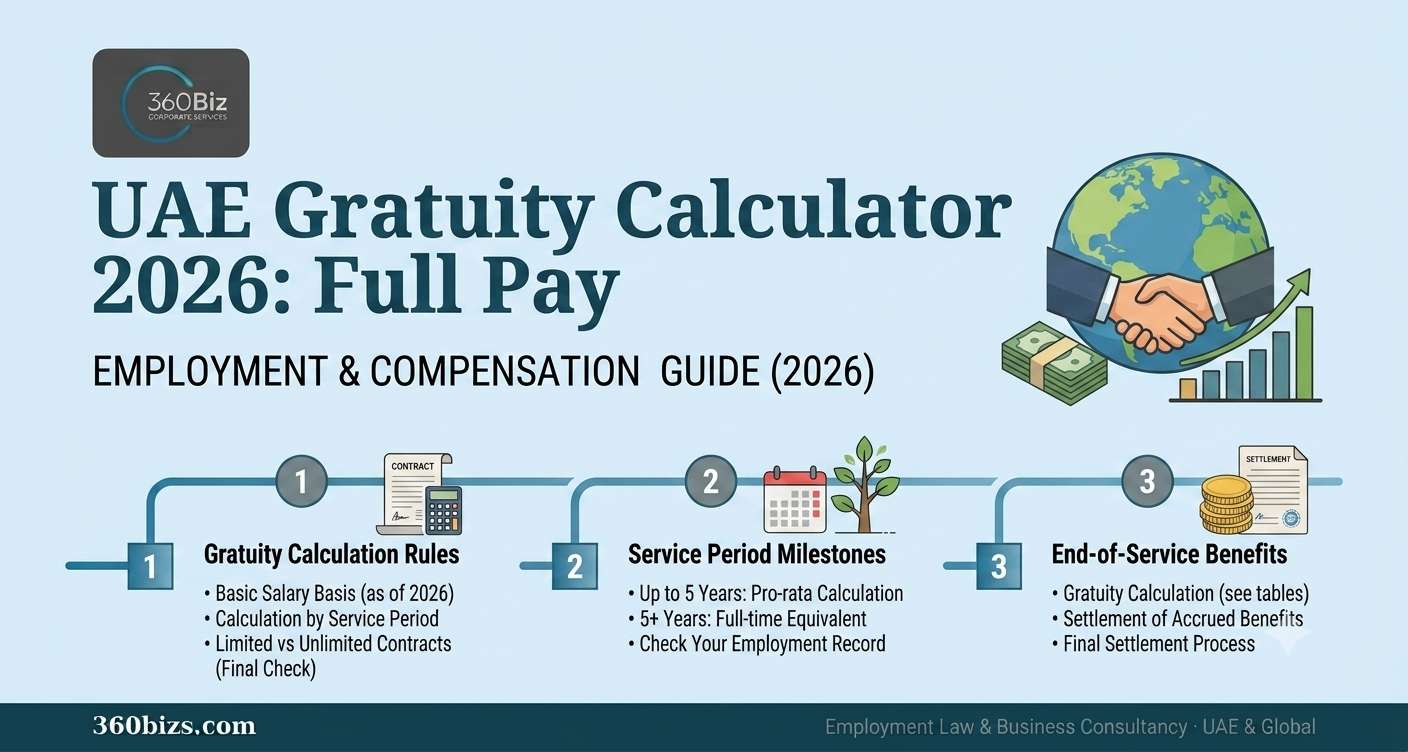
UAE Gratuity Calculator 2026: Full Pay Breakdown
A UAE gratuity calculator works out the end-of-service benefit an employee is owed when their job ends based on their last basic salary, joining and leaving dates, and the reason for leaving. If you’re a foreign investor setting up your first Dubai company, gratuity isn’t just an employee question it’s a recurring cost your business must budget for from day one of hiring. This guide covers the 2026 formula, a full worked example, and how founders should provision for it when setting up in the mainland, a free zone, or offshore.
What Is Gratuity Under UAE Labour Law?
Gratuity, or end-of-service benefit (EOSB), is a lump-sum payment employers in the UAE private sector are legally required to pay staff when employment ends, provided the employee has completed at least one year of continuous service. It’s set out under Federal Decree-Law No. 33 of 2021 on the Regulation of Labour Relations, enforced by the Ministry of Human Resources and Emiratisation (MOHRE)
Two things matter most: gratuity is calculated only on basic salary, not total salary with allowances, and it applies to expatriate employees UAE nationals receive a pension through the national scheme instead.
For entrepreneurs, this means every non-Emirati employee on your payroll accrues a liability the moment they cross the one-year mark. It’s a real, growing number on your books, not a one-off cost.
The 2026 Gratuity Calculation Formula
The formula hasn’t changed for 2026:
Gratuity = (Basic salary ÷ 30) × gratuity days × years of service
- First 5 years of service: 21 days of basic salary per year
- Beyond 5 years: 30 days of basic salary per year
- Cap: total gratuity can never exceed two years of basic salary, regardless of tenure
This applies uniformly whether you’re using a gratuity calculator Dubai, Abu Dhabi, or Sharjah the formula is federal, not emirate-specific.
Worked Example: Full Pay Breakdown
Take an employee with a basic salary of AED 10,000/month who completes 6 years of service:
| Service Period | Days per Year | Amount |
|---|---|---|
| First 5 years | 21 days | AED 35,000 |
| Year 6 | 30 days | AED 10,000 |
| Total Gratuity | AED 45,000 |
Add unpaid salary, leave encashment, and other dues, minus any deductions (loans, advances), to get the full and final settlement figure. Under the law, employers must pay this within 14 days of the contract ending.
For a new business owner, this AED 45,000 is a cost you should be provisioning for monthly from the employee’s start date not scrambling to find at exit.
Employer’s View: Budgeting Gratuity Into Your UAE Company Setup
This is where most guides stop short and where it matters most if you’re incorporating a company rather than just checking your own payout.
A practical rule many accountants use: set aside roughly 5.5–8% of each employee’s basic salary monthly as a gratuity provision, scaling up after year five. For a team of five staff on AED 8,000 basic salary each, that’s an ongoing liability worth planning into your cash flow from the first hiring decision alongside visa costs, WPS payroll setup, and office lease.
If you’re still deciding on your entity type, this liability doesn’t disappear based on structure it follows any employee you sponsor, whether under mainland company formation or a free zone business setup. The one place it does differ is DIFC and ADGM, covered below.
Mainland vs Free Zone vs DIFC/ADGM: Does Gratuity Change?
| Structure | Gratuity Rule |
|---|---|
| Mainland | Standard federal formula (21/30 days) |
| Free zone (JAFZA, DDA, etc.) | Same federal formula applies |
| DIFC | Replaced by the funded DEWS scheme — monthly employer contributions instead of a lump sum |
| ADGM | Own employment regulations — check zone-specific rules |
If you’re weighing a free zone setup against DIFC specifically for its financial-services positioning, factor in that DEWS shifts gratuity from a year-end liability into a predictable monthly cost which some founders actually prefer for cash flow planning.
Who Is Eligible, and When Does It Not Apply?
An employee qualifies for gratuity when they:
- Have completed at least one year of continuous service
- Are an expatriate private-sector employee
- Leave through lawful resignation (with notice served) or termination that isn’t for gross misconduct
Unpaid leave periods don’t count toward service time, and gratuity can be withheld for serious misconduct as defined by law.
Contract Types: What Changed
The UAE moved away from limited/unlimited contracts to a single fixed-term contract system. The old penalty that cut gratuity for early resignation is gone if an employee has completed one year and serves proper notice (30–90 days per contract), they receive full gratuity whether they resign or are terminated lawfully.
Setting Up Payroll and PRO Compliance Correctly
Getting gratuity right starts with correct labour card registration, WPS enrollment, and contract documentation from day one this is exactly where new business owners get tripped up. Our corporate PRO services handle labour card processing, visa sponsorship, and MOHRE filings so your gratuity calculations are built on accurate service dates from the start.
If you’re opening company or payroll accounts to manage these disbursements, our bank account opening assistance service helps structure accounts that separate operational funds from gratuity provisions.
What Happens to Gratuity If You Close Your Company?
This is a question most founders don’t think about until it’s urgent: if you liquidate or close your UAE company, all outstanding gratuity and end-of-service dues to staff must be settled before the closure process completes MOHRE and the relevant authority will expect proof of settlement. Planning this early avoids delays. Our company closure and liquidation service include staff settlement guidance as part of the exit process.
Is Gratuity Taxable?
No. The UAE has no personal income tax, so gratuity payments are entirely tax-free for the employee and there’s no separate tax deduction complexity for the employer either, beyond standard payroll accounting.
Common Mistakes Employers Make
- Calculating gratuity on gross salary instead of basic salary only
- Not tracking exact joining/leaving dates in HR records
- Failing to provision monthly, leading to cash-flow shock at exit
- Forgetting the two-year salary cap when estimating long-term liabilities
- Missing the DIFC/ADGM carve-out if operating in those zones
FAQs
How do I calculate gratuity in the UAE?
Divide the employee’s basic monthly salary by 30 for the daily wage, then multiply by 21 days per year for the first five years and 30 days per year after that.
Do free zone companies pay gratuity differently than mainland?
No free zones like JAFZA and DDA follow the same federal formula as mainland companies. Only DIFC and ADGM operate under separate rules.
How much gratuity budget should a new company set aside?
A common approach is provisioning roughly 5.5–8% of each employee’s basic salary monthly, increasing after the five-year mark, though exact figures depend on salary structure and turnover expectations.
What happens to unpaid gratuity if a company shuts down?
All gratuity and end-of-service dues must be settled as part of the liquidation process before company closure is finalized with the relevant authority.
Is gratuity taxable in the UAE?
No there is no personal income tax on gratuity or any salary component in the UAE.
What is the maximum gratuity an employee can receive?
Gratuity is capped at two years of the employee’s basic salary, regardless of total years worked.
Disclaimer: This article is for general informational purposes and does not constitute legal or financial advice. Confirm exact gratuity entitlements against current UAE Labour Law and your specific employment contracts, or consult a business setup advisor.