
Qualifying Free Zone Person: How to Maintain 0% Corporate Tax
Setting up in a UAE free zone does not hand you a 0% corporate tax rate automatically. It hands you access to one and only if you continue to meet a specific set of conditions as a Qualifying Free Zone Person (QFZP). Miss any one of them, and your company doesn’t just pay 9% on the income that slipped up. It can lose QFZP status entirely, for the current tax period and the four periods after it.
That “all-or-nothing” design is exactly why this is one of the most consequential compliance areas for any free zone business owner in 2026. This guide breaks down what QFZP status actually requires, what counts as qualifying versus non-qualifying income, and the practical steps that keep your 0% rate intact year after year.
What Is a Qualifying Free Zone Person?
A Qualifying Free Zone Person is a free zone company that the UAE Corporate Tax Law recognises as eligible for a 0% rate on its qualifying income, with the standard 9% rate applying to everything else. The framework sits under Federal Decree-Law No. 47 of 2022, with the operating detail set out in Cabinet Decision No. 100 of 2023 and the current activity list under Ministerial Decision No. 229 of 2025.
The important distinction is between being a Free Zone Person and being a Qualifying Free Zone Person. Every company licensed in a UAE free zone is automatically a Free Zone Person. Very few automatically qualify for the 0% incentive that status has to be earned and actively maintained, on a tax-period-by-tax-period basis.
If you’re still deciding between a free zone, mainland, or offshore structure, this is worth weighing early the QFZP regime is one of the strongest reasons founders still choose a free zone over mainland, but only if the business model genuinely fits the qualifying income rules below.
The Six Conditions for QFZP Status
To qualify for the 0% rate, a free zone entity must satisfy all six of the following at the same time:
- Be a Free Zone Person incorporated, established, or registered in a UAE free zone, including branches of free zone entities.
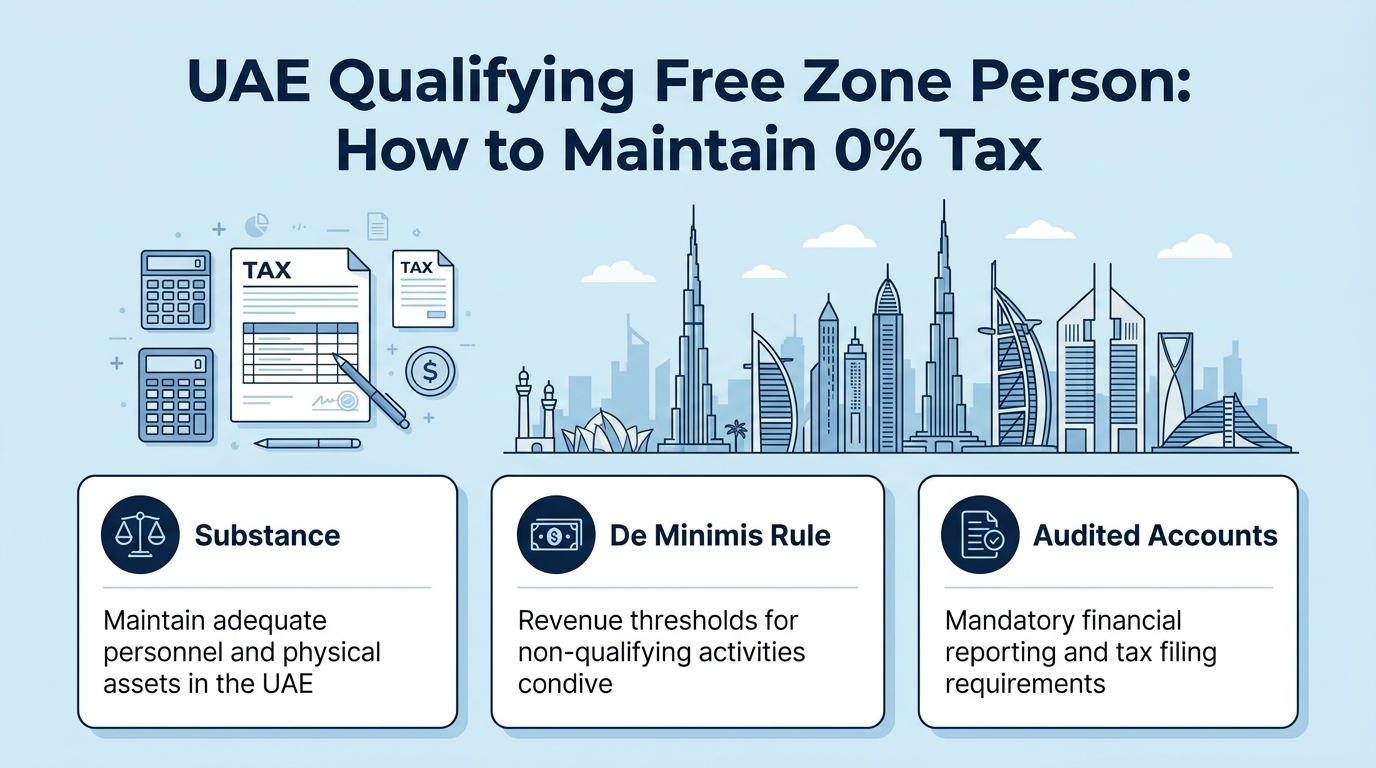
- Maintain adequate substance in the free zone real staff, assets, and operating expenditure that match the scale of the income being earned.
- Derive qualifying income income that falls within the categories defined by Ministerial Decision No. 229 of 2025.
- Not elect to be taxed under the standard 9% regime QFZP status is available by default, but a company can voluntarily opt out.
- Comply with transfer pricing rules arm’s-length pricing and full documentation for related-party and connected-person transactions.
- Stay within the de minimis threshold for non-qualifying revenue.
Fail even one, and the 0% rate is gone not just on the income tied to the failure, but across the board.
What Counts as Qualifying Income
Qualifying income generally falls into two groups:
- Transactions with other Free Zone Persons, provided the recipient is the beneficial recipient of the goods or services and the activity isn’t on the excluded list.
- Transactions with anyone (including mainland or foreign parties) for activities specifically listed as Qualifying Activities under Ministerial Decision No. 229 of 2025 manufacturing and processing of goods, holding of shares and other securities, ownership and operation of ships, reinsurance, fund and wealth management, headquarter services to related parties, treasury and financing services, financing and leasing of aircraft, and distribution of goods from a Designated Zone, among others.
Excluded Activities, which never qualify regardless of who the customer is, include transactions with natural persons (with limited exceptions), most banking and insurance activities, finance and leasing outside the aircraft carve-out, and income from owning or exploiting immovable property other than commercial property within a free zone leased to another free zone business.
Where a company deals directly with UAE mainland customers or the general public, most of that income falls outside the qualifying bracket, taxed at 9% instead. If mainland reach is central to your business plan, our accounting and bookkeeping team can map your actual revenue mix against these categories before it becomes a filing-season surprise.
The De Minimis Rule: How Much Non-Qualifying Income Is Safe?
A QFZP is allowed some non-qualifying revenue without losing its status but only up to the de minimis threshold, the lower of:
- AED 5,000,000, or
- 5% of total revenue for the tax period.
Stay within that limit, and the non-qualifying portion is simply taxed at 9% while the rest keeps its 0% rate. Cross it, even by a small margin, and the company loses QFZP status for the entire tax period 9% then applies to all taxable income for that period, not just the excess.
A company doing AED 6 million in total revenue, for example, has a de minimis cap of AED 300,000 (5% of revenue, since that’s lower than AED 5 million) a threshold that’s easy to breach unnoticed if a handful of mainland invoices land late in the year.
Adequate Substance: What the FTA Actually Checks
To meet the adequate substance requirement, a QFZP generally needs to show sufficient qualified employees physically present in the free zone, adequate assets located there to carry out core income-generating activities, and operating expenditure proportionate to the business conducted there.
A company can outsource part of its core income-generating activities to another party within the same (or a different) free zone, provided it retains adequate monitoring and control. Outsourcing to a mainland provider, or an unrelated party outside the UAE, generally doesn’t satisfy the substance test. A registered address and a laptop are not substance; payroll, a functioning office, and real operating spend are.
Audited Financial Statements Are Mandatory
Every Qualifying Free Zone Person must maintain audited financial statements, regardless of revenue size one of the few audit requirements in UAE corporate tax with no revenue threshold. Under Ministerial Decision No. 84 of 2025, this sits alongside taxable persons with revenue above AED 50 million and tax groups preparing special-purpose financial statements.
What Happens If You Lose QFZP Status
- Taxed at 9% on all taxable income for that tax period not only the non-qualifying portion.
- Automatically disqualified from QFZP status for the following four tax periods.
- Full requalification only possible after that five-tax-period window ends.
One bad year of non-compliance can mean five years at the standard rate which is why this needs quarterly monitoring, not an annual scramble.
Every Free Zone Company Still Registers for Corporate Tax
Corporate tax registration with the FTA is mandatory for every free zone company, including ones expecting 0% on all income. Non-registration is a compliance failure in its own right, separate from any tax owed.
Businesses with revenue at or below AED 3,000,000 can separately elect Small Business Relief and be treated as having no taxable income, for tax periods available up to 31 December 2026 this runs alongside, not instead of, the QFZP regime.
Practical Steps to Maintain Your 0% Rate
- Map revenue against Qualifying and Excluded Activities quarterly, not annually.
- Track non-qualifying revenue against the de minimis cap in real time.
- Keep genuine, documented substance in your free zone.
- Maintain transfer pricing documentation for related-party transactions.
- Commission audited financial statements early, not at the deadline.
- Register for corporate tax immediately upon incorporation.
- Review your structure annually as thresholds and activity lists are periodically updated.
How 360bizs Supports Your QFZP Compliance
Our VAT consultancy and accounting and bookkeeping teams work together to keep qualifying and non-qualifying revenue properly separated in your books, so nothing surfaces for the first time at audit stage.
If your current structure is creating avoidable non-qualifying income, it’s worth revisiting your setup itself our free zone business setup and mainland company formation teams can advise on a dual-licence approach or mainland branch. Government paperwork runs through our corporate PRO services, and if a related entity needs winding down, our company closure and liquidation team handles that cleanly.
Setting up fresh with QFZP eligibility in mind? Worth reading alongside our guide on business setup costs in Sharjah, or talk to our team directly.
FAQs: Qualifying Free Zone Person
What is a Qualifying Free Zone Person (QFZP)?
A QFZP is a UAE free zone company that meets all six conditions under the Corporate Tax Law to access a 0% rate on qualifying income, with non-qualifying income taxed at 9%.
Is every free zone company automatically a QFZP?
No. Every free zone company is a Free Zone Person by default, but QFZP status requires meeting substance, qualifying income, transfer pricing, and de minimis conditions on an ongoing basis.
What is the de minimis threshold for a QFZP?
The lower of AED 5,000,000 or 5% of total revenue. Non-qualifying revenue within this limit is taxed at 9% without affecting status; exceeding it removes QFZP status for the whole period.
What happens if a company loses QFZP status?
9% tax on all income for that period, plus disqualification for the following four periods a five-period bar before requalification is possible.
Do QFZPs need audited financial statements?
Yes, mandatory regardless of revenue, under Ministerial Decision No. 84 of 2025.
Does a 0% rate mean a free zone company skips corporate tax registration?
No. Every free zone company must register regardless of the rate that applies. Non-registration carries its own penalties.
Can a QFZP deal with mainland customers?
Yes, but most mainland and general-public income doesn’t qualify for 0% and counts toward the de minimis threshold.
Disclaimer: This article is for general informational purposes only and does not constitute tax or legal advice. Corporate tax rules and thresholds are subject to change by the UAE Ministry of Finance and Federal Tax Authority. Consult a licensed tax advisor for guidance specific to your company.