

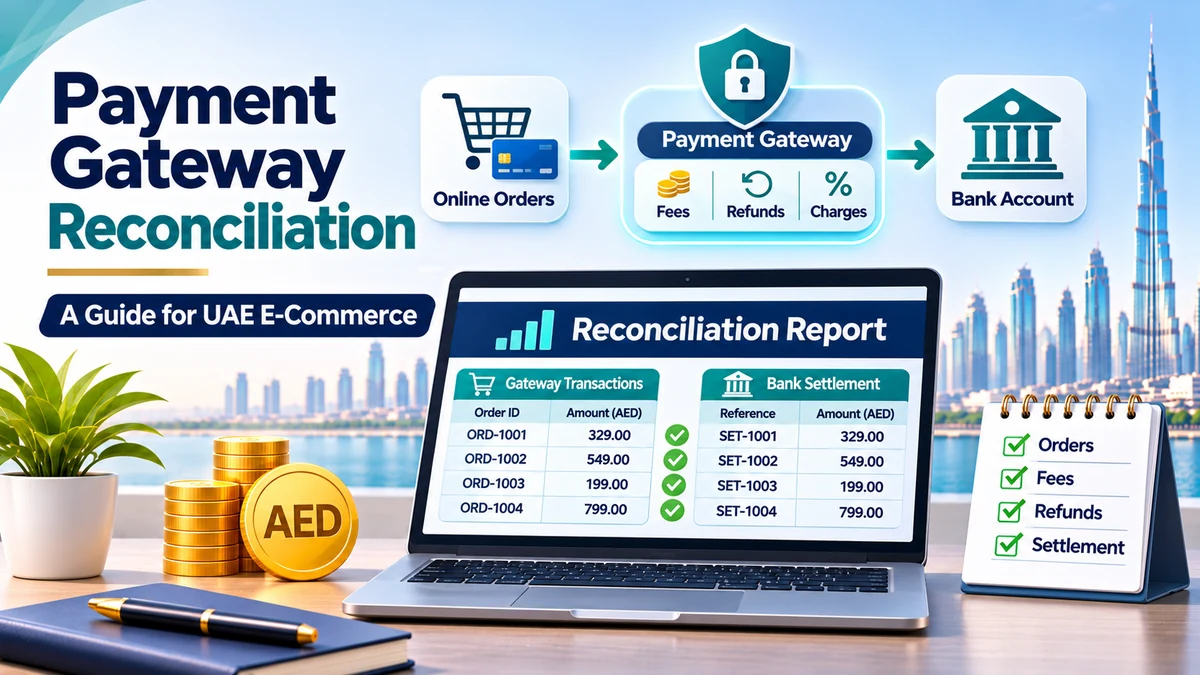
Payment gateway reconciliation UAE e-commerce businesses carry out is the process of matching every online sale, fee, refund and chargeback recorded by a payment gateway with the actual settlements received in the business bank account. It confirms that every dirham your customers paid has either reached your bank or is clearly explained.
For online stores, subscription businesses, marketplaces and service providers taking card payments in the UAE, this is one of the most common accounting headaches. Sales appear in your e-commerce platform at full value, the gateway deducts fees and refunds, settlements arrive days later in batches, and the amount in the bank never seems to match the sales report. This guide explains how e-commerce payment reconciliation works, how to record gateway transactions correctly, and a step-by-step method with a worked AED example.
What Is Payment Gateway Reconciliation?
Payment gateway reconciliation is a type of merchant transaction reconciliation that compares three sets of records:
- Sales records: orders and payments captured in your e-commerce platform, POS or invoicing system.
- Gateway reports: transaction, fee, refund, chargeback and settlement reports from your payment provider.
- Bank statements: the actual deposits received in your business bank account.
When all three agree, or any differences are identified and explained, your online payment reconciliation is complete. Payment providers commonly used in the UAE include Network International (N-Genius), Telr, PayTabs, Checkout.com, Stripe, Amazon Payment Services, and buy-now-pay-later providers such as Tabby and Tamara. The reconciliation principles are the same across all of them.
How Do Payment Gateway Settlements Work?
Understanding the money flow is the first step to accurate payment settlement reconciliation:
| Stage | What Happens | Where It Is Recorded |
|---|---|---|
| 1. Online sale | Customer pays by card, wallet or BNPL at checkout. | E-commerce platform and gateway |
| 2. Payment gateway | Gateway authorises and captures the payment, holding funds temporarily. | Gateway transaction report |
| 3. Processing fees | Gateway deducts percentage fees, fixed per-transaction fees and VAT on fees. | Gateway fee report or invoice |
| 4. Refunds and chargebacks | Amounts returned to customers or reversed by card issuers are deducted. | Gateway refund and dispute reports |
| 5. Net settlement | Gateway pays out the remaining balance in batches, often after a delay. | Gateway settlement report |
| 6. Bank statement | Net settlement arrives as a single deposit covering many orders. | Bank statement |
Because one bank deposit can represent hundreds of orders minus fees and refunds, you cannot simply match individual sales to bank entries. That is why a structured process is essential.
Why Do Bank Settlements Differ from Online Sales?
The most common reasons your bank deposits do not equal your sales report include:
- Processing fees: percentage-based and fixed fees deducted before payout.
- VAT on gateway fees: UAE-based providers commonly charge 5% VAT on their fees.
- Refunds: deducted from settlements, sometimes in a later period than the original sale.
- Chargebacks and dispute fees: reversed payments plus penalty fees.
- Settlement timing: payouts may take one or more business days, so end-of-month sales may settle next month.
- Rolling reserves: some providers hold back a percentage of sales for a period as security.
- Foreign currency conversion: payments in USD or other currencies converted at the gateway’s rate.
- Failed or pending transactions: orders marked paid on the store but not captured by the gateway.
- Monthly or setup charges: subscription fees deducted from payouts.
Why Is Payment Reconciliation Important?
Regular payment reconciliation UAE online businesses perform protects revenue and keeps records compliant. It helps you:
- Identify missing settlements and unpaid funds from the gateway
- Report revenue correctly at the gross sales value, not the net amount received
- Claim input VAT on gateway fees where eligible
- Calculate output VAT correctly on sales and refunds
- Detect fraud, duplicate charges and errors early
- Monitor the true cost of payments as a percentage of sales
- Support corporate tax and audit with clear, traceable records
How Should Transaction Fees Be Recorded?
Correct payment processing fees accounting follows one key principle: record sales at gross value and fees separately as an expense. Recording only the net amount received understates both revenue and expenses, distorts margins and can lead to VAT errors.
Best practice is to use a Payment Gateway Clearing account, which is a current asset account representing money held by the gateway on your behalf:
- Sales are debited to the clearing account at full value.
- Fees, refunds and chargebacks are credited to the clearing account.
- Settlements received in the bank are credited to the clearing account.
- The remaining balance should equal funds still held by the gateway, such as pending payouts or reserves.
Fees should be posted to an expense account such as “Payment Processing Fees” or “Bank and Gateway Charges”, with VAT on fees posted to input VAT recoverable where the business is VAT-registered and the tax invoice requirements are met.
Worked Example: Reconciling One Week of Gateway Transactions
An illustrative Dubai-based online store processes the following through its payment gateway in one week. All sales prices include 5% VAT.
| Item | Amount (AED) |
|---|---|
| Gross card sales (120 orders) | 50,000.00 |
| Refunds issued to customers | (2,000.00) |
| Chargeback reversed by card issuer | (500.00) |
| Processing fees (2.5% of sales + AED 1 per order = 1,250 + 120) | (1,370.00) |
| Chargeback fee | (50.00) |
| VAT at 5% on processing fees (5% of 1,370) | (68.50) |
| Expected net settlement | 46,011.50 |
| Actually received in bank this week | 41,011.50 |
| Difference to investigate | 5,000.00 |
On reviewing the gateway settlement report, the accountant finds that orders worth AED 5,000 placed on the last day of the week are in a pending payout batch scheduled to settle two business days later. The difference is a timing difference, not lost money. It remains in the clearing account until the payout arrives and is then ticked off.
Illustrative Accounting Entries
| Entry | Debit (AED) | Credit (AED) |
|---|---|---|
| Payment Gateway Clearing | 50,000.00 | |
| Sales Revenue | 47,619.05 | |
| VAT Output | 2,380.95 | |
| To record gross online sales | ||
| Sales Returns | 1,904.76 | |
| VAT Output | 95.24 | |
| Payment Gateway Clearing | 2,000.00 | |
| To record customer refunds | ||
| Chargebacks / Disputed Sales | 500.00 | |
| Payment Gateway Clearing | 500.00 | |
| To record chargeback (review VAT treatment with your advisor) | ||
| Payment Processing Fees | 1,420.00 | |
| VAT Input (Recoverable) | 68.50 | |
| Payment Gateway Clearing | 1,488.50 | |
| To record processing and chargeback fees | ||
| Bank Account | 41,011.50 | |
| Payment Gateway Clearing | 41,011.50 | |
| To record settlement received |
After these entries, the clearing account shows a debit balance of AED 5,000, exactly matching the pending payout. The payment gateway accounting is complete and fully explained.
How Do You Reconcile Payment Gateway Reports with Bank Statements? Step by Step
Step 1: Download All Reports for the Same Period
Export the e-commerce order report, gateway transaction report, gateway settlement or payout report, fee report and bank statement, all for the same date range.
Step 2: Match Orders to Gateway Transactions
Match each paid order to a captured gateway transaction using the order ID or transaction reference. Identify orders marked paid but not captured, and gateway transactions without matching orders.
Step 3: Identify Deductions
List all fees, VAT on fees, refunds, chargebacks, reserves and other charges for the period.
Step 4: Calculate the Expected Net Settlement
Gross captured sales minus refunds, chargebacks, fees and reserves should equal the total payouts reported by the gateway.
Step 5: Match Payouts to Bank Deposits
Match each gateway payout batch to the corresponding bank deposit by date, amount and payout reference.
Step 6: Investigate Differences
Classify every unexplained difference as timing (pending payout), fee discrepancy, missing settlement, currency difference or error, and follow up with the gateway where needed.
Step 7: Post Entries and Review the Clearing Account
Record sales, refunds, fees and settlements in your accounting software. The clearing account balance should equal funds still held by the gateway. An unexplained or growing balance signals a problem.
How Should Refunds Be Reconciled?
- Match each refund in the gateway report to a credit note or refund record in your sales system.
- Record refunds against sales returns and reduce output VAT accordingly, issuing tax credit notes where required.
- Watch for refunds processed in a different period than the original sale, which affects period-end reconciliation.
- Check whether the gateway refunds its processing fee on refunded transactions. Many providers do not.
How Should Chargebacks Be Handled?
A chargeback occurs when a customer disputes a payment with their card issuer and the funds are reversed. To manage chargebacks properly:
- Record the reversed amount and any dispute fee separately.
- Track the dispute status. If you win the dispute, record the funds when they are returned.
- Keep evidence such as delivery confirmation, customer communication and invoices.
- Review the VAT treatment of chargebacks with your tax advisor, as it depends on the circumstances.
- Monitor chargeback ratios, as high rates can lead to higher fees or account restrictions.
How Can Businesses Identify Missing Payment Settlements?
- Compare the gateway’s payout schedule with actual bank deposits each week.
- Review the age of balances in the clearing account. Anything older than the normal settlement cycle should be investigated.
- Check for reserves or holds placed on your merchant account.
- Confirm the correct bank account details are registered with the gateway.
- Raise a ticket with the provider, quoting payout IDs and transaction references.
What About Cash on Delivery and Marketplaces?
Many UAE e-commerce businesses also receive payments through courier cash on delivery (COD) and marketplaces. The same clearing-account approach applies: record gross sales, deduct courier COD fees or marketplace commissions as expenses, and reconcile courier or marketplace remittance reports to bank deposits. Use a separate clearing account for each provider to keep reconciliations clean.
How Frequently Should Reconciliation Be Performed?
The right frequency depends on your transaction volume:
- Daily: high-volume stores processing hundreds of orders per day.
- Weekly: most growing SMEs. This catches missing settlements quickly.
- Monthly at minimum: all businesses, as part of month-end close before VAT and management reporting.
Automation tools and accounting software integrations can import gateway data automatically, significantly reducing manual work. Our guide on choosing the right accounting software in the UAE covers integration features to look for.
Common Payment Gateway Reconciliation Mistakes
- Recording net settlements as revenue instead of gross sales
- Ignoring VAT on gateway fees and missing input VAT recovery
- Not reducing output VAT on refunds
- Using a single clearing account for multiple gateways
- Leaving unexplained balances in the clearing account
- Reconciling only once a year
- Not tracking reserves held by the gateway
Frequently Asked Questions
How do e-commerce businesses reconcile payment gateway transactions?
They match e-commerce orders to gateway transactions, deduct fees, refunds and chargebacks to calculate the expected net settlement, and match gateway payouts to bank deposits, investigating any differences.
How should payment gateway fees be recorded?
Record gross sales as revenue and gateway fees as a separate expense, with any VAT on fees recorded as input VAT where recoverable. Do not record only the net payout as revenue.
What causes settlement discrepancies?
Common causes include settlement timing, unrecorded fees, refunds, chargebacks, reserves, currency conversion and orders that were not captured by the gateway.
Can payment gateway reconciliation be automated?
Yes. Many accounting platforms and third-party tools integrate with gateways to import transactions and payouts automatically, although review and investigation of exceptions still require human oversight.
Conclusion
Accurate payment gateway reconciliation UAE e-commerce businesses perform regularly ensures that revenue is reported correctly, VAT is calculated accurately, fees are tracked transparently and no settlement goes missing. By understanding the flow from online sale to bank deposit, using a clearing account and reconciling weekly or monthly, online businesses can turn a confusing process into a reliable routine.
If your e-commerce sales, gateway reports and bank statements are not matching, 360Bizs can help. Explore our accounting and bookkeeping services or contact our team to set up a clean, reliable reconciliation process.