

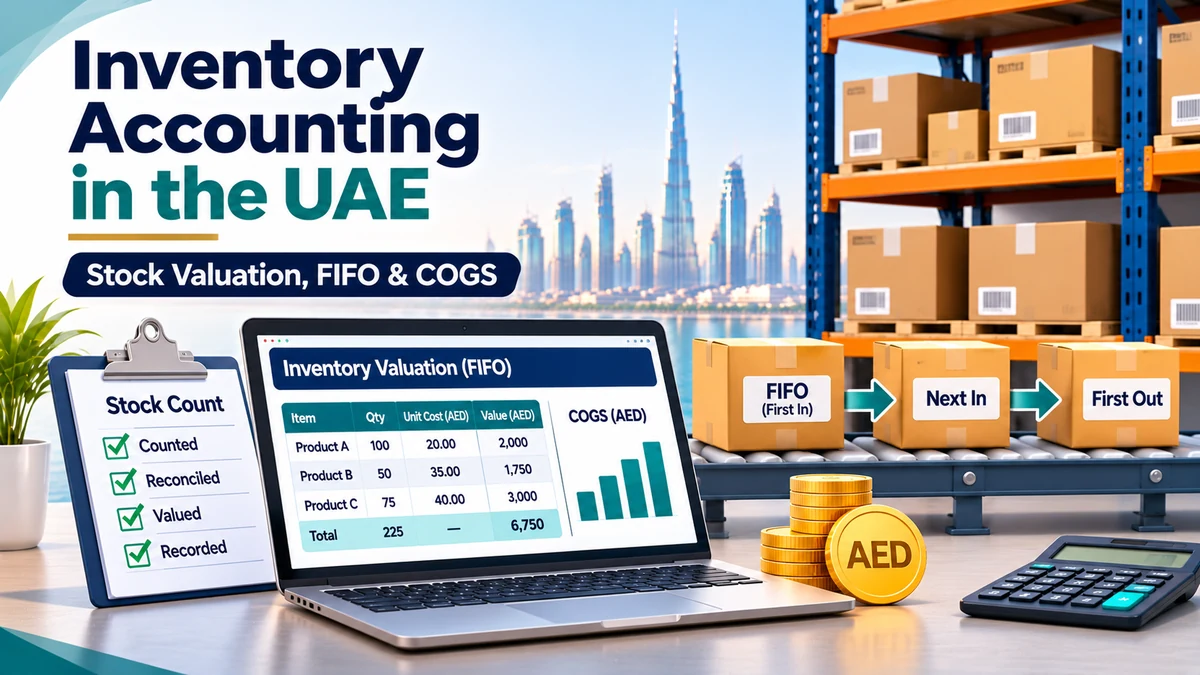
Inventory accounting UAE trading businesses follow is the process of recording, valuing and tracking the stock a company buys and sells, and calculating the cost of the goods it has sold during a period. For any business that imports, distributes, wholesales or retails products, inventory is often the largest current asset on the balance sheet, and the way it is valued directly affects gross profit, net profit and tax.
Whether you run a general trading company in Deira, an e-commerce store in a free zone or an electronics distributor in Sharjah, getting your inventory valuation UAE approach right is essential. This guide explains what inventory accounting is, the main stock valuation methods, how the FIFO inventory method compares with the weighted average cost method, how to perform a cost of goods sold calculation, and how to deal with damaged or obsolete stock, all with worked examples in AED.
What Is Inventory Accounting?
Inventory accounting covers everything involved in measuring and reporting the goods a business holds for sale. It answers three key questions:
- How much stock do we have? Quantities on hand by item and location.
- What is it worth? The value at which stock is recorded on the balance sheet.
- What did the goods we sold cost us? The cost of goods sold (COGS) recorded in the profit and loss statement.
For inventory accounting for trading companies, these answers determine gross profit, which is often the most important performance indicator in a trading business.
What Is Inventory Valuation?
Inventory valuation is the method used to assign a monetary value to the stock a business holds at the end of a period. Because the same product is often purchased at different prices over time, a business needs a consistent method to decide which costs stay in closing inventory and which costs move to cost of goods sold.
UAE businesses generally prepare their financial statements under International Financial Reporting Standards (IFRS). Under IFRS, specifically IAS 2 Inventories, inventory is measured at the lower of cost and net realisable value. The permitted cost formulas for interchangeable items are FIFO and weighted average cost. LIFO (last in, first out) is not permitted under IFRS.
What Is Included in the Cost of Inventory?
The cost of inventory includes all costs incurred to bring stock to its present location and condition, such as:
- Purchase price from the supplier, less trade discounts and rebates
- Import customs duty and non-recoverable taxes
- Inbound freight, shipping and insurance
- Clearing, handling and port charges directly related to the purchase
The following are usually excluded from inventory cost and treated as expenses:
- Recoverable input VAT (this goes to the VAT recoverable account instead)
- Storage costs after goods are ready for sale, unless storage is part of the production process
- Selling and distribution costs, such as delivery to customers
- General administrative overheads
- Abnormal wastage
What Are the Main Inventory Accounting Methods?
There are three main inventory accounting methods relevant to UAE businesses reporting under IFRS:
| Method | How It Works | Best Suited For |
|---|---|---|
| FIFO (First In, First Out) | Assumes the oldest stock is sold first. Closing stock reflects the most recent purchase prices. | Perishables, fashion, electronics, FMCG and most trading businesses |
| Weighted Average Cost | Assigns each unit an average cost based on the total cost of goods available divided by total units. | Bulk, homogeneous goods such as building materials, chemicals, fuel or grains |
| Specific Identification | Tracks the actual cost of each individual item. | High-value, unique items such as vehicles, jewellery, machinery or real estate units |
Businesses should apply the same method consistently to inventories of a similar nature and use.
Perpetual vs Periodic Inventory Systems
Alongside the valuation method, businesses use one of two tracking systems:
- Perpetual system: stock records are updated in real time with every purchase and sale, usually through accounting or inventory software. COGS is recorded with each sale.
- Periodic system: stock is physically counted at the end of a period, and COGS is calculated using the formula below.
Most growing UAE trading companies benefit from a perpetual system supported by regular physical counts.
How Do You Calculate Cost of Goods Sold?
The standard cost of goods sold calculation is:
COGS = Opening Inventory + Purchases (including direct costs) – Closing Inventory
And gross profit is:
Gross Profit = Revenue – Cost of Goods Sold
The value you place on closing inventory therefore has a direct effect on COGS and gross profit. A higher closing inventory value means lower COGS and higher profit, and vice versa. This is why consistent, accurate stock valuation methods matter so much.
FIFO vs Weighted Average: A Worked Example in AED
Let us look at an illustrative UAE trading company that sells one product line during a month.
| Transaction | Units | Cost per Unit (AED) | Total Cost (AED) |
|---|---|---|---|
| Opening inventory | 100 | 50 | 5,000 |
| Purchase 1 | 200 | 55 | 11,000 |
| Purchase 2 | 150 | 60 | 9,000 |
| Total goods available for sale | 450 | 25,000 |
During the month, the company sells 300 units at AED 90 each, generating revenue of AED 27,000. It has 150 units left in closing stock.
How Does the FIFO Method Work?
Under the FIFO inventory method, the 300 units sold are assumed to come from the oldest stock first:
- 100 units from opening inventory at AED 50 = AED 5,000
- 200 units from Purchase 1 at AED 55 = AED 11,000
- FIFO COGS = AED 16,000
The 150 units remaining are from Purchase 2 at AED 60:
- FIFO closing inventory = 150 × 60 = AED 9,000
Check using the formula: 5,000 + 20,000 – 9,000 = AED 16,000.
What Is Weighted Average Costing?
Under the weighted average cost method, every unit is valued at the average cost of all goods available:
- Average cost per unit = AED 25,000 ÷ 450 units = AED 55.56
- Weighted average COGS = 300 × 55.56 ≈ AED 16,667
- Weighted average closing inventory = 150 × 55.56 ≈ AED 8,333
Note that under a perpetual system, the average is recalculated after each purchase (a moving average), so results can differ slightly from this periodic calculation.
Comparing the Results
| Item (AED) | FIFO | Weighted Average |
|---|---|---|
| Revenue | 27,000 | 27,000 |
| Cost of goods sold | 16,000 | 16,667 |
| Gross profit | 11,000 | 10,333 |
| Gross profit margin | 40.7% | 38.3% |
| Closing inventory | 9,000 | 8,333 |
How Does Inventory Valuation Affect Gross Profit?
In the example above, purchase prices were rising. Under FIFO, older and cheaper costs flow into COGS first, producing a lower COGS and a higher gross profit of AED 11,000. Weighted average smooths costs across all units, producing a slightly higher COGS and lower gross profit of AED 10,333.
Key takeaways:
- When prices are rising: FIFO usually shows higher profit and higher closing inventory than weighted average.
- When prices are falling: FIFO usually shows lower profit than weighted average.
- When prices are stable: both methods produce similar results.
- Over the full life of the stock, total cost recognised is the same. The methods only affect timing between periods.
Because UAE Corporate Tax generally starts from accounting profit prepared under applicable accounting standards, the inventory valuation method can also influence the timing of taxable profit. Businesses should choose a method that reflects how stock actually moves and apply it consistently, rather than switching methods to manage profit.
How Should Damaged or Obsolete Stock Be Recorded?
Under IFRS, inventory must not be carried at more than it is expected to realise. If stock is damaged, expired, obsolete or can only be sold at a lower price, it must be written down to its net realisable value (NRV).
NRV = Estimated Selling Price – Estimated Costs to Complete and Sell
NRV Write-Down Example
Using the FIFO example, suppose 20 of the remaining units (cost AED 60 each, total AED 1,200) are found damaged in the warehouse. They can be sold for AED 25 each after AED 5 per unit in repair and repackaging costs.
- NRV per unit = 25 – 5 = AED 20
- Total NRV = 20 × 20 = AED 400
- Write-down required = 1,200 – 400 = AED 800
The AED 800 is recorded as an expense, typically within cost of sales or as an inventory write-down, and the carrying value of the damaged stock is reduced to AED 400. If stock is completely unsellable and has no scrap value, it should be written off entirely.
Good practice for damaged and obsolete stock includes:
- Recording damage, expiry and losses promptly with supporting documentation
- Keeping photos, inspection reports or disposal certificates where relevant
- Reviewing slow-moving items regularly, for example stock not sold in 6 or 12 months
- Making a provision for obsolescence based on ageing and historical experience
- Reviewing the VAT implications of write-offs and disposals with your tax advisor
How Do UAE Trading Companies Calculate Inventory Value? Step by Step
- Count physical stock: conduct a physical stock count or cycle count at period end.
- Reconcile with system records: investigate and adjust differences between physical counts and software records.
- Apply the chosen cost formula: FIFO, weighted average or specific identification, consistently.
- Include all purchase costs: add duty, freight and directly attributable charges, and exclude recoverable VAT.
- Review for NRV: identify damaged, slow-moving or obsolete items and write them down where needed.
- Post adjustments: record closing inventory and the resulting COGS in the general ledger.
- Review gross margins: compare margins with previous periods to identify unusual movements.
What Inventory Records Should Trading Businesses Maintain?
Strong inventory accounting for trading companies depends on good records. Trading businesses in the UAE should maintain:
- Item master list: SKU codes, descriptions, units of measure and categories
- Purchase records: supplier invoices, purchase orders, goods received notes and import documents
- Landed cost workings: calculations showing how freight, duty and charges were allocated to items
- Sales records: tax invoices, delivery notes and returns
- Stock movement records: transfers between warehouses, branches or locations
- Stock count sheets: signed count records and reconciliation reports
- Write-off and damage reports: approvals and supporting evidence
- Valuation workings: FIFO layers or weighted average calculations and NRV reviews
These records support accurate financial statements, VAT returns and corporate tax filings, and they make audits significantly smoother.
Common Inventory Accounting Mistakes
- Using LIFO: it is not permitted under IFRS.
- Ignoring landed costs: leaving freight and duty out of stock cost understates inventory and distorts margins.
- Including recoverable VAT in inventory cost: this overstates stock and COGS.
- Never counting stock: relying only on software figures without physical verification.
- Not writing down damaged or obsolete stock: this overstates assets and profit.
- Switching valuation methods frequently: this makes results inconsistent and hard to compare.
- Poor cut-off: recording sales or purchases in the wrong period around month-end.
Frequently Asked Questions
What is the difference between FIFO and weighted average costing?
FIFO assumes the oldest stock is sold first, so closing stock reflects recent prices. Weighted average assigns every unit the same average cost. When prices are rising, FIFO generally reports higher profit and higher closing inventory.
Is LIFO allowed in the UAE?
UAE businesses reporting under IFRS cannot use LIFO, as IAS 2 does not permit it. FIFO, weighted average and, for unique items, specific identification are the accepted approaches.
Can a business change its inventory valuation method?
A change is generally only appropriate if it results in more reliable and relevant information, and it must be properly disclosed. Businesses should discuss any change with their accountant or auditor first.
How often should stock be counted?
At a minimum, businesses should conduct a full physical count at year end. Many trading businesses also carry out monthly or quarterly cycle counts on high-value or fast-moving items.
Does accounting software handle inventory valuation automatically?
Many accounting and inventory platforms support FIFO or average cost valuation automatically, but the results are only accurate if purchases, landed costs, sales and stock adjustments are recorded correctly.
Conclusion
Accurate inventory accounting UAE trading businesses can rely on is essential for correct gross profit, trustworthy financial statements and confident decision-making. By choosing an appropriate method, whether the FIFO inventory method or the weighted average cost method, including the right costs, performing a reliable cost of goods sold calculation and writing down damaged or obsolete stock to net realisable value, businesses can keep their inventory figures accurate and compliant.
If you need help setting up inventory accounting, reconciling stock records or reviewing your inventory valuation UAE approach, 360Bizs can support you. Explore our accounting and bookkeeping services or contact our team to get started.