
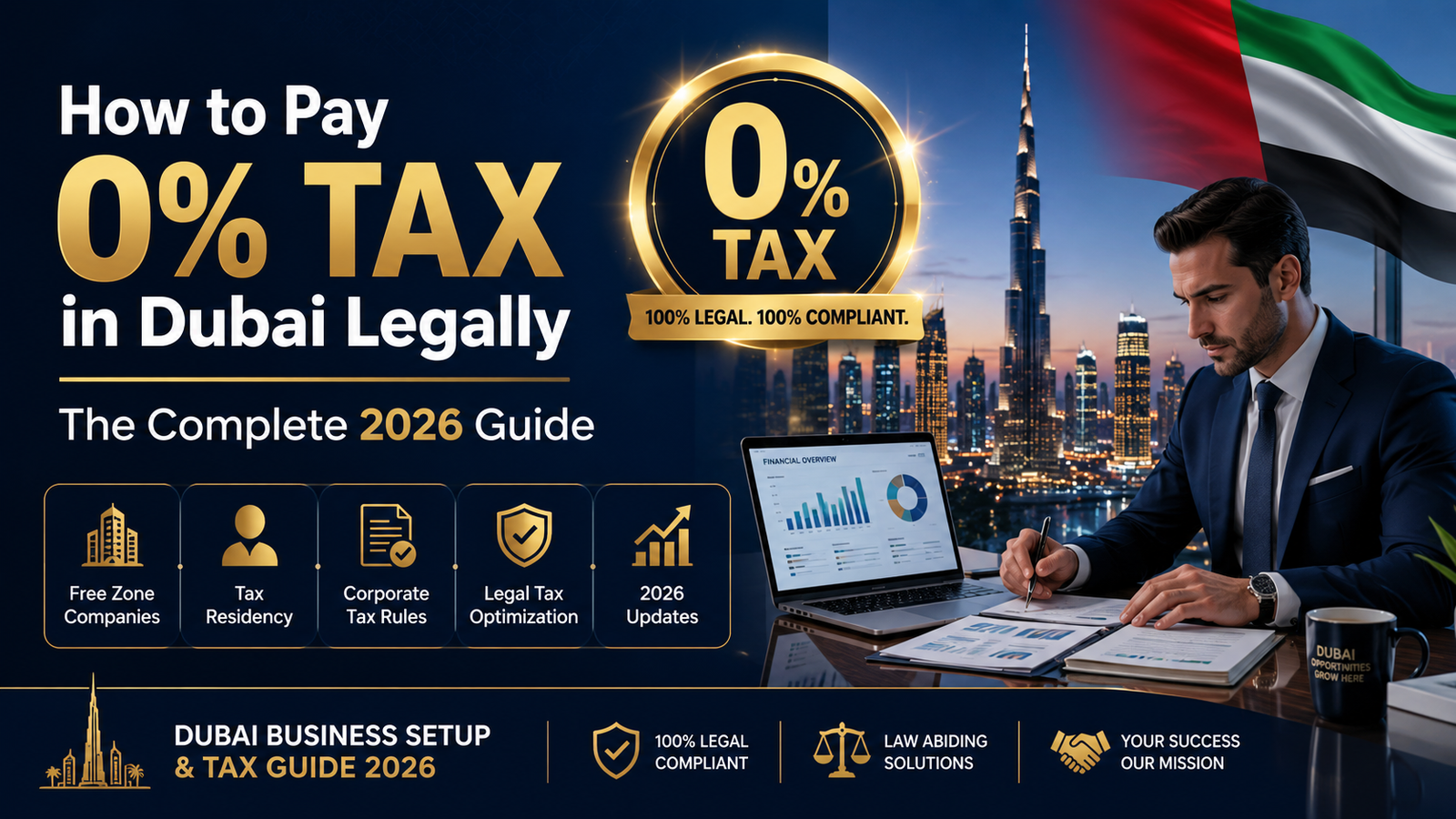
How to Pay 0% Tax in Dubai Legally: The Complete 2026 Guide
Table of Contents
- Dubai’s Tax Landscape in 2026: What Has Actually Changed?
- Zero Personal Income Tax: What It Means for UAE Residents
- UAE Corporate Tax: The 9% Rate and Who Actually Pays It
- How to Legally Pay 0% Corporate Tax in Dubai
- The Qualifying Free Zone Person (QFZP) Rules Explained
- UAE Small Business Relief: Zero Tax Under AED 3 Million
- VAT, Excise Tax, and Other UAE Tax Obligations
- How to Structure Your Dubai Company for Maximum Tax Efficiency
- Common Mistakes That Disqualify You From 0% Tax
- Frequently Asked Questions
- Conclusion
Dubai’s Tax Landscape in 2026: What Has Actually Changed?
How to pay zero tax in Dubai legally in 2026 is a question that every entrepreneur, digital nomad, and international investor asks when they begin exploring the UAE. The answer is nuanced — and significantly more favourable than most Western tax advisors will acknowledge.
The UAE has undergone a deliberate, staged evolution of its tax system over the past decade. Before 2017, the country was effectively a zero-tax jurisdiction across the board. The introduction of Excise Tax in 2017, VAT at 5% in January 2018, and most significantly 9% Corporate Tax under UAE Federal Decree-Law No. 47 of 2022 — effective for financial years beginning on or after 1 June 2023 — has changed the landscape. But critically, it has not eliminated the legitimate routes to zero tax liability for qualifying businesses and individuals.
In 2026, the UAE still offers:
- 0% personal income tax — no tax on salaries, dividends, or personal investment returns
- 0% corporate tax for businesses with taxable profits below AED 375,000 per year
- 0% corporate tax for qualifying free zone persons earning qualifying income
- 0% corporate tax for businesses electing Small Business Relief (revenues under AED 3 million)
- No capital gains tax on most asset disposals
- No withholding tax on dividends, interest, or royalties paid to foreign entities
In this guide, you will learn exactly which legal structures and conditions give your business genuine zero tax liability in Dubai — and how 360bizs helps you implement the right framework from day one.
Zero Personal Income Tax: What It Means for UAE Residents
The most immediate and universally applicable tax advantage in Dubai is the complete absence of personal income tax. Unlike the United Kingdom (20–45% income tax), Germany (up to 45%), the United States (up to 37%), or Pakistan (up to 35%), the UAE levies absolutely zero tax on personal income — regardless of how much you earn.
For UAE residents in 2026, this means:
- Salaries and wages: 0% tax — you keep 100% of your gross employment income
- Business profits distributed as dividends: 0% personal tax on dividend receipts
- Investment returns: 0% tax on interest income, rental yields, and most capital gains
- Freelance income: 0% personal income tax (though VAT may apply on B2B supplies above threshold)
- No income tax return filing requirement — unlike almost every other major economy, UAE residents do not file annual personal income tax returns
This personal tax advantage is entirely unconditional — it applies to every UAE resident regardless of nationality, income level, or business structure. It is the single most powerful financial benefit of UAE tax residency and the primary driver behind the significant inflow of high-earning professionals, entrepreneurs, and investors relocating to Dubai from Europe, North America, Pakistan, India, and beyond.
To benefit fully, you must establish genuine UAE tax residency — which requires a valid UAE residence visa, a primary residential address in the UAE, and in most cases, physical presence in the UAE for a minimum of 183 days per calendar year. 360bizs manages UAE company formation and residence visa processing as integrated parts of our relocation and business setup service.
UAE Corporate Tax: The 9% Rate and Who Actually Pays It
The UAE corporate tax — introduced under Federal Decree-Law No. 47 of 2022 and administered by the UAE Federal Tax Authority (FTA) — applies a 9% rate on taxable profits exceeding AED 375,000 per financial year. This threshold translates to approximately USD 102,000 or £80,000 — meaning most early-stage businesses and small enterprises operate entirely below the taxable threshold.
Here is the critical framework every business owner must understand:
| Taxable Profit Band | Corporate Tax Rate |
|---|---|
| AED 0 – AED 375,000 | 0% |
| Above AED 375,000 | 9% |
| Qualifying Free Zone Income | 0% (if QFZP conditions met) |
| Small Business Relief (revenue < AED 3M) | 0% (by election) |
All UAE companies — mainland LLCs, free zone entities, branches, and foreign entities conducting regular UAE business — must register for UAE corporate tax with the Federal Tax Authority (FTA), regardless of whether they expect to be taxable. Failure to register attracts administrative penalties.
However, registration does not mean you will pay tax. The legal pathways to 0% corporate tax liability in Dubai are multiple, well-defined, and entirely legitimate — when structured correctly with professional guidance. 360bizs’ accounting and bookkeeping team manages corporate tax registration and compliance for all clients as part of our standard post-formation service.
How to Legally Pay 0% Corporate Tax in Dubai
There are four primary, legally recognised routes to zero corporate tax liability in Dubai in 2026. Each applies to different business profiles and requires specific structural and operational conditions to be maintained.
Route 1: Profits Below the AED 375,000 Threshold
The most straightforward route. If your UAE company’s taxable profit — after deducting all allowable business expenses including salaries, rent, travel, professional fees, and depreciation — does not exceed AED 375,000 per financial year, your corporate tax liability is zero.
This threshold is generous for early-stage businesses, freelancers, consultants, and lean digital enterprises operating through a free zone company or mainland LLC. Properly maintained financial records — handled through 360bizs’ accounting and bookkeeping services — ensure your taxable profit calculation is accurate and optimised for all legitimate deductions.
Route 2: Small Business Relief Election
The UAE Small Business Relief provision allows businesses with total annual revenues of AED 3 million or less (in any given tax period, for periods ending on or before 31 December 2026) to elect for zero corporate tax — treating their taxable income as nil for that period. This election must be made annually through the FTA portal and is available to both resident juridical persons and natural persons conducting business in the UAE.
Key conditions:
- Revenue must not exceed AED 3 million in the tax period
- The election must be made explicitly — it is not automatic
- Companies that are members of a multinational enterprise (MNE) group with global revenues exceeding AED 3.15 billion are not eligible
- Qualifying Free Zone Persons (QFZPs) are not eligible to elect Small Business Relief
Route 3: Qualifying Free Zone Person (QFZP) — 0% on Qualifying Income
This is the most strategically powerful route for international entrepreneurs, digital businesses, and holding structures — and the one that makes Dubai free zone business setup so compelling for foreign investors in 2026.
A free zone company that meets the conditions for Qualifying Free Zone Person (QFZP) status pays 0% corporate tax on all qualifying income — regardless of profit level. This is fully explained in the next section.
Route 4: Exempt Persons and Specific Exemptions
Certain categories of UAE entities are entirely exempt from the scope of UAE corporate tax:
- UAE government entities and government-controlled entities
- Qualifying public benefit organisations (charities, foundations)
- Investment funds meeting specific criteria
- Pension funds and social security funds
- UAE businesses engaged exclusively in the extraction of natural resources (subject to emirate-level taxes instead)
For private business owners and entrepreneurs, Routes 1, 2, and 3 are the operative pathways — with the QFZP route offering the most powerful 0% outcome for businesses with revenues above AED 3 million.
The Qualifying Free Zone Person (QFZP) Rules Explained
The Qualifying Free Zone Person (QFZP) regime is the centrepiece of the UAE’s 0% corporate tax offering for international businesses in 2026. It allows a free zone company — registered in any UAE-recognised free zone including IFZA, DMCC, SHAMS, JAFZA, RAKEZ, or any of the 40+ other UAE free zones — to pay 0% corporate tax on all qualifying income, provided it meets a defined set of conditions.
The Five Core QFZP Conditions
For a free zone company to maintain QFZP status and benefit from the 0% corporate tax rate, it must satisfy all five of the following conditions:
Condition 1: Adequate Substance in the UAE The company must conduct its core income-generating activities from within the UAE free zone. It must have an appropriate number of qualified employees, adequate operating expenditure, and genuine business operations in the UAE. Substance cannot be superficial — the FTA assesses whether the economic reality matches the legal structure.
Condition 2: Qualifying Income Only The 0% rate applies only to qualifying income — broadly defined as income from:
- Transactions with other free zone persons (other free zone companies)
- International transactions (income from non-UAE sources)
- Qualifying activities as defined by the Ministry of Finance (manufacturing, processing, holding of shares in group companies, treasury and financing, distribution in or from a designated zone, and others)
Income from UAE mainland customers generally does not qualify as QFZP income — it is taxed at 9%.
Condition 3: Non-Qualifying Revenue Below 5% (De Minimis Rule) A free zone company may receive some non-qualifying income without losing QFZP status, provided it remains below the de minimis threshold — either AED 5 million or 5% of total revenue (whichever is lower). Exceeding this threshold in any tax period disqualifies the entire company from QFZP status for that year, making the 9% rate applicable to all income.
Condition 4: Compliant Financial Statements The company must maintain audited financial statements prepared in accordance with UAE accounting standards. This is a non-negotiable compliance requirement — companies without properly maintained, audited accounts cannot demonstrate QFZP eligibility. 360bizs’ accounting and bookkeeping team prepares QFZP-compliant financial statements as part of our annual compliance service.
Condition 5: Transfer Pricing Compliance Transactions between the free zone company and related parties must be conducted at arm’s length — priced as they would be between independent parties. Transfer pricing documentation must be maintained and available for FTA review on request. This condition is particularly relevant for entrepreneurs who operate multiple entities or have related-party transactions with home-country businesses.
| QFZP Condition | Requirement |
|---|---|
| UAE Substance | Qualified employees, office, operations in UAE free zone |
| Qualifying Income | From free zone persons, international sources, qualifying activities |
| De Minimis | Non-qualifying income < AED 5M or 5% of total revenue |
| Audited Accounts | Annual audited financial statements required |
| Transfer Pricing | Arm’s length pricing for all related-party transactions |
360bizs structures every free zone company setup with QFZP eligibility in mind — ensuring your business activity selection, operational structure, and financial record-keeping are aligned with the FTA’s qualifying conditions from the outset.
UAE Small Business Relief: Zero Tax Under AED 3 Million
For entrepreneurs, freelancers, consultants, and early-stage businesses in the UAE, the Small Business Relief election is the most practical and immediately accessible route to zero corporate tax in 2026 — without the complexity of the QFZP framework.
Under the FTA’s Small Business Relief guidelines, any UAE-resident business with total revenues of AED 3 million or less per tax period may elect to be treated as having zero taxable income for that period. The election is made annually through the FTA corporate tax portal and must be submitted with your annual corporate tax return.
What counts as “revenue” for the AED 3 million threshold?
Revenue means all income derived from your business activities — sales, service fees, commissions, rental income from business assets, and similar. It is a gross revenue test, not a net profit test. A business with AED 2.5 million in revenue but only AED 200,000 in profit still qualifies for Small Business Relief based on the revenue figure.
Who should use Small Business Relief?
- Freelancers and sole practitioners with a UAE professional licence
- Consultancies, agencies, and service businesses in the first 3–5 years of UAE operation
- Free zone company owners whose revenue is growing but not yet above AED 3 million
- Mainland LLC owners in their early trading years
Important limitations:
- Not available to Qualifying Free Zone Persons — if you have QFZP status, you use the 0% rate under that regime instead
- Not available to businesses forming part of a Multinational Enterprise (MNE) group with consolidated global revenues exceeding AED 3.15 billion
- Must be elected explicitly — it does not apply automatically
- Currently available for tax periods ending on or before 31 December 2026 (subject to FTA extension)
360bizs’ accounting and bookkeeping team monitors your revenue position annually and files the Small Business Relief election on your behalf where applicable.
VAT, Excise Tax, and Other UAE Tax Obligations
Zero corporate tax does not mean zero tax obligations entirely. Business owners in Dubai must understand the full scope of the UAE tax framework to remain compliant — even when their corporate tax liability is zero.
UAE VAT (5%)
The UAE Value Added Tax at 5% applies to most supplies of goods and services made by UAE businesses. Registration with the Federal Tax Authority (FTA) is mandatory once your annual taxable supplies exceed AED 375,000. Voluntary registration is available from AED 187,500.
Registered businesses must:
- Issue VAT-compliant tax invoices for all taxable supplies
- File VAT returns quarterly (or monthly for high-turnover businesses) through the FTA portal
- Maintain VAT records for a minimum of 5 years
- Pay VAT collected on sales to the FTA, net of VAT incurred on business expenses
360bizs provides full VAT consultancy and advisory services — including VAT registration, invoice template review, quarterly return preparation, and FTA correspondence management. Visit tax.gov.ae for official FTA VAT guidance.
UAE Excise Tax
UAE Excise Tax was introduced in October 2017 and applies to specific categories of goods deemed harmful to human health or the environment:
- Tobacco products: 100%
- Carbonated drinks (excluding unflavoured sparkling water): 50%
- Energy drinks: 100%
- Electronic smoking devices and liquids: 100%
- Sweetened drinks: 50%
Excise tax is typically relevant only for businesses in the food and beverage manufacturing, import, or distribution sector. Most free zone and mainland service and consulting businesses have no excise tax exposure.
Economic Substance Regulations (ESR)
UAE companies conducting relevant activities — banking, insurance, investment fund management, finance and leasing, headquarters functions, shipping, intellectual property holding, and distribution/service centres — must demonstrate genuine economic substance in the UAE and file annual ESR notifications and reports. Penalties for non-compliance reach AED 50,000 for first-time failures and AED 400,000 for repeat failures.
Country-by-Country Reporting (CbCR)
UAE entities that are part of a Multinational Enterprise (MNE) group with consolidated annual revenues of AED 3.15 billion or more must comply with Country-by-Country Reporting obligations — filing detailed breakdowns of revenue, profits, taxes paid, and business activities across all jurisdictions where the group operates.
Corporate Tax Registration (Mandatory for All)
Every UAE company — regardless of size, profitability, or tax liability — must register for UAE corporate tax with the FTA. Failure to register triggers automatic penalties. Registration does not create a tax liability — it is a compliance obligation. 360bizs handles FTA corporate tax registration as a standard step in every company formation engagement.
How to Structure Your Dubai Company for Maximum Tax Efficiency
Achieving 0% or minimal tax liability in Dubai legally is not simply a matter of choosing the right free zone — it requires deliberate structural design that aligns your business model, revenue flows, and operational substance with UAE tax law. Here are the key structuring principles 360bizs applies for international entrepreneurs:
1. Match Your Jurisdiction to Your Revenue Sources
If your clients are primarily international (outside the UAE mainland) — you are a consultant, digital service provider, software company, or trading business serving clients in Europe, South Asia, or globally — a free zone company with QFZP status is almost certainly your optimal structure. Your qualifying income from international sources will be taxed at 0%, and your corporate tax registration remains active but generates zero liability.
If your clients are primarily UAE mainland businesses or consumers — you are a retailer, contractor, real estate agent, or service business serving the UAE domestic market — a mainland LLC with proper expense management keeps your taxable profit below AED 375,000 in the early years, and the 9% rate applies only to profits above that threshold once you scale.
2. Use an Offshore Holding Structure Where Appropriate
For international entrepreneurs with complex multi-jurisdiction operations, an offshore holding company — through RAK ICC or JAFZA Offshore — can hold shares in operating subsidiaries, receive dividends, and manage IP assets in a tax-efficient manner. UAE offshore companies are not subject to UAE corporate tax on passive income, and the UAE’s extensive double tax treaty network (covering over 130 countries) can reduce withholding taxes on cross-border income flows.
3. Optimise Allowable Deductions
UAE corporate tax law permits deduction of all ordinary and necessary business expenses incurred in generating taxable income — including salaries, rent, professional fees, travel, marketing, technology subscriptions, depreciation, and interest on business debt (subject to a 30% EBITDA cap). Maximising legitimate deductions through proper bookkeeping and accounting directly reduces your taxable profit — potentially below the AED 375,000 threshold entirely.
4. Establish Genuine UAE Residency
The 0% personal income tax benefit requires genuine UAE tax residency — not just a visa. To be recognised as a UAE tax resident, you must spend a minimum of 183 days per year in the UAE or demonstrate that your permanent home and centre of vital interests are in the UAE. UAE tax residency certificates — issued by the Ministry of Finance — are increasingly important for entrepreneurs from high-tax countries seeking to confirm their non-resident status in their home jurisdiction.
5. Maintain QFZP-Compliant Operations
If your free zone company depends on QFZP status for its 0% rate, operational compliance is non-negotiable. This means: maintaining qualified employees in the UAE, conducting genuine business activities from your registered UAE address, keeping non-qualifying income below the 5% de minimis threshold, and producing audited financial statements annually. 360bizs’ accounting team manages all QFZP compliance requirements on a retained basis.
Common Mistakes That Disqualify You From 0% Tax
- Failing to register for UAE corporate tax — every UAE company must register with the FTA, regardless of expected tax liability. Non-registration is a compliance violation attracting automatic penalties, not an exemption strategy.
- Exceeding the 5% de minimis rule without realising it — free zone companies that start taking on UAE mainland clients or conducting non-qualifying activities can inadvertently breach the QFZP de minimis threshold, triggering 9% tax on all income for that year — not just the non-qualifying portion. Revenue monitoring through proper accounting and bookkeeping prevents this.
- Claiming Small Business Relief without proper eligibility — businesses that are part of an MNE group, or QFZPs, cannot elect Small Business Relief. Incorrectly claiming the relief triggers penalties and back-tax assessments.
- Inadequate substance for QFZP claims — a free zone company with no genuine UAE employees, no real office activity, and management conducted entirely from abroad will not satisfy the FTA’s substance requirements. The 0% QFZP rate requires genuine economic substance — not just a registered address and a flexi desk.
- Not maintaining audited financial statements — QFZP status requires annually audited accounts. Companies that fail to audit their financials lose QFZP eligibility for that year. 360bizs manages the full audit coordination process for all qualifying clients.
- Ignoring VAT registration obligations — the VAT threshold is separate from corporate tax. A business can have zero corporate tax liability and still be obligated to register for UAE VAT once taxable supplies exceed AED 375,000. Late registration attracts FTA penalties of AED 10,000 for first-time failures.
- Assuming 0% tax means zero compliance — the UAE’s tax system rewards legitimate structures but enforces compliance rigorously. FTA audits, administrative penalties for late filing, and ESR enforcement have all increased significantly since 2023. Maintain full compliance through professional accounting services — zero tax liability is not the same as zero compliance obligation.
Frequently Asked Questions
Is Dubai really tax-free in 2026?
Not entirely — but it remains one of the most tax-efficient jurisdictions in the world. Dubai offers 0% personal income tax on salaries, dividends, and investment returns for all UAE residents. For businesses, 0% corporate tax is legally achievable through the Qualifying Free Zone Person (QFZP) framework, Small Business Relief (revenues under AED 3 million), or by keeping taxable profits below AED 375,000. The UAE’s 9% corporate tax rate — applicable above AED 375,000 in taxable profit — remains the lowest corporate tax rate of any major global economy.
How can a free zone company pay 0% corporate tax in Dubai?
A UAE free zone company can pay 0% corporate tax by qualifying as a Qualifying Free Zone Person (QFZP). This requires: maintaining adequate UAE substance (employees, office, operations); earning primarily qualifying income (from other free zone persons, international clients, or qualifying activities); keeping non-qualifying income below the 5% de minimis threshold; maintaining audited financial statements; and complying with transfer pricing rules for related-party transactions. When all five conditions are met, the 0% rate applies to all qualifying income — regardless of profit level.
What is the UAE Small Business Relief and who qualifies?
UAE Small Business Relief allows businesses with total annual revenues of AED 3 million or less to elect for zero corporate tax liability for that tax period. The election must be made annually through the FTA portal. It is not available to Qualifying Free Zone Persons or businesses that are part of multinational enterprise groups with global revenues exceeding AED 3.15 billion. It is currently available for tax periods ending on or before 31 December 2026.
Does the UAE have personal income tax?
No. The UAE levies zero personal income tax — there is no tax on salaries, wages, dividends, rental income, capital gains, or any other form of personal income for UAE residents. There is also no requirement to file a personal income tax return. This applies universally to all UAE residents regardless of nationality or income level.
What taxes do Dubai business owners need to pay?
In 2026, a Dubai business owner may be subject to: UAE Corporate Tax at 9% on taxable profits above AED 375,000 (with legal 0% routes available as described in this guide); UAE VAT at 5% on taxable supplies above AED 375,000 per year; UAE Excise Tax if operating in tobacco, energy drinks, or related sectors; and ESR reporting if conducting certain regulated activities. There is no personal income tax, no capital gains tax, and no withholding tax on dividends. 360bizs’ VAT consultancy and accounting team manages all ongoing tax obligations.
Can I pay 0% tax in Dubai if I earn more than AED 375,000 profit?
Yes — through the Qualifying Free Zone Person (QFZP) route. A free zone company that meets all QFZP conditions pays 0% corporate tax on qualifying income regardless of profit level. Many international businesses earning AED 1 million, AED 5 million, or more in annual profit through qualifying activities — international consulting, cross-border trading, IP licensing — pay 0% UAE corporate tax through this mechanism.
Do I need to register for UAE corporate tax even if I will pay 0%?
Yes — UAE corporate tax registration with the FTA is mandatory for all UAE companies, regardless of expected liability. Failure to register triggers administrative penalties. Registration simply establishes your company’s tax identity; it does not create a payment obligation if your taxable profit is zero or if you qualify for Small Business Relief or QFZP status. 360bizs handles FTA registration as part of every company formation package.
How do I establish UAE tax residency to benefit from 0% personal income tax?
To establish genuine UAE tax residency, you need: a valid UAE residence visa (obtained through company formation, free zone setup, property purchase, or employment); a primary residential address in the UAE; and ideally 183+ days of physical presence per calendar year. UAE tax residency certificates — issued by the UAE Ministry of Finance — formally confirm your resident status for the purposes of double tax treaty claims with your home country.
What is the difference between UAE corporate tax and VAT?
UAE Corporate Tax (9%) applies to business profits above AED 375,000 — it is a tax on what your company earns after expenses. UAE VAT (5%) applies to the value of goods and services your company supplies — it is a consumption tax collected from your customers and remitted to the FTA, net of VAT you have paid on your own business expenses. Both are administered by the Federal Tax Authority (FTA) but operate through entirely separate registration, filing, and payment systems. 360bizs’ VAT consultancy team and accounting specialists manage both obligations for all clients.
Is it legal to use a Dubai company to reduce taxes from my home country?
This is one of the most important questions for international entrepreneurs — and the answer depends on your home country’s tax laws, your personal residency status, and how your UAE company is structured. The UAE itself imposes no restrictions on international tax planning. However, your home country may apply Controlled Foreign Corporation (CFC) rules, exit taxes, or residency-based taxation that continues to apply until you formally establish UAE tax residency and cease to be a resident of your home jurisdiction. 360bizs provides referrals to qualified international tax advisors who can assess your specific home-country position as part of our UAE market entry service. [INTERNAL LINK: https://360bizs.com/]
Conclusion
How to pay zero tax in Dubai legally in 2026 has a clear, structured answer: establish a qualifying free zone company with genuine UAE substance and qualifying income, elect Small Business Relief while your revenues are below AED 3 million, or structure your profits to remain below the AED 375,000 corporate tax threshold in the early years of your UAE business. Simultaneously, establish genuine UAE personal tax residency to benefit from the country’s permanent 0% personal income tax — the most immediately impactful financial benefit of living and working in Dubai.
The UAE’s tax framework in 2026 is not a loophole — it is a deliberately designed, internationally compliant system that rewards genuine business substance, investment, and residency. The routes to zero tax are legal, transparent, and well-documented. What they require is correct structural design from the outset, proper ongoing accounting and bookkeeping to maintain QFZP eligibility and FTA compliance, and expert VAT advisory to keep all your obligations in order.
At 360bizs, our team has helped hundreds of entrepreneurs from Pakistan, the UK, Europe, and beyond structure UAE businesses that are not only legally formed but financially optimised. We manage mainland company formation, free zone business setup, offshore company formation, VAT registration and compliance, and full accounting services — all under one roof, with one point of contact.
👉 Book your free consultation with 360bizs today and let our UAE tax and company formation specialists design the right structure for your business — legally, efficiently, and built for maximum tax efficiency from day one.