
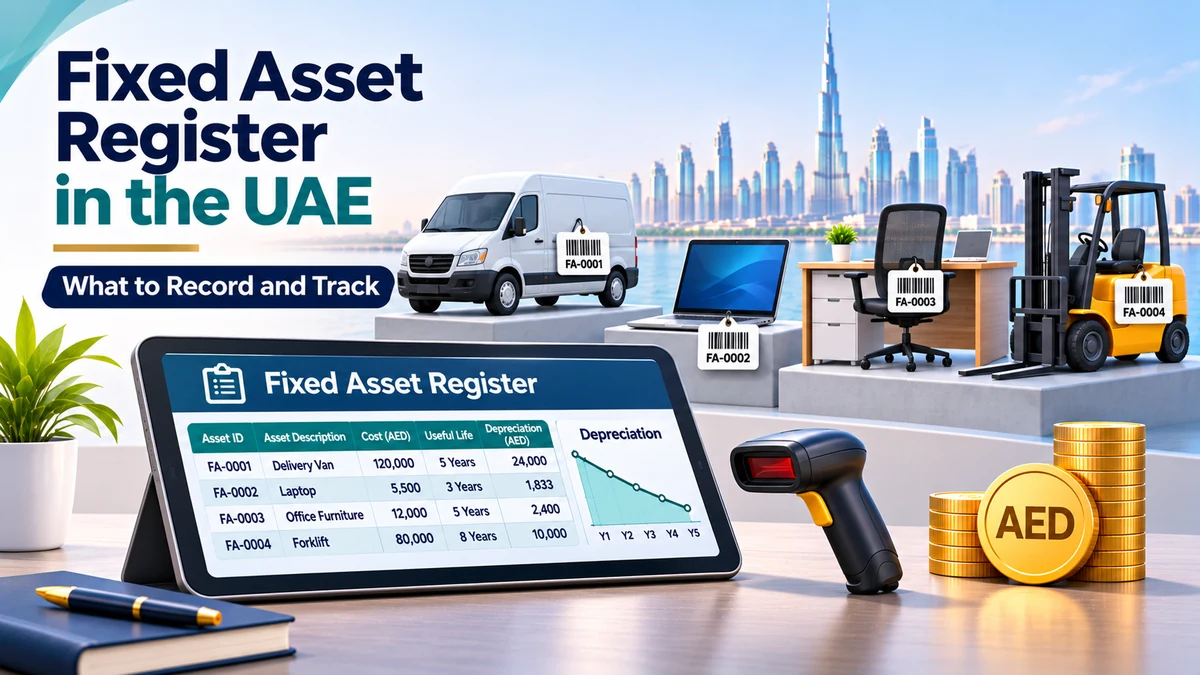
A fixed asset register UAE businesses maintain is a detailed record of every long-term asset the company owns, such as furniture, computers, vehicles, machinery and office fit-outs, along with each asset’s cost, location, depreciation and current book value. It is the single source of truth for what the business owns, where it is and what it is worth.
Many SMEs in Dubai, Abu Dhabi and across the Emirates record asset purchases in their accounts but never track them individually. Over time, laptops go missing, disposed vehicles stay on the balance sheet, and depreciation figures no longer make sense. A properly maintained register solves these problems and supports accurate financial statements, audits, VAT and corporate tax. This guide explains what to record, how to calculate and track depreciation, how to handle disposals, and includes a practical fixed asset register example in AED.
What Is a Fixed Asset Register?
A fixed asset register is a schedule, usually maintained in accounting software, dedicated asset management software or a structured spreadsheet, that lists each fixed asset individually. While the general ledger shows the total value of categories such as “Furniture” or “Motor Vehicles”, the register breaks those totals down item by item.
The total cost and accumulated depreciation in the register should always reconcile to the fixed asset balances in your general ledger. If they do not, either the register or the accounts contain errors.
Why Should Businesses Maintain an Asset Register?
Effective fixed asset management UAE companies practise delivers clear benefits:
- Accurate financial statements: fixed assets and depreciation are correctly reported on the balance sheet and profit and loss statement.
- Correct depreciation: each asset is depreciated according to its own cost and useful life.
- Loss and theft prevention: business asset tracking by location and custodian makes it clear who is responsible for each asset.
- Audit readiness: auditors can verify assets quickly using the register.
- Tax support: clear records support corporate tax calculations and VAT treatment on asset purchases and disposals.
- Insurance: accurate values support insurance cover and claims.
- Better planning: knowing when assets reach the end of their useful lives helps plan replacements and capital budgets.
- Business sale or valuation: a reliable register supports due diligence when selling or restructuring a business.
What Is the Difference Between Fixed Assets and Current Assets?
| Aspect | Fixed (Non-Current) Assets | Current Assets |
|---|---|---|
| Purpose | Used to operate the business over several years | Held for sale or conversion to cash within 12 months |
| Examples | Vehicles, machinery, furniture, computers, fit-outs, buildings | Cash, receivables, inventory, prepaid expenses |
| Accounting treatment | Capitalised and depreciated over useful life | Not depreciated; valued at cost, NRV or collectable amount |
| Balance sheet position | Non-current assets | Current assets |
Which Assets Should Be Recorded?
In accounting for fixed assets UAE businesses generally follow IFRS, particularly IAS 16 Property, Plant and Equipment. An item is usually recorded as a fixed asset when it:
- Is held for use in operations, rental to others or administrative purposes
- Is expected to be used for more than one year
- Will provide future economic benefits
- Has a cost that can be measured reliably
Common categories include:
- Land and buildings
- Leasehold improvements and office fit-outs
- Furniture and fixtures
- Computers, servers and IT equipment
- Office equipment, such as printers and air-conditioning units
- Motor vehicles and delivery vans
- Plant, machinery and warehouse equipment
Setting a Capitalisation Threshold
Most businesses set a capitalisation policy, for example recording only items costing more than AED 2,000 or AED 5,000 as fixed assets and expensing smaller items immediately. The threshold should be reasonable for the size of the business, documented in writing and applied consistently.
What Details Should an Asset Register Contain?
A practical fixed asset register format should include the following fields:
| Field | Purpose |
|---|---|
| Asset ID / tag number | Unique identifier linked to a physical tag or barcode |
| Asset description | Clear name, make, model and serial number |
| Asset category | Matches the chart of accounts category, such as IT equipment or vehicles |
| Location / branch | Where the asset is physically kept |
| Custodian / department | Person or team responsible for the asset |
| Supplier and invoice number | Links the asset to its purchase evidence |
| Acquisition date | Date the asset was purchased or ready for use |
| Cost (excluding recoverable VAT) | Purchase price plus directly attributable costs |
| Useful life | Expected number of years in use |
| Residual value | Estimated value at the end of the useful life |
| Depreciation method | Straight-line, reducing balance or units of production |
| Annual depreciation | Depreciation charge per year |
| Accumulated depreciation | Total depreciation charged to date |
| Net book value (NBV) | Cost minus accumulated depreciation |
| Status | In use, idle, under repair, disposed or written off |
| Disposal details | Disposal date, proceeds and gain or loss |
| Insurance and warranty details | Policy, expiry and warranty information |
Fixed Asset Register Example in AED
Below is an illustrative fixed asset register example for a small UAE trading company at the end of its third year of operations, using the straight-line method.
| Asset ID | Description | Acquired | Cost (AED) | Residual (AED) | Useful Life | Annual Dep. (AED) | Accum. Dep. (AED) | NBV (AED) |
|---|---|---|---|---|---|---|---|---|
| FA-001 | Office furniture – Dubai office | Start of Year 1 | 36,000 | 0 | 6 years | 6,000 | 18,000 | 18,000 |
| FA-002 | Laptops (5 units) | Start of Year 2 | 25,000 | 0 | 3 years | 8,333 | 16,667 | 8,333 |
| FA-003 | Delivery van | Start of Year 2 | 95,000 | 15,000 | 5 years | 16,000 | 32,000 | 63,000 |
| FA-004 | Office fit-out (leasehold) | Start of Year 1 | 120,000 | 0 | 5 years | 24,000 | 72,000 | 48,000 |
| FA-005 | Warehouse forklift | Start of Year 3 | 60,000 | 6,000 | 6 years | 9,000 | 9,000 | 51,000 |
| Total | 336,000 | 63,333 | 147,667 | 188,333 | ||||
In a real register, each row would also include the location, custodian, serial number, supplier invoice and status. The totals for cost (AED 336,000) and accumulated depreciation (AED 147,667) should reconcile to the general ledger.
How Do You Calculate Depreciation?
Depreciation spreads the cost of an asset over its useful life. Maintaining accurate asset depreciation records is a core part of fixed asset accounting. The three most common methods are:
1. Straight-Line Method
Annual Depreciation = (Cost – Residual Value) ÷ Useful Life
For the delivery van: (95,000 – 15,000) ÷ 5 = AED 16,000 per year. This is the most widely used method for SMEs because it is simple and consistent.
2. Reducing Balance Method
Annual Depreciation = Net Book Value at Start of Year × Depreciation Rate
Using a 30% rate on the same van:
- Year 1: 95,000 × 30% = AED 28,500 (NBV AED 66,500)
- Year 2: 66,500 × 30% = AED 19,950 (NBV AED 46,550)
This method charges more depreciation in early years and suits assets that lose value quickly, such as vehicles and technology.
3. Units of Production Method
Depreciation = (Cost – Residual Value) × (Units Used in Period ÷ Total Expected Units)
This method suits machinery whose wear depends on usage, such as production equipment measured by machine hours or output.
Whichever method you choose, it should reflect how the asset’s benefits are actually consumed, and useful lives and residual values should be reviewed at least annually.
Typical Useful Lives
| Asset Category | Typical Useful Life Range |
|---|---|
| Computers and IT equipment | 3 to 5 years |
| Furniture and fixtures | 5 to 10 years |
| Motor vehicles | 4 to 6 years |
| Plant and machinery | 5 to 15 years |
| Leasehold improvements | Shorter of useful life or lease term |
| Buildings | 20 to 50 years |
These ranges are illustrative. Each business should set useful lives based on its own usage and experience.
How Should Companies Record Asset Purchases?
- Capitalise the full cost: include the purchase price, delivery, installation, registration and other costs needed to bring the asset into use.
- Exclude recoverable VAT: input VAT on eligible asset purchases is recorded separately as VAT recoverable, not as part of the asset cost.
- Exclude ongoing costs: routine repairs, maintenance, fuel and insurance are expensed, not capitalised.
- Tag the asset: assign an asset ID and attach a physical tag or barcode.
- Record in the register on the same day the purchase is posted in the accounts.
- Keep the evidence: retain invoices, delivery notes and registration documents.
For high-value capital assets, UAE VAT rules include a Capital Assets Scheme that may require adjustments to recovered input VAT if the use of certain assets valued at AED 5 million or more (excluding VAT) changes over a specified adjustment period. Businesses with such assets should seek specialist VAT advice.
How Should Asset Disposal Be Recorded?
When an asset is sold, scrapped, donated or lost, it must be removed from both the register and the general ledger. The steps are:
- Charge depreciation up to the disposal date.
- Remove the asset’s cost and accumulated depreciation.
- Record any sale proceeds received.
- Recognise the gain or loss on disposal in the profit and loss statement.
- Update the register status to “Disposed” with the date and details.
Disposal Example
At the end of Year 3, the business sells the delivery van (FA-003) for AED 55,000 plus 5% VAT.
- Cost: AED 95,000
- Accumulated depreciation: AED 32,000
- Net book value: AED 63,000
- Sale proceeds (excluding VAT): AED 55,000
- Loss on disposal: 63,000 – 55,000 = AED 8,000
The business would also record output VAT of AED 2,750 on the sale where applicable, as the sale of a business asset is generally a taxable supply for a VAT-registered business.
How Often Should Businesses Verify Fixed Assets?
A register is only reliable if it matches reality. Best practice for business asset tracking includes:
- Annual physical verification of all assets, ideally before year-end.
- More frequent checks for portable or high-risk items such as laptops, phones and tools.
- Reconciliation of the register with the general ledger every month or quarter.
- Impairment review where assets are damaged, idle or obsolete. Under IFRS, an asset should not be carried above its recoverable amount.
- Investigation of missing assets and write-off with proper approval where they cannot be found.
Common Fixed Asset Register Mistakes
- Expensing assets that should be capitalised, or capitalising small items below the threshold
- Including recoverable VAT in asset cost
- Leaving sold or scrapped assets in the register
- Not tagging assets, making physical verification impossible
- Using one row for many different assets bought at different times
- Never reviewing useful lives and residual values
- Failing to reconcile the register with the general ledger
Frequently Asked Questions
Is a fixed asset register mandatory in the UAE?
Businesses are required to keep adequate accounting records, and fixed asset details form part of that. A fixed asset register is the most practical way to maintain these records and is generally expected by auditors.
Can I maintain a fixed asset register in Excel?
Yes, a structured spreadsheet can work for small businesses with few assets. As the number of assets grows, accounting software with a fixed asset module or dedicated asset management software is usually more efficient and reliable.
Does depreciation affect UAE Corporate Tax?
UAE Corporate Tax generally starts from accounting profit prepared under applicable accounting standards, so depreciation recorded in the accounts typically affects taxable income. Specific adjustments may apply in certain cases, so businesses should confirm their position with a tax advisor.
What is net book value?
Net book value is an asset’s cost minus its accumulated depreciation and any impairment. It shows the remaining carrying value of the asset in the accounts.
Conclusion
A well-maintained fixed asset register UAE businesses keep up to date provides accurate depreciation, reliable financial statements, smoother audits and better control over valuable business assets. By recording the right details for every asset, calculating depreciation consistently, handling disposals correctly and verifying assets regularly, SMEs can protect their investments and keep their accounts compliant.
If you need help building or cleaning up your fixed asset register, calculating depreciation or reconciling assets with your accounts, 360Bizs can support you. Explore our accounting and bookkeeping services or contact our team today.