

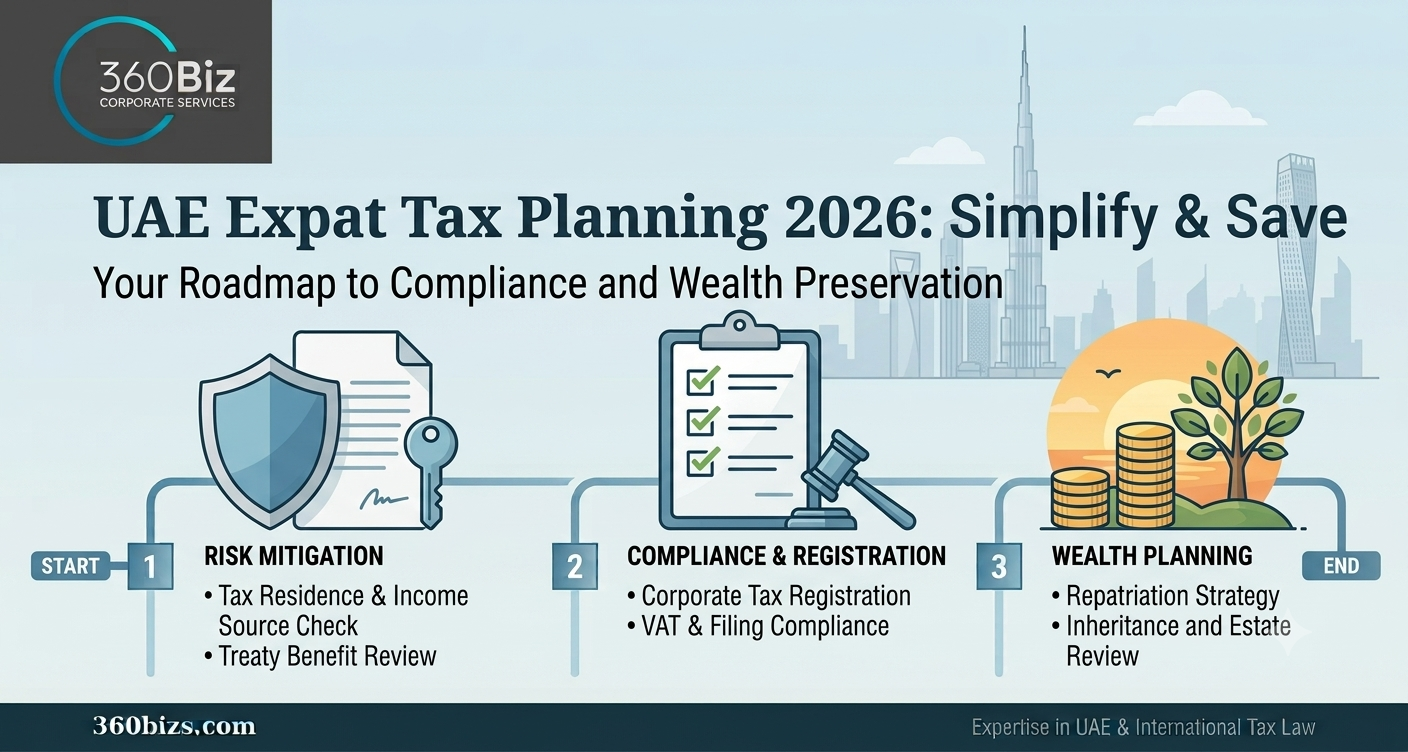
Expat Tax Planning in UAE: How Foreign Residents Can Reduce Tax Risks and Stay Compliant
The UAE has no personal income tax but that doesn’t mean expat tax planning is optional. Foreign residents who assume “tax-free” means “nothing to file” often walk straight into double taxation from their home country, CRS reporting mismatches, or a rejected Tax Residency Certificate application at the worst possible time. This guide breaks down exactly what foreign residents and business owners in the UAE need to get right in 2026 to stay compliant and legally minimize tax exposure back home.
Is the UAE Really Tax-Free for Expats?
Yes, for individuals. The UAE does not levy personal income tax on salaries, dividends, or capital gains. There’s no expat-specific tax bracket to worry about. What catches people out isn’t UAE law it’s the tax law of their home country, which may still consider them a tax resident there unless they can formally prove otherwise.
This is where most of the actual risk sits: not in what the UAE charges you, but in what your home country still thinks it’s owed.
Why “No Income Tax” Doesn’t Mean “No Tax Planning”
Three things create exposure even in a tax-free jurisdiction:
- Home-country tax residency rules. Many countries (UK, India, Pakistan, several EU states) use day-count or “center of life” tests. If you don’t formally break residency there, you may still owe tax at home even while living in the UAE.
- CRS and automatic exchange of information. UAE banks report account data to your home tax authority under the Common Reporting Standard. If your bank data doesn’t match your declared residency status, it raises flags.
- Corporate tax obligations for business owners. Since UAE Corporate Tax came into effect, entrepreneurs running a UAE company also need to separate personal tax residency from business tax registration correctly.
The 2026 UAE Tax Residency Rules: Three Qualifying Routes
Under Cabinet Decision No. 85 of 2022 and Ministerial Decision No. 27 of 2023, an individual qualifies as a UAE tax resident through one of three non-hierarchical routes:
| Route | Requirement |
|---|---|
| 183-Day Rule | Physical presence in the UAE for 183+ days within a 12-month period |
| 90-Day Rule | 90+ days present, plus a valid UAE residence permit, plus either a permanent home (Ejari/title deed) or active employment/business in the UAE |
| Center of Life Test | UAE is your habitual residence and the center of your financial and personal interests, even below 90 days — rarely used, requires heavy documentation |
A practical example: an expat holding a Golden Visa who spends 95 days a year overseeing a locally registered business and holds a long-term lease satisfies the 90-day route on both counts at once.
How to Apply for a UAE Tax Residency Certificate (TRC)
A Tax Residency Certificate is the official FTA document that proves your UAE tax residency to a foreign government or bank, unlocking benefits under the UAE’s Double Taxation Agreements the UAE has signed 137 DTAs with major trading partners.
Steps to apply:
- Confirm which of the three residency routes applies to you for the specific 12-month period.
- Gather your ICP entry/exit report (90+ days), employment contract or trade license, and Ejari/title deed.
- Provide at least six months of consecutive UAE bank statements showing regular local activity.
- Submit via EmaraTax with the applicable fee.
- Receive your certificate valid for the one 12-month period applied for, and renewable annually.
TRC fees (2026):
| Applicant Type | Fee |
|---|---|
| Registrant with Corporate Tax TRN | AED 500 |
| Natural person without TRN | AED 1,000 |
| Legal person (company) without TRN | AED 1,750 |
| Additional hard copy | AED 250 |
Important limits: the FTA will not issue a TRC for a future period only for a 12-month window that has already started or passed. And a certificate obtained today does not retroactively resolve a back-tax claim from a home country for years when you held no TRC. Offshore companies without physical UAE presence are not eligible for a TRC at all a key reason many investors pair an offshore company with a mainland or free zone entity if they need residency-linked tax benefits.
Business Owners: Where Personal and Corporate Tax Planning Intersect
If you own a UAE company, your personal tax residency and your company’s tax position are two separate tracks that need to line up.
For a company’s own TRC eligibility, a Corporate Tax Registration Number is now effectively a prerequisite applications without one face higher fees and more scrutiny, and newly incorporated companies generally need at least 12 months of operating history (though applications can be filed after just 3 months into the relevant tax period in some cases).
This is a common trip point for founders choosing between structures. Whether you’re setting up as mainland company formation or a free zone business setup, your entity type affects how straightforward your corporate TRC application will be, and how your personal residency route lines up with it. Getting the structure right at incorporation stage avoids a rebuild later.
Documentation Checklist for Expat Tax Planning
Keep these current and ready year-round, not just at renewal time:
- Valid UAE residence permit (employment, investor, or Golden Visa)
- ICP entry/exit movement report showing day count
- Ejari tenancy contract or title deed as proof of permanent residence
- Employment contract or active trade license
- Six-plus months of consecutive UAE bank statements
- Salary certificate (employees) or business registry extract (owners)
If you don’t yet have a UAE business address to satisfy the permanent-place-of-business requirement, an affordable business centre with a valid Ejari can meet this documentation need without a full office lease commitment.
Common Tax Risks Foreign Residents Overlook
- Assuming a residence visa equals tax residency. It doesn’t they’re separate legal concepts entirely.
- Not tracking day counts properly. The 183-day and 90-day rules are counted precisely from ICP records, not personal recollection.
- Letting the TRC lapse. It’s valid for one 12-month period only and must be renewed annually with updated documents.
- Banking activity that doesn’t match declared residency. CRS reporting compares your bank data against what you’ve told the FTA and your home country inconsistencies invite scrutiny. Structuring your accounts properly from the start, including through bank account opening assistance, helps keep this clean.
- Assuming a TRC fixes past tax problems. It only certifies residency going forward for the period applied it has no retroactive effect on back-tax assessments.
Double Taxation Agreements: What They Actually Save You
DTAs prevent the same income from being taxed twice once in the UAE (where it isn’t taxed anyway) and once in your home country. A practical example: a UK expat earning UK dividend income would normally face 15% withholding tax. With a valid UAE TRC applied under the UK-UAE tax treaty, that withholding can drop to 5%, a meaningful saving on recurring investment income.
This only works if your TRC is current, your residency route is properly documented, and you’ve filed the treaty relief claim correctly with the foreign tax authority steps that are easy to get wrong without guidance.
FAQs
Is the UAE tax-free for expats?
Yes, for personal income there’s no income tax on salary, dividends, or capital gains. Tax exposure typically comes from your home country’s residency rules, not the UAE.
How many days do I need to spend in the UAE to be a tax resident?
Either 183+ days in a 12-month period, or 90+ days combined with a valid residence permit and either a permanent home or active employment/business in the UAE.
How much does a UAE Tax Residency Certificate cost in 2026?
AED 500 for tax registrants with a Corporate Tax TRN, AED 1,000 for individuals without one, and AED 1,750 for companies without one, plus AED 250 per hard copy.
Can a UAE TRC cancel back taxes I owe in my home country?
No. A TRC only certifies residency for the specific 12-month period it covers going forward it has no retroactive effect on prior years without a certificate.
Do offshore companies qualify for a UAE TRC?
No. Offshore companies lack the physical presence required, so they’re not eligible for a Tax Residency Certificate.
How often do I need to renew my TRC?
Annually. Each application covers a single 12-month period and requires fresh, updated documentation.
Disclaimer: This article is for general informational purposes and does not constitute tax or legal advice. Confirm your exact tax residency position and treaty benefits with a qualified advisor before relying on it for cross-border tax filings.