
Starting an online business in Dubai can be an attractive opportunity for entrepreneurs, freelancers and established companies. However, before selling products or services through a website, social media account or online marketplace, it is important to understand which business licence fits your activity.
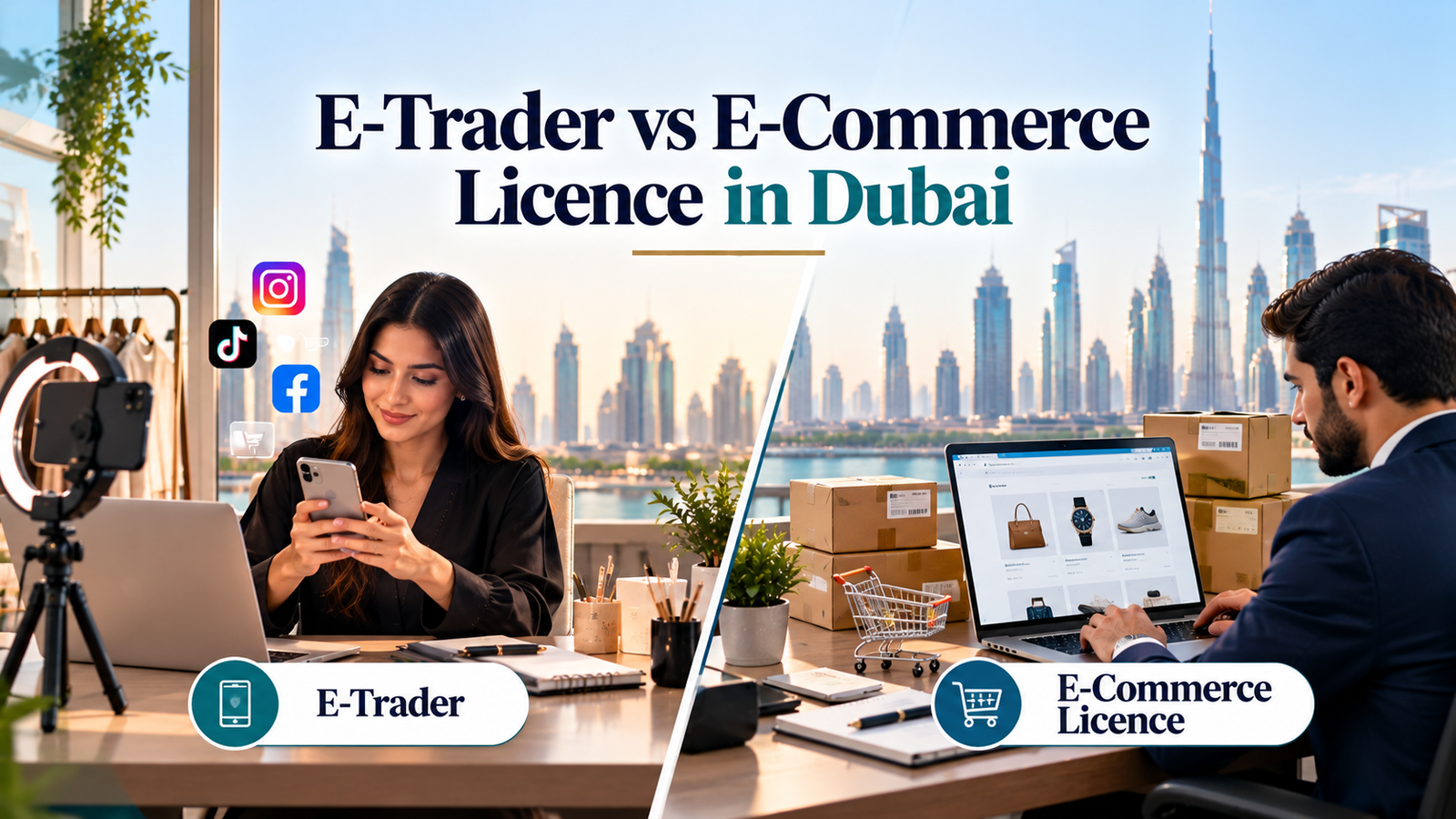
The main difference between an E-Trader licence and an e-commerce licence in Dubai is the type of business structure and activity each option is designed to support. An E-Trader licence may suit eligible individuals operating a qualifying small online business, while a commercial licence that includes e-commerce activities is generally more suitable for businesses that need a broader commercial structure, inventory operations, employees or a plan to expand.
The correct option depends on your nationality and eligibility, the products or services you intend to sell, your operating model and the legal structure you need. Dubai’s licensing rules and permitted activities must be checked with the relevant authority before you apply.
What Is an E-Trader Licence in Dubai?
An E-Trader licence is a licensing option associated with certain individual or small-scale business activities conducted online. Depending on the approved activity and applicable eligibility rules, it may be relevant to people who sell products or provide services through social media and other digital channels.
It is important not to assume that every person who wants to sell online qualifies for an E-Trader licence. Dubai’s official licensing information identifies the E-Trader licence with specific legal-form and activity conditions. Applicants should confirm their eligibility and permitted activities through the Dubai Department of Economy and Tourism (DET) or the official Invest in Dubai licensing platform.
An E-Trader licence may be worth exploring if you:
- Operate a small online venture.
- Provide a qualifying service through digital channels.
- Sell through social media, where the proposed activity is permitted.
- Want to begin with an eligible individual business model.
- Do not need the broader structure of a conventional commercial company.
Important: Eligibility, permitted activities, nationality conditions and legal-form requirements must be confirmed for your specific application. Do not rely on general online claims that an E-Trader licence is available to every UAE resident or every type of online seller.
What Is an E-Commerce Licence in Dubai?
An e-commerce licence allows a business to conduct approved commercial activities through online channels. Depending on the business model, the licence may cover online sales through a website, mobile application, social media or a digital marketplace.
On the Dubai mainland, businesses generally need an appropriate commercial licence from DET that includes the relevant e-commerce or online trading activity. A business may also consider a suitable free zone licence, subject to the issuing authority’s rules and any requirements that apply to selling directly into the UAE mainland market.
An e-commerce licence may be appropriate for a business that intends to:
- Operate a dedicated online store.
- Sell approved products through an e-commerce website or marketplace.
- Build a larger online retail operation.
- Employ staff or use a more formal company structure.
- Work with suppliers, fulfilment providers or distribution partners.
- Expand its approved activities as the business develops.
The exact licence type depends on the activities you plan to carry out. An online consultancy, a store selling physical products and a business importing regulated goods may have different licensing and approval requirements.
E-Trader vs E-Commerce Licence in Dubai: Key Differences
The following comparison is a starting point for choosing a licence. It is not a substitute for confirming the latest eligibility rules and activity classifications with the relevant authority.
| Factor | E-Trader licence | E-commerce commercial licence |
|---|---|---|
| General purpose | Certain eligible individual online activities | Approved online trading activities through a commercial business |
| Typical business model | A qualifying small online venture | An online store or a broader e-commerce operation |
| Legal structure | Subject to specific legal-form and eligibility conditions | Depends on the chosen mainland or free zone structure |
| Eligibility | Must be confirmed against current DET rules | Depends on the chosen licence, ownership, legal form and activity |
| Online channels | Only channels and activities permitted by the licence | Website, marketplace, app or social commerce, as approved |
| Product sales | Not every product or trading model will qualify | Product trading may be included if the activity is licensed and required approvals are obtained |
| Employees and expansion | Check what the selected licence and legal form allow | May offer a more suitable structure for a growing team or operation |
| Regulated products | Additional approvals may apply, and the activity may not be eligible | Additional product-specific approvals may still be required |
| Best considered for | Eligible individuals testing a permitted online business model | Businesses seeking a formal commercial structure for online trading |
Neither licence should be chosen on the assumption that it is automatically cheaper, faster or more flexible. Fees, eligibility, approved activities and operational permissions can vary. Obtain a current quotation and activity-specific confirmation before making a decision.
Who Can Apply for an E-Trader Licence in Dubai?
Eligibility depends on the proposed activity and the licensing authority’s current conditions. The official Invest in Dubai activity records show that E-Trader licensing is linked to the sole-establishment legal form for applicable activities. This means applicants must check both the activity and the legal form rather than relying on the licence name alone.
Before applying, confirm:
- Applicant eligibility: Check whether your nationality, residency status and personal circumstances meet the current conditions for your selected activity.
- Approved activity: Confirm that your intended product or service is included in the activities available under the licence.
- Legal form: Verify the permitted legal structure for the activity.
- Online channel: Explain whether you will sell through Instagram, another social platform, a website, an app or a marketplace.
- Additional approvals: Identify whether the product, service or method of operation requires approval from another authority.
If you are a foreign entrepreneur or UAE resident who does not meet the E-Trader licence conditions, do not assume that you cannot start an online business in Dubai. A suitable mainland commercial licence or an eligible free zone structure may be an alternative, depending on your circumstances.
Official reference: Invest in Dubai licensing activity records.
Who Should Choose an E-Commerce Licence?
A commercial e-commerce licence is often the more relevant option when your business requires a formal commercial setup rather than a limited individual activity.
Consider this route if you plan to:
- Sell physical products through your own website.
- Build an online retail brand with a long-term growth plan.
- Source products from manufacturers or wholesalers.
- Use third-party warehouses or fulfilment partners.
- Hire employees or establish a more extensive operating structure.
- Apply for a business bank account under an appropriate company structure.
- Add approved commercial activities as your business grows.
These are practical decision factors, not automatic guarantees of what any particular licence permits. For example, a business that imports cosmetics, food, supplements, electronics or other regulated products may need product registration, conformity documentation or other approvals in addition to its trade licence.
If you intend to operate from a free zone, confirm how your chosen licence permits sales into the mainland market. A free zone licence does not automatically remove every mainland distribution, importation or activity-specific requirement.
Can You Sell Products Online With an E-Trader Licence?
Only if the intended product-trading activity is permitted under your specific licence and you meet all applicable conditions.
The fact that a product can be promoted on social media does not mean that the seller is automatically authorised to trade it. You must check the approved activity, the type of goods involved and any additional regulatory requirements.
Before committing to an E-Trader licence for product sales, ask the licensing authority:
- Is the exact product category permitted under this licence?
- Can the goods be sold commercially, or is the activity limited to another type of online service?
- Are imports, warehousing or resale from suppliers covered?
- Are product registration, conformity certification or other approvals required?
- Can the business use the intended sales channels and delivery model?
For regulated products, confirm the relevant product-specific rules before purchasing stock or launching advertisements. A trade licence and a product approval serve different purposes.
Can an E-Trader Licence Support a Larger Online Business?
It depends on the licence’s permitted scope and your future operating requirements. An E-Trader licence should not be treated as a universal starting licence that automatically supports every later stage of business growth.
If you expect to move from a small social-media operation to a larger e-commerce company, review your plans before choosing your initial structure.
Consider whether you will need:
- A separate company or more suitable legal form.
- Additional approved trading activities.
- Employees or a larger operational team.
- Import and export arrangements.
- Inventory storage and fulfilment.
- Business-to-business contracts.
- A wider range of products or services.
- A commercial bank account and more extensive supplier relationships.
If these requirements are central to your business plan, a commercial e-commerce licence may be a more suitable option from the beginning. However, the right choice should be based on the actual activities and eligibility rules, not on assumptions about one licence being universally better.
What Documents May Be Required?
The documents required depend on the licence type, applicant, legal structure and selected activity. Treat the following as a preparation checklist rather than a definitive list for every application.
For an E-Trader licence
You may need to prepare:
- Applicant identification and relevant personal details.
- Contact information and address details, as requested.
- Information about the intended business activity.
- Details of the online channels you plan to use.
- Any supporting documents required for the selected activity.
- Additional approvals, if applicable.
For an e-commerce commercial licence
Depending on the setup, you may need:
- Passport and identification documents for owners or authorised signatories.
- Proposed business name and activity details.
- Legal-form and ownership information.
- Application and incorporation documents.
- Address or premises information where required.
- Details of the intended online store, marketplace or digital sales channel.
- External approvals for restricted or regulated activities.
- Additional documents required by the chosen mainland or free zone authority.
The authority may request further documents after reviewing your application. Confirm the current checklist before submitting paperwork or paying third-party service fees.
How to Choose the Right Licence: Step-by-Step
Step 1: Define your business model
Write down exactly what you will sell or provide. Distinguish between physical products, digital products, professional services and other online activities.
Step 2: Confirm your eligibility
Check whether your applicant profile and intended activity qualify for the E-Trader route. If not, explore the commercial licence options available for your circumstances.
Step 3: Decide where the business will be established
Determine whether a Dubai mainland licence or a suitable free zone setup fits your customers, operating model and growth plans. Compare the relevant permissions, costs and restrictions.
Step 4: Identify additional approvals
Check whether your goods or services are regulated. Product approvals, import permissions or sector-specific approvals may be needed separately from the trade licence.
Step 5: Compare the complete cost
Request a current breakdown of licensing, registration, renewal and any relevant additional costs. Also consider costs linked to premises, visas, staffing, banking and product approvals where applicable.
Step 6: Plan for future growth
Think about your next 12–24 months. If you intend to add products, hire staff, import stock or build a larger online store, choose a structure that can support your intended operations.
Step 7: Confirm the final activity and licence in writing
Before applying, ask the relevant authority or a qualified business setup adviser to confirm the proposed activity, legal form, eligibility and additional approvals. Keep the confirmation with your business records.
Common Mistakes to Avoid
1. Assuming an E-Trader licence is available to everyone
Eligibility conditions can restrict which applicants and activities qualify. Confirm the current rules for your specific situation.
2. Choosing a licence based only on its advertised price
The lowest initial fee may not reflect the full cost of operating your business. Compare renewals, additional approvals and the structure you actually need.
3. Confusing a trade licence with product registration
A business licence authorises specified business activities; it does not automatically approve every product you want to sell.
4. Assuming social-media selling has no licensing requirements
Selling through Instagram, TikTok, Facebook or another digital channel can still be a commercial activity. Confirm the applicable licensing and approval requirements.
5. Overlooking mainland sales restrictions
If you choose a free zone structure, check what arrangements or additional approvals may apply to selling directly into the mainland market.
6. Ignoring future operational needs
A licence that fits a small initial activity may not meet the needs of a larger company, import operation or multi-channel retailer.
7. Relying on outdated online information
Licensing requirements and available activity classifications can change. Use current official sources and verify the details before applying.
Practical Checklist Before You Apply
Use this checklist to organise your decision:
- I have clearly defined my products or services.
- I have checked whether my proposed activity is permitted.
- I have confirmed my eligibility for the selected licence.
- I have compared the relevant mainland and free zone options.
- I know which online channels I intend to use.
- I have checked whether external approvals are required.
- I have requested a current breakdown of all relevant fees.
- I have considered staffing, banking, inventory and fulfilment needs.
- I have reviewed how the business may grow over the next 12–24 months.
- I have confirmed the proposed activity and legal structure with the relevant authority.
Frequently Asked Questions
1. What is the difference between an E-Trader licence and an e-commerce licence in Dubai?
An E-Trader licence is associated with specific eligible individual online activities, while an e-commerce commercial licence is designed for approved online trading under a commercial business structure. Eligibility, permitted activities and legal-form requirements determine which option is suitable.
2. Is an E-Trader licence the same as an e-commerce licence?
No. The terms refer to different licensing options and should not be used interchangeably. Check the official activity classification and legal structure applicable to your business.
3. Can a foreigner apply for an E-Trader licence in Dubai?
Do not assume eligibility based on residency alone. The applicant’s circumstances, selected activity and current DET conditions must be checked. A foreign entrepreneur who does not qualify for the E-Trader route may be able to explore another appropriate mainland or free zone business licence.
4. Do I need a licence to sell products online in Dubai?
You generally need the appropriate licence and any required approvals to conduct commercial online selling in the UAE. The correct requirements depend on the activity, product category, business location and operating model.
5. Can I sell on Instagram with an E-Trader licence?
Only where the approved activity and licence conditions permit the proposed selling model. Confirm the specific activity and any relevant online-channel requirements before trading.
6. Can I sell regulated products with an e-commerce licence?
Not automatically. An e-commerce licence does not replace product-specific approvals, registration or conformity requirements. Check the rules for each regulated product category before selling.
7. Is a free zone licence suitable for an online business in Dubai?
It may be suitable, depending on your business model and the free zone’s permitted activities. If you plan to sell directly to customers on the UAE mainland, confirm whether a local distributor, additional approval or another arrangement is required.
8. Which licence is better for a growing online business?
A commercial e-commerce licence may be more suitable when you need a formal company structure, broader commercial operations or a planned expansion. An E-Trader licence may be worth considering for an eligible applicant with a permitted small online activity. Confirm the specific rules before deciding.
Conclusion
Choosing between an E-Trader and an e-commerce licence in Dubai starts with understanding your business activity, applicant eligibility and long-term plans.
An E-Trader licence may suit certain eligible individual online activities. A commercial e-commerce licence may be more appropriate for businesses planning a structured online retail operation or broader commercial growth. Neither option automatically authorises every product, service or sales channel.
Before applying, confirm the latest requirements with Dubai’s licensing authority, identify any additional approvals and compare the full cost of each suitable option.
Need help choosing the right licence for your online business? 360Bizs can help you review your proposed activity, compare suitable business setup options and understand the documentation and approvals involved. Explore our business setup and licensing support to discuss your requirements before moving forward.