
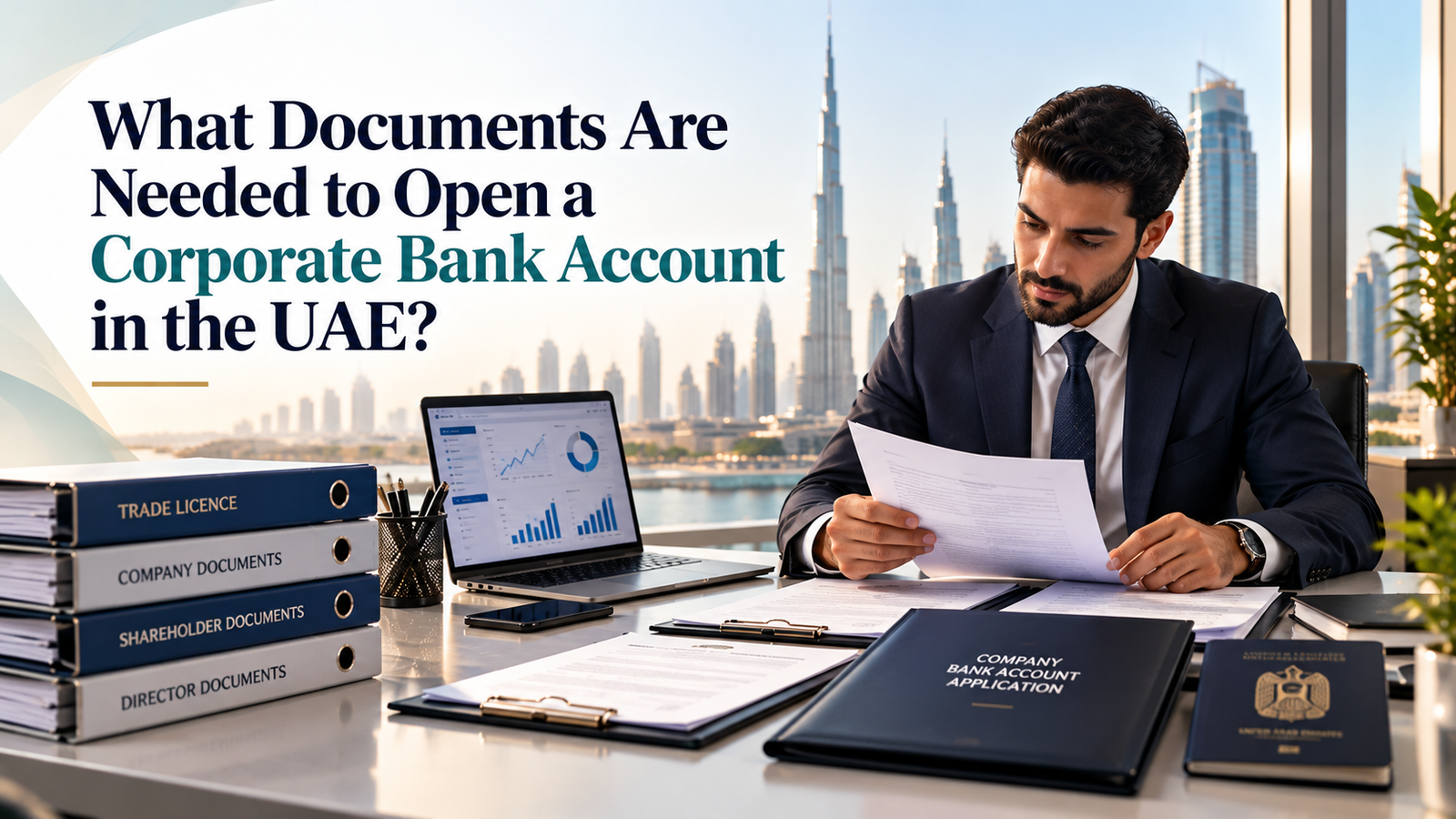
Opening a corporate bank account is an important step for businesses operating in the United Arab Emirates. A dedicated business account helps companies receive customer payments, pay suppliers, manage operating expenses, and maintain clear financial records. However, opening an account requires more than simply presenting a trade licence. Banks need to understand the company, verify its owners and authorised signatories, and assess its business activities, expected transactions, and source of funds.
The documents required to open a corporate bank account in the UAE typically include a valid trade licence, company incorporation documents, the Memorandum and Articles of Association (MOA/AOA), passport and Emirates ID copies where applicable, proof of business address, and documents explaining the company’s business activities and financial position. Depending on the bank and the applicant’s circumstances, additional items may include a business plan, bank statements, contracts, invoices, and source-of-funds evidence.
This guide explains the main corporate bank account documents required in the UAE, why banks request them, which documents may be needed from shareholders, and how to prepare a complete application file before approaching a bank.
What Documents Are Required to Open a UAE Corporate Bank Account?
The exact checklist varies by bank, business structure, ownership arrangements, and account type. Nevertheless, most corporate account applications involve several common document categories.
| Document category | Typical documents | Purpose |
|---|---|---|
| Company registration | Trade licence, certificate of incorporation, commercial registration where applicable | Confirms the company’s legal existence and licensed activities |
| Constitutional documents | MOA, AOA, partnership agreement, amendments where applicable | Explains the company’s ownership and legal structure |
| Shareholder and signatory identification | Passports, Emirates IDs and residence visa details where applicable | Verifies relevant individuals |
| Authorisation documents | Board resolution, power of attorney, authorised signatory details | Establishes who can operate the account |
| Address verification | Tenancy agreement, registered office documents, or other accepted proof | Supports verification of the company’s address |
| Business activity evidence | Business plan, contracts, invoices, website details or supplier information where relevant | Explains what the company does and how it operates |
| Financial information | Personal or company bank statements, financial statements, turnover estimates | Helps the bank understand financial activity |
| Source-of-funds evidence | Relevant bank records, contracts, investment documents or other supporting evidence | Explains where the business’s money originates |
This table is a preparation guide rather than a universal mandatory list. For example, Emirates NBD’s published business-account requirements include a valid trade licence, constitutional documents, shareholder and partner identification, and tenancy documentation. Other banks publish their own requirements and may request additional information. You can review the Emirates NBD business account requirements and ADCB’s business account FAQ.
1. Valid UAE Trade Licence
A valid trade licence is one of the most important documents in a corporate bank account application.
The licence identifies the company and its approved business activities. It helps the bank understand the nature of the business and determine whether the declared activities are consistent with the proposed banking relationship.
Before applying, check the following:
- The trade licence is valid and current.
- The legal company name matches the other company documents.
- The licensed business activities are accurately represented.
- The company details are consistent across the application and supporting records.
- Any required amendments or renewals have been completed.
Depending on the company and issuing authority, the bank may also request a certificate of incorporation, commercial registration, establishment-related records, or other formation documents.
Practical tip: Prepare a clear, current copy of the trade licence and verify that the company name and registration details match the rest of the application file.
2. Certificate of Incorporation and Company Registration Documents
A bank may request evidence showing that the company has been legally established.
The precise documents depend on the jurisdiction and legal structure. Examples include:
- Certificate of incorporation.
- Commercial registration certificate, where applicable.
- Company registration certificate issued by the relevant free zone authority.
- Other official company formation documents.
- Relevant registration amendments, where applicable.
These records help establish the company’s legal identity and connect its banking application to the entity registered with the relevant authority.
Mainland, free zone, and offshore entities may have different document sets. A certificate issued by one jurisdiction may not replace another document required by a particular bank.
What should you do? Ask the selected bank for its checklist for your company’s specific legal structure before submitting the application.
3. Memorandum of Association (MOA) and Articles of Association (AOA)
The Memorandum of Association and Articles of Association, where applicable, are important corporate bank account documents because they provide information about the company’s constitution and ownership arrangements.
Depending on the company structure, a bank may request:
- Memorandum of Association (MOA).
- Articles of Association (AOA).
- Partnership agreement or equivalent constitutional document.
- Amendments to the original documents.
- Attested or signed copies where required.
These documents can help the bank understand the ownership structure, management arrangements, and relevant authority to act on behalf of the company.
If the company has undergone ownership changes or amendments, make sure the submitted records reflect the current position.
For some applications, the bank may also require additional documentation relating to shareholders or ultimate beneficial owners (UBOs). The exact requirements depend on the bank’s due-diligence process.
4. Passport Copies of Shareholders and Authorised Signatories
Banks generally need to identify the people who own, control, or are authorised to act for the business.
Depending on the bank’s requirements, you may need to provide passport copies for:
- Company shareholders.
- Directors or managers.
- Authorised account signatories.
- Ultimate beneficial owners, where required.
- Other relevant individuals identified during the bank’s review.
The bank may request additional identification or verification information depending on the ownership structure and risk assessment.
Before submitting the documents, check that passport details are legible and that the names match the company’s official records.
If the company has several shareholders, ask whether the bank requires identification documents from every shareholder or only specified individuals in particular categories. Do not assume that providing the managing director’s passport alone will be sufficient.
5. Is an Emirates ID Required to Open a Corporate Bank Account?
An Emirates ID may be required for UAE-resident shareholders, directors, or authorised signatories, depending on the bank’s procedures and the individuals involved.
Banks may also request residence visa details or other identity documentation where applicable.
However, an Emirates ID requirement should not be treated as identical across every corporate account application. Requirements can differ depending on the account type, bank, applicant’s residency status, and ownership structure.
Before applying, confirm:
- Whether an Emirates ID is required for each shareholder.
- Whether the authorised signatory must provide an Emirates ID.
- Whether passport and visa copies are also needed.
- What additional identification documents may be accepted for non-resident owners.
- Whether the bank requires original documents, certified copies, or digital verification.
If one or more shareholders live outside the UAE, explain this when requesting the bank’s checklist. Non-resident ownership may lead to additional verification requirements, but the precise process depends on the bank.
6. Board Resolution or Power of Attorney
Banks need to establish who has authority to open and operate the corporate account.
Depending on the company’s legal structure and governing documents, the bank may request a board resolution, power of attorney, or other authorisation document.
A board resolution may specify:
- The decision to open the corporate bank account.
- The bank with which the company intends to establish the relationship, where required.
- The authorised signatory or signatories.
- The scope of the signatories’ authority.
- Relevant account operation or approval arrangements.
A power of attorney may be relevant where someone acts under delegated authority, subject to the bank’s requirements.
The document should be properly approved, signed, and formatted according to the applicable company rules and bank requirements.
Common mistake: Naming a person as the account signatory in the application without providing the authorisation documents required by the bank.
Confirm the required format before preparing the resolution or power of attorney.
7. Proof of Business Address
Banks may request evidence of the company’s registered or operating address.
Depending on the bank and company arrangement, acceptable documents may include:
- Tenancy agreement.
- Ejari or equivalent tenancy documentation where applicable.
- Free zone office or facility documentation.
- Registered office records.
- Utility bills or other address evidence accepted by the bank.
The precise document depends on the company’s location, licensing jurisdiction, and office arrangement.
A company operating from a shared office, business centre, or other permitted arrangement should ask the bank which documents it accepts for that setup.
Check that the company name, address, and other details are consistent across the licence, tenancy documents, and application.
Do not assume that a virtual office arrangement automatically meets every bank’s requirements. The bank may need additional information about the company’s physical presence, business operations, or address.
8. Business Plan and Description of Business Activities
A business plan or detailed business description may be requested, particularly when the company is newly established or the bank needs further information about its operations.
The purpose is to help the bank understand what the business does, how it expects to generate revenue, and how the account will be used.
A useful business plan may explain:
- The company’s products or services.
- Its target customers and markets.
- Its suppliers and commercial relationships.
- Its operating model.
- Expected revenue and transaction volumes.
- Expected payment methods and currencies.
- Anticipated local and international transactions.
- The company’s current stage of operations.
The information should match the licensed activities and other documents supplied to the bank.
For example, a consultancy business may explain its services, client locations, pricing model, and expected invoice payments. A trading business may need to explain its products, suppliers, customers, and anticipated goods-related transactions.
Avoid vague descriptions that do not explain how the company actually operates.
9. Financial Documents and Bank Statements
Financial information helps the bank assess the company’s expected activity and understand its financial background.
Depending on the circumstances, the bank may request:
- Recent company bank statements, if the business already operates.
- Personal bank statements from shareholders or owners, where required.
- Financial statements.
- Management accounts or other available accounting records.
- Turnover forecasts.
- Expected deposit and transaction information.
- Evidence supporting the company’s projected revenue.
A newly formed company may not yet have company bank statements or historical financial statements. In that case, the bank may request alternative evidence, such as a business plan, initial capital information, contracts, or available shareholder financial records.
An established company may need to demonstrate its existing trading activity through financial statements, invoices, contracts, or bank records.
Important: The required period and type of bank statements vary by bank. Do not assume that every bank requires the same number of months or accepts the same substitute documents.
10. Source-of-Funds Evidence
Banks may ask where the company’s initial capital and expected funds originate.
This is part of the bank’s due-diligence process and may be particularly relevant when reviewing ownership structures, international transactions, or businesses with more complex funding arrangements.
Depending on the circumstances, supporting evidence may include:
- Relevant personal or company bank statements.
- Share capital or investment documentation.
- Business contracts and invoices.
- Financial statements.
- Documents relating to the sale of assets or other legitimate funding sources.
- Other evidence requested by the bank.
The evidence should be consistent with the information provided in the application.
For example, if the business expects to receive payments from overseas clients, the company should be prepared to explain the nature of those transactions and provide supporting commercial documents if requested.
A clear explanation of the source of funds can help the bank understand the company’s financial profile. It does not, however, guarantee approval.
11. Do UAE Banks Require Business Contracts and Invoices?
Not every bank requires business contracts or invoices in every application, but they may request them to verify that the company has genuine commercial activity and that its proposed transactions make sense.
Supporting documents may include:
- Signed customer contracts.
- Supplier agreements.
- Purchase orders.
- Sales invoices.
- Service agreements.
- Quotations or other commercial records.
- Shipping or trade documents where relevant to the business.
The appropriate evidence depends on the company’s activities.
A business that has already started trading may be able to provide actual contracts and invoices. A newly formed company may instead provide available proposals, planned commercial arrangements, or a business plan, subject to the bank’s acceptance.
Never create or submit artificial contracts or invoices simply to strengthen an application. All supporting documents should accurately represent the business and its actual or properly documented planned activities.
12. Additional Documents for Different Business Structures
The standard checklist may not cover every situation. Additional requirements can arise because of the company’s jurisdiction, shareholder structure, business activities, or banking arrangements.
| Business situation | Additional documents that may be requested |
|---|---|
| Newly established company | Business plan, expected turnover, initial capital information, proposed commercial arrangements |
| Existing operating company | Recent financial statements, company bank statements, invoices and contracts |
| Company with several shareholders | Identification documents and ownership information for relevant individuals |
| Company with corporate shareholders | Parent-company registration documents, ownership structure and UBO information |
| Company with a delegated signatory | Board resolution, power of attorney or other accepted authorisation |
| Trading or import/export business | Supplier and customer details, purchase orders, invoices, shipping or trade records |
| Company with international transactions | Details of counterparties, expected countries and currencies, and supporting transaction information |
This is an illustrative list. The bank may ask for additional documents or decide that some items are unnecessary for a particular application.
If the ownership structure includes a foreign corporate shareholder, ask whether the bank requires certified, legalised, or attested corporate documents.
How to Prepare Your Corporate Bank Account Application: Step-by-Step Checklist
A systematic approach can help reduce avoidable documentation gaps.
Step 1: Identify the Right Bank and Account Type
Compare available business accounts based on your company’s activities, expected turnover, transaction needs, currencies, payment requirements, and applicable fees.
Before committing, obtain the bank’s current documentation checklist for your particular business structure.
Step 2: Create a Company Document Folder
Collect the trade licence, incorporation documents, MOA/AOA, relevant amendments, and other company records.
Use clear file names and ensure that the documents are current and readable.
Step 3: Collect Shareholder and Signatory Documents
Prepare the identification documents requested for the relevant shareholders, UBOs, directors, and authorised signatories.
Confirm whether the bank requires any additional verification for non-resident individuals.
Step 4: Prepare the Authorisation Documents
Arrange the board resolution, power of attorney, or other documents needed to establish who can open and operate the account.
Confirm the required wording, approval process, and signing arrangements with the bank.
Step 5: Organise Financial and Commercial Evidence
Prepare available bank statements, financial statements, business plans, contracts, invoices, and source-of-funds evidence relevant to your business.
For a new company, identify which documents are available and ask the bank what alternatives it accepts for records that do not yet exist.
Step 6: Check Consistency Across the Application
Review company names, registration numbers, addresses, shareholder details, business activities, and financial information.
Differences between documents can prompt questions or requests for clarification.
Step 7: Submit the Application and Track Requests
Submit the documents through the bank’s accepted application channel. Keep copies of the submission, reference number, and any correspondence.
Respond promptly and accurately if the bank requests additional information.
Step 8: Confirm Any Outstanding Requirements
Before assuming the file is complete, ask whether further documentation, verification, or an in-person step is required.
A complete initial file can make the process more organised, but the bank may still conduct additional due diligence.
What Causes Corporate Bank Account Documentation Delays in the UAE?
Documentation delays can occur for several reasons. They do not always indicate that a company is ineligible to open an account.
Incomplete Company Records
A missing trade licence amendment, unsigned constitutional document, or outdated company record may lead to a request for additional information.
How to avoid it: Compare every document against the bank’s current checklist before submission.
Inconsistent Shareholder Information
Differences in names, passport details, ownership records, or signatory information may require clarification.
How to avoid it: Verify the information against official documents and explain any legitimate differences where necessary.
Unclear Business Activities
A general business description may not adequately explain the company’s revenue model, customers, suppliers, or expected transactions.
How to avoid it: Prepare a concise, accurate business profile supported by relevant commercial information.
Missing Financial Evidence
The bank may need more information about the company’s expected turnover, funding, or transaction patterns.
How to avoid it: Organise available financial records and ask what alternative evidence is accepted for a newly established business.
Delayed Responses to Bank Requests
Applications may remain incomplete if the company does not respond promptly to requests for further information.
How to avoid it: Assign a responsible person to monitor correspondence and maintain a list of outstanding items.
Applying Without Checking Bank-Specific Requirements
A checklist suitable for one bank may not satisfy another bank’s requirements.
How to avoid it: Obtain the selected bank’s current requirements before finalising the file.
Frequently Asked Questions About Corporate Bank Account Documents in the UAE
1. What documents are required to open a UAE corporate bank account?
Commonly requested documents include a valid trade licence, incorporation records, MOA/AOA where applicable, shareholder and authorised signatory identification, proof of business address, and relevant authorisation documents. The bank may also request financial records, contracts, a business plan, and source-of-funds evidence.
2. Do banks require a trade licence to open a corporate bank account?
A valid trade licence or equivalent registration document is a standard requirement for many UAE corporate bank account applications. The exact documents depend on the company’s legal structure and the selected bank.
3. Is an Emirates ID required for a corporate bank account?
An Emirates ID may be required for UAE-resident shareholders, directors, or authorised signatories. Requirements for non-residents and other individuals can differ, so confirm the exact checklist with the bank.
4. Do all shareholders need to provide passport copies?
Banks may require passport copies and other identification documents for shareholders, UBOs, directors, and authorised signatories. Whether every shareholder must provide particular documents depends on the bank’s requirements and the ownership structure.
5. Do UAE banks ask for business contracts?
Some banks request customer contracts, supplier agreements, invoices, or other commercial evidence to understand the company’s activities and expected transactions. These documents are not necessarily mandatory for every applicant.
6. Is proof of address required for a UAE business bank account?
Banks commonly request evidence of the company’s registered or operating address. Depending on the arrangement, this may include a tenancy agreement, Ejari where applicable, free zone office documentation, or another accepted record.
7. What financial documents may a bank request?
Depending on the company, the bank may ask for company or personal bank statements, financial statements, turnover forecasts, business plans, and evidence of the source of funds. New companies may need to provide alternative supporting information where historical records do not exist.
8. Can a newly established company apply without company bank statements?
A newly established company may apply without historical company bank statements, but the bank may request alternative evidence, such as a business plan, expected turnover, source-of-funds information, or proposed commercial arrangements. Acceptance depends on the bank.
9. Why do corporate bank account applications get delayed?
Common causes include incomplete documents, inconsistent information, unclear business activities, missing financial evidence, and slow responses to additional requests. Bank-specific checks can also affect the process.
10. Does submitting all the required documents guarantee approval?
No. A complete application helps the bank assess the business, but approval depends on the bank’s eligibility criteria, due diligence, risk assessment, and internal policies.
Conclusion
Preparing the right corporate bank account documents in the UAE is an important part of establishing a banking relationship for your business. A valid trade licence, company registration records, shareholder identification, authorisation documents, proof of address, and relevant financial and commercial evidence form the foundation of many applications.
However, the precise requirements vary by bank and company structure. The most practical approach is to obtain the current checklist from your selected bank, organise the supporting records, check that the information is consistent, and respond promptly to requests for clarification.
If your company needs help organising its application, understanding documentation requirements, or coordinating the corporate banking process, explore 360Bizs bank account assistance in the UAE. The relevant support can be discussed according to your business structure and banking needs.
Disclaimer: This article is for general informational purposes only and does not guarantee account eligibility or approval. Bank documentation requirements, verification procedures, and account terms can change. Always confirm the current requirements directly with the bank you intend to approach.