

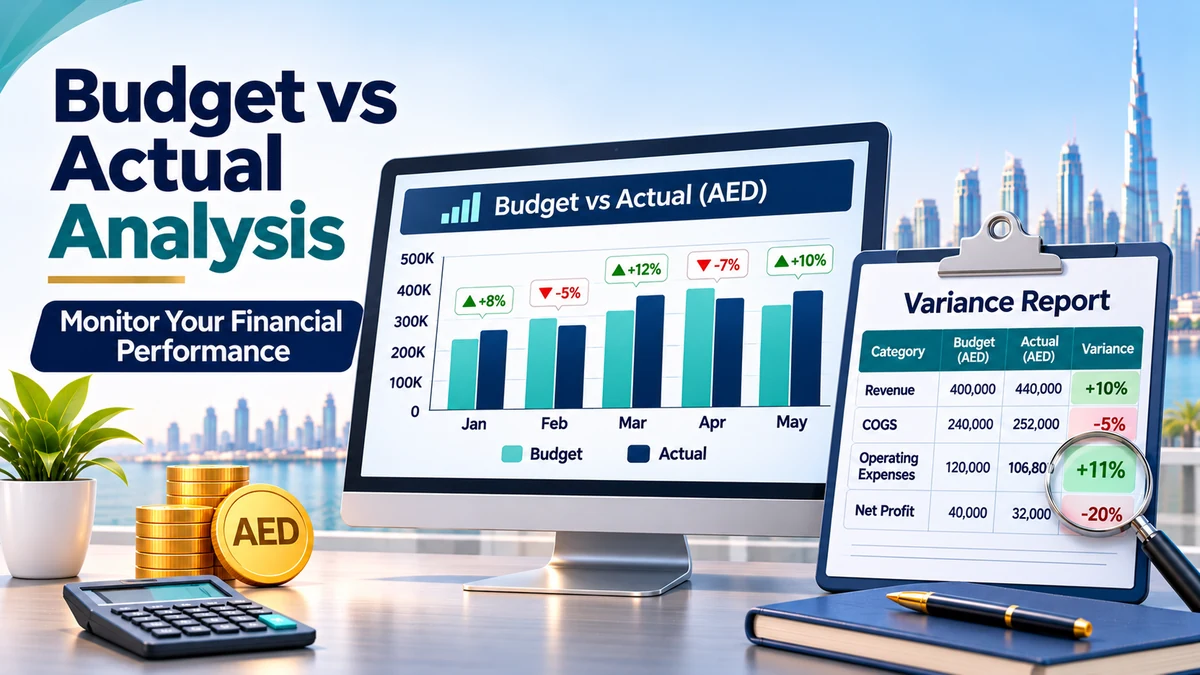
Budget vs actual analysis is the process of comparing what a business planned to earn and spend with what actually happened, then understanding why the numbers differ. For UAE business owners, it is one of the simplest and most powerful tools for financial performance monitoring, turning a budget from a once-a-year spreadsheet into a practical management tool that guides decisions every month.
Many SMEs in Dubai, Abu Dhabi and Sharjah prepare a budget at the start of the year and never look at it again. When profits fall short, owners struggle to pinpoint whether the cause was lower sales, discounting, rising costs or overspending in one department. This guide explains how budget variance analysis works, how to calculate and interpret variances, how to analyse revenue and expense differences, and includes a practical monthly report in AED.
What Is Budget vs Actual Analysis?
Budget vs actual analysis compares budgeted figures (your financial plan) with actual results (recorded in your accounts) for the same period, usually month by month and year to date. The difference between the two is called a variance.
A typical actual vs budget reporting pack shows, for each line of the profit and loss statement:
- Budgeted amount
- Actual amount
- Variance in AED
- Variance as a percentage
- Whether the variance is favourable or unfavourable
- A short explanation for significant variances
Budget vs actual analysis focuses on performance against plan, usually on a profit basis. It differs from cash flow forecasting, which focuses on the timing of cash movements. Our guide on building a cash flow forecast for a UAE small business covers that separate process.
Why Should Businesses Compare Actual and Planned Results?
Regular financial budget monitoring helps business owners:
- Spot problems early: identify falling sales, shrinking margins or overspending within weeks, not at year-end.
- Hold teams accountable: give department heads clear targets and visibility of their spending.
- Control costs: enforce budget control for SMEs before small overspends become large losses.
- Improve forecasting: learn from past variances to build more realistic future budgets.
- Make informed decisions: decide when to cut costs, increase marketing, adjust pricing or hire.
- Communicate with stakeholders: give partners, investors and banks clear performance reporting.
How Do You Calculate Budget Variance?
The basic formulas are:
Variance (AED) = Actual – Budget
Variance % = (Actual – Budget) ÷ Budget × 100
For example, if marketing was budgeted at AED 12,000 and actual spending was AED 18,500:
- Variance = 18,500 – 12,000 = AED 6,500 over budget
- Variance % = 6,500 ÷ 12,000 × 100 = 54.2% over budget
What Is Favourable and Unfavourable Variance?
Whether a variance is good or bad depends on whether the line is income or expense:
| Line Type | Actual Higher Than Budget | Actual Lower Than Budget |
|---|---|---|
| Revenue / Income | Favourable (F) | Unfavourable (U) |
| Costs / Expenses | Unfavourable (U) | Favourable (F) |
| Profit | Favourable (F) | Unfavourable (U) |
A favourable variance is not always good news, and an unfavourable one is not always bad. Lower marketing spending looks favourable, but if it caused lower sales, the business is worse off overall. Context matters.
Budget vs Actual Report Example in AED
Below is an illustrative monthly budget vs actual analysis for a Dubai-based trading SME.
| Line Item | Budget (AED) | Actual (AED) | Variance (AED) | Variance % | F / U |
|---|---|---|---|---|---|
| Revenue | 250,000 | 228,000 | -22,000 | -8.8% | U |
| Cost of goods sold | 150,000 | 141,000 | 9,000 | -6.0% | F |
| Gross profit | 100,000 | 87,000 | -13,000 | -13.0% | U |
| Salaries | 45,000 | 45,000 | 0 | 0.0% | – |
| Rent | 15,000 | 15,000 | 0 | 0.0% | – |
| Marketing | 12,000 | 18,500 | -6,500 | +54.2% | U |
| Utilities | 4,000 | 4,600 | -600 | +15.0% | U |
| Professional fees | 3,000 | 2,500 | 500 | -16.7% | F |
| Bank and gateway charges | 2,000 | 2,400 | -400 | +20.0% | U |
| Total operating expenses | 81,000 | 88,000 | -7,000 | +8.6% | U |
| Net profit / (loss) | 19,000 | (1,000) | -20,000 | -105.3% | U |
Note: In this table, a negative variance in AED means the result is worse for profit, and a positive variance means it is better for profit.
What This Report Tells the Owner
- The business planned a profit of AED 19,000 but made a small loss of AED 1,000, a total shortfall of AED 20,000.
- AED 13,000 of the shortfall came from lower gross profit, and AED 7,000 from higher operating expenses.
- Marketing was AED 6,500 (54.2%) over budget, yet revenue still fell. This needs urgent review of campaign effectiveness.
- Cost of goods sold looks favourable, but only because fewer goods were sold. Gross margin actually fell from 40.0% to 38.2%.
How Do Businesses Analyse Revenue Differences?
Effective revenue variance analysis separates the effect of selling a different volume from the effect of selling at a different price.
In our example, the budget assumed 500 units at AED 500 each (AED 250,000). The business actually sold 480 units at an average price of AED 475 (AED 228,000).
| Revenue Variance Component | Calculation | Result (AED) |
|---|---|---|
| Sales volume variance | (Actual units – Budget units) × Budget price = (480 – 500) × 500 | -10,000 U |
| Sales price variance | (Actual price – Budget price) × Actual units = (475 – 500) × 480 | -12,000 U |
| Total revenue variance | Volume + Price | -22,000 U |
More than half of the revenue shortfall came from discounting (lower average price), not from selling fewer units. This points the owner towards pricing and discount policies rather than only sales volume.
Using a Flexible Budget
Comparing actual costs with a fixed budget can be misleading when sales volumes change. A flexible budget adjusts variable costs to the actual level of activity.
- Budgeted cost per unit = 150,000 ÷ 500 = AED 300
- Flexed COGS for 480 units = 480 × 300 = AED 144,000
- Actual COGS = AED 141,000
- Cost efficiency variance = AED 3,000 favourable
So out of the AED 9,000 favourable COGS variance, AED 6,000 is simply due to lower volume, while only AED 3,000 reflects genuine cost savings.
How Should Unexpected Expenses Be Evaluated?
Good business expense variance analysis asks a few structured questions about each significant variance:
- Is it a timing difference? For example, an annual licence renewal paid in a different month than budgeted.
- Is it a one-off or recurring? A one-time repair is different from a permanent increase in rent or utilities.
- Is it controllable? Marketing spend is controllable, while a government fee increase may not be.
- Did it generate value? Extra marketing that brought in profitable sales may be justified.
- Was the budget realistic? Sometimes the variance shows that the original budget was wrong.
- Is it an accounting error? Misclassified expenses or missing accruals can create false variances.
Setting Investigation Thresholds
Not every variance needs investigation. Many SMEs set materiality thresholds, for example investigating any variance above 10% and above AED 5,000, or any variance above AED 10,000 regardless of percentage. This focuses management attention where it matters most.
What Should a Monthly Budget Variance Report Include?
An effective monthly report for financial performance monitoring should include:
- Summary dashboard: revenue, gross profit, net profit and cash compared with budget
- Monthly and year-to-date comparison: budget, actual and variance for each line
- Variance percentages and F/U indicators
- Commentary explaining the main variances in plain language
- Key ratios: gross margin, operating expense ratio and net margin versus budget
- Departmental or branch breakdowns where relevant
- Action points with owners and deadlines
- Updated full-year forecast based on actual results to date
How Frequently Should Budgets Be Reviewed?
- Monthly: review budget vs actual after closing the books each month. This is the standard for most SMEs.
- Quarterly: reforecast the remainder of the year based on actual performance and updated expectations.
- Annually: prepare the new budget using lessons learned from the past year’s variances.
- Weekly (selected lines): fast-moving businesses may track sales and key costs weekly.
Monthly reviews are only meaningful if your bookkeeping is complete and accurate by the time of the review. Late or incomplete books lead to misleading variances.
How Can Variance Analysis Improve Business Decisions?
Used consistently, budget variance analysis supports better decisions across the business:
- Pricing: identify when discounting is eroding margins.
- Marketing: link spending to results and reallocate budget to effective channels.
- Purchasing: detect rising supplier costs early and renegotiate.
- Staffing: decide when to hire based on actual revenue trends.
- Cost reduction: target recurring overspends instead of making across-the-board cuts.
- Future budgets: set more accurate, achievable targets.
Steps to Implement Budget vs Actual Analysis in Your Business
- Build a realistic budget using historical data and clear assumptions.
- Align the budget with your chart of accounts so budget lines match accounting categories.
- Phase the budget monthly, placing seasonal sales and periodic costs in the right months.
- Close the books promptly each month, including accruals and reconciliations.
- Produce the variance report from your accounting software or spreadsheet.
- Investigate significant variances using your thresholds.
- Agree actions and track them in the following month.
- Reforecast quarterly to keep plans realistic.
Common Budget vs Actual Mistakes
- Spreading the annual budget equally across 12 months, ignoring seasonality
- Comparing figures from incomplete or unreconciled books
- Focusing only on totals without looking at individual lines
- Treating every favourable variance as good news
- Not separating price and volume effects in revenue
- Reporting variances without explanations or actions
- Never updating the budget or forecast during the year
Frequently Asked Questions
What is the difference between a budget and a forecast?
A budget is the original financial plan set at the start of a period. A forecast is an updated estimate of expected results based on actual performance so far and current expectations. Many businesses compare actual results against both.
Why is actual spending different from the budget?
Common reasons include timing differences, unexpected costs, price changes, different activity levels, unrealistic budget assumptions and accounting errors such as misclassified expenses.
Can accounting software produce budget vs actual reports?
Yes. Most modern accounting software allows you to enter budgets by account and month and automatically generate budget vs actual reports with variances.
What is a good variance threshold for SMEs?
Many SMEs investigate variances above 5 to 10% that also exceed a set AED amount. The right threshold depends on the size of the business and the importance of each line.
Conclusion
Consistent budget vs actual analysis gives UAE business owners a clear, monthly view of whether the business is on track, where performance is drifting and what action is needed. By calculating variances correctly, separating price and volume effects, using flexible budgets and focusing on material differences, SMEs can turn their budget into a real budget control for SMEs tool that drives better decisions.
Reliable variance reporting depends on accurate, timely bookkeeping. If you need help setting up budgets, closing your books monthly or producing clear actual vs budget reporting, 360Bizs can help. Explore our accounting and bookkeeping services or contact our team to get started.