

Managing business finances is essential for every company operating in the United Arab Emirates. Whether you run a startup in Dubai, a small trading company, a professional services firm, or an established business, you need accurate financial records to understand your performance, manage cash flow, and meet applicable compliance obligations.
However, many business owners use the terms bookkeeping and accounting interchangeably. Although these functions are closely connected, they serve different purposes.
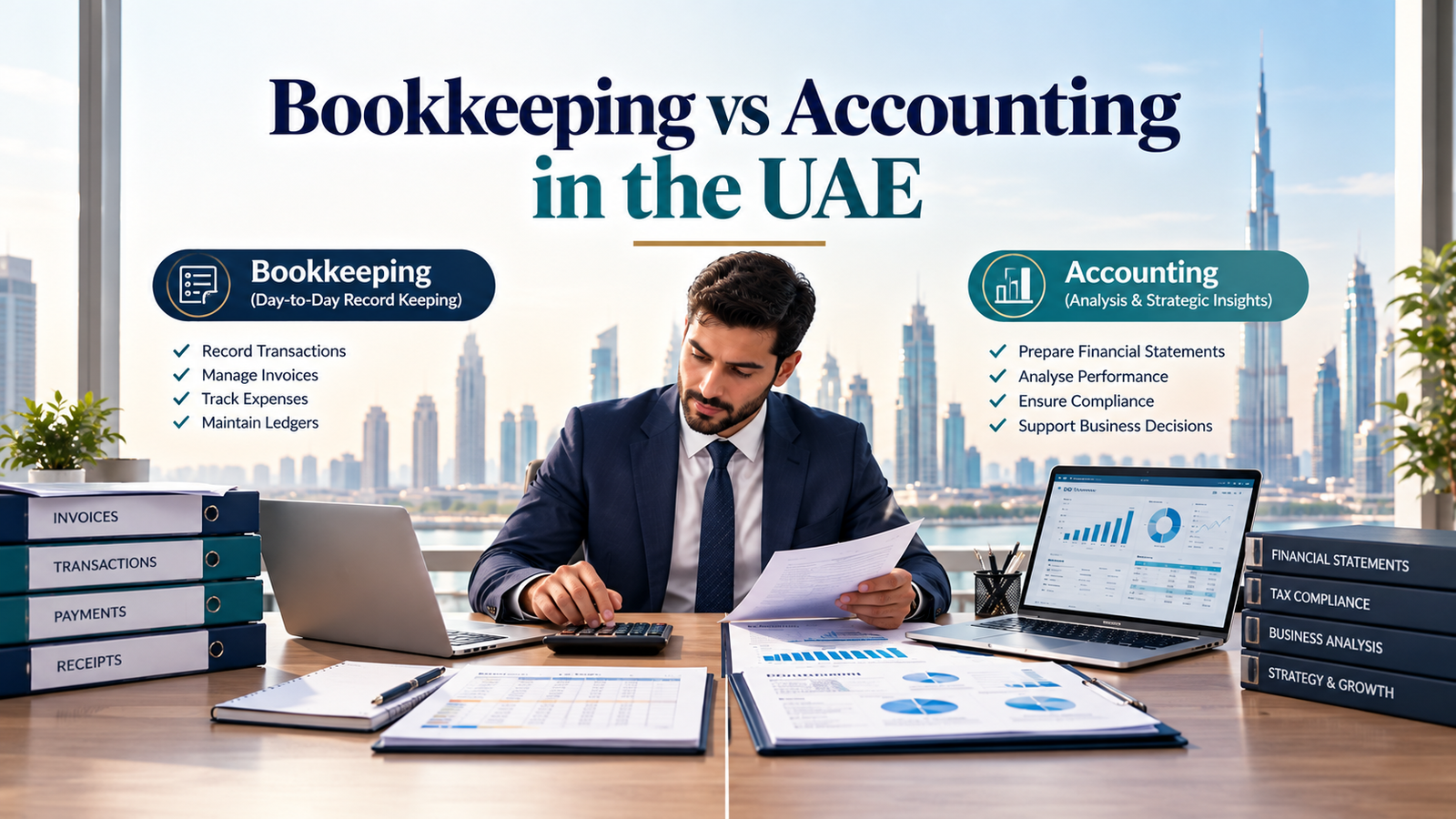
Bookkeeping is the process of recording and organising day-to-day financial transactions, while accounting involves interpreting, analysing, adjusting, and reporting financial information to help a business understand its financial position and make informed decisions.
In simple terms, bookkeeping establishes the financial records, while accounting turns those records into meaningful financial information.
Understanding the difference between bookkeeping vs accounting in the UAE can help you decide which services your business needs, when to outsource financial tasks, and how to maintain records that support VAT compliance and other applicable reporting requirements.
This guide explains both functions, compares their responsibilities, outlines the requirements of UAE businesses, and helps you determine when to hire a bookkeeper, an accountant, or both.
What Is Bookkeeping in the UAE?
Bookkeeping is the systematic recording, classification, and organisation of a business’s financial transactions.
Every time a company issues a sales invoice, receives a payment, purchases supplies, pays rent, or incurs an operating expense, the transaction should be recorded accurately in its accounting records.
The objective of bookkeeping is to create a reliable, up-to-date record of the business’s financial activity.
What Does a Bookkeeper Do?
A bookkeeper may perform the following tasks, depending on the business and the agreed scope of work:
- Record daily sales, purchases, receipts, and payments.
- Enter supplier invoices and customer invoices.
- Track accounts receivable and accounts payable.
- Categorise income and business expenses.
- Maintain cash and bank transaction records.
- Reconcile bank statements with accounting records.
- Organise receipts, invoices, and supporting documents.
- Maintain records of relevant VAT transactions.
- Update accounting software and transaction schedules.
- Prepare basic financial summaries for review.
For example, imagine a Dubai-based consultancy receives AED 15,000 from a customer and pays AED 3,000 for business-related expenses during a reporting period.
The bookkeeper records the transactions, assigns the appropriate categories, matches the relevant supporting documents, and ensures that the entries are reflected correctly in the company’s financial records.
These records provide the foundation for subsequent accounting analysis.
Why Is Bookkeeping Important for UAE Businesses?
Accurate bookkeeping helps business owners understand where their money comes from and where it goes.
It also supports several important business functions:
Cash flow visibility: Regularly updated records help management understand available funds, expected customer receipts, and upcoming supplier payments.
Expense tracking: Proper categorisation helps identify major operating costs and areas where spending may need attention.
VAT record keeping: Organised transaction records and supporting tax invoices help businesses prepare for applicable VAT reporting obligations.
Financial reporting: Complete bookkeeping records provide the information needed to prepare financial statements and other management reports.
Audit and review readiness: Well-organised documentation makes it easier to retrieve relevant records when they are requested by an auditor, adviser, bank, or competent authority.
Bookkeeping is therefore more than data entry. It is an important control that supports the wider financial management of a business.
What Is Accounting in the UAE?
Accounting is the broader process of examining, classifying, adjusting, interpreting, and reporting financial information.
It uses the information recorded through bookkeeping to explain a company’s financial position, financial performance, and other relevant business indicators.
Accounting may involve preparing financial statements, reviewing accounting entries, assessing financial trends, supporting budgeting, and helping businesses understand applicable tax and reporting requirements.
The exact scope depends on the company’s size, activities, reporting framework, and professional engagement.
What Does an Accountant Do?
An accountant may be responsible for tasks such as:
- Reviewing the accuracy and completeness of bookkeeping records.
- Preparing or overseeing financial statements.
- Reviewing revenue, expenses, assets, liabilities, and equity.
- Assessing accounting adjustments and accruals.
- Analysing profit margins and operating costs.
- Preparing budgets and financial forecasts.
- Reviewing financial performance and cash flow.
- Supporting applicable VAT and tax reporting processes.
- Helping organise financial information for audits or external reviews.
- Providing management with financial insights for decision-making.
Some accounting functions may require specialist expertise or a separate engagement, particularly where tax advice, assurance, audit, or other regulated professional services are involved.
Why Is Accounting Important for UAE Businesses?
Accounting helps business owners understand what their financial records reveal about the company.
For example, a business may record increasing sales every month but still experience cash shortages. Accounting analysis can help investigate whether the problem relates to slow customer payments, rising expenses, inventory costs, debt repayments, or another factor.
Accounting also supports decisions such as:
- Whether the business can afford to hire additional employees.
- Which products or services generate stronger margins.
- Whether operating costs are increasing too quickly.
- How much working capital may be needed.
- Whether the company is meeting its financial targets.
- What financial information may be required for lenders, investors, or other stakeholders.
For UAE businesses, accounting also helps organise the financial information needed to assess applicable regulatory and tax responsibilities.
Bookkeeping vs Accounting in the UAE: Key Differences
The main difference is that bookkeeping focuses on recording financial transactions, whereas accounting focuses on reviewing, interpreting, adjusting, and reporting financial information.
| Comparison factor | Bookkeeping | Accounting |
|---|---|---|
| Main purpose | Record and organise financial transactions | Interpret and report financial information |
| Primary focus | Accurate, complete transaction records | Financial position, performance, analysis, and reporting |
| Typical tasks | Invoice entry, expense recording, bank reconciliation | Financial statements, adjustments, financial analysis |
| Data used | Source documents and transaction details | Bookkeeping records and other financial evidence |
| Main outputs | Organised ledgers and transaction records | Financial statements, reports, analysis, and forecasts |
| Time focus | Primarily records activity as it occurs | Reviews historical results and supports future planning |
| Decision-making role | Supplies reliable financial data | Helps explain results and support business decisions |
| Typical tools | Accounting software, invoice records, transaction schedules | Accounting software, reporting tools, analysis and forecasting models |
| Business benefit | Better financial record keeping | Better financial understanding and planning |
These functions overlap in practice. In a small company, one qualified professional may handle both bookkeeping and accounting. In a larger organisation, the responsibilities may be divided among different team members.
The distinction concerns the work being performed, not simply the person’s job title.
Bookkeeping vs Accounting: A Practical Example
Consider a Dubai-based trading company that purchases products from suppliers and sells them to customers.
During a month, the company records the following illustrative figures:
- Sales revenue: AED 100,000.
- Cost of goods sold: AED 55,000.
- Other operating expenses: AED 20,000.
The figures below exclude VAT and other adjustments and are provided only to demonstrate the difference between bookkeeping and accounting.
What Does Bookkeeping Do?
The bookkeeper records the sales invoices, supplier purchases, customer receipts, supplier payments, and operating expenses.
The bookkeeper also checks the relevant documents, categorises the transactions, and reconciles the bank records.
This creates an organised record of the company’s financial activity.
What Does Accounting Do?
The accountant reviews the records, checks whether transactions have been classified appropriately, and considers any necessary accounting adjustments.
The accountant may then help management interpret the figures.
In this simplified example, the difference between sales revenue and cost of goods sold is AED 45,000. After deducting the AED 20,000 in other operating expenses, the illustrative result is AED 25,000 before other costs, adjustments, and applicable taxes.
The accountant may examine whether this performance is sustainable, how expenses compare with previous periods, and whether the business has sufficient cash to meet its obligations.
The bookkeeper helps establish what was recorded. The accountant helps determine what the records mean.
Does Every UAE Business Need Bookkeeping?
Businesses operating in the UAE should maintain accurate financial records appropriate to their activities and applicable legal obligations.
The exact requirements depend on the business’s legal structure, activities, and relevant legislation. However, maintaining reliable records is important even for businesses that are not currently registered for VAT.
The UAE’s Ministry of Finance explains that businesses must record their financial transactions and maintain accurate financial records. The Federal Tax Authority also publishes requirements relating to accounting records, commercial books, and tax documentation.
Official references include the UAE Ministry of Finance’s VAT information and FTA Decision No. 4 of 2026 on accounting records and commercial books.
A business should not assume that having few transactions eliminates its record-keeping responsibilities.
Why Startups Need Bookkeeping
Startups may initially have relatively few transactions, but recording them correctly from the beginning helps prevent problems later.
A startup should establish a process for recording:
- Customer invoices and receipts.
- Supplier invoices and payments.
- Business expenses.
- Bank transactions.
- Employee-related payments, where applicable.
- Asset purchases.
- Relevant VAT transactions.
- Owner contributions and other funding transactions.
Good records also make it easier to understand early cash flow, prepare financial information for lenders or investors, and identify when the business may need additional financial support.
Why Established Businesses Need Bookkeeping
As a company grows, its transaction volume, supplier relationships, payroll responsibilities, and reporting needs may become more complex.
Regular bookkeeping helps management maintain visibility over customer balances, supplier liabilities, operating costs, and financial records.
It also provides the accounting team with more complete information for reporting and analysis.
When Should a UAE Startup Hire a Bookkeeper?
A startup should consider professional bookkeeping support when managing financial transactions internally becomes difficult, inconsistent, or too time-consuming.
There is no single transaction threshold that determines when a business must hire a bookkeeper. The decision depends on transaction volume, complexity, internal expertise, and the cost of errors.
Common signs that a startup may benefit from bookkeeping support include:
1. Transactions Are Becoming Difficult to Track
If the founder relies on scattered spreadsheets, email attachments, and unorganised receipts, it may become difficult to identify the latest financial position.
A bookkeeper can help introduce a consistent recording process and organise supporting documentation.
2. Customer and Supplier Balances Are Unclear
If the business does not know which customers have outstanding invoices or which supplier payments are due, cash flow management can suffer.
Bookkeeping helps maintain clearer records of receivables and payables.
3. Bank Reconciliation Is Falling Behind
Bank reconciliation helps identify differences between the bank statement and the company’s accounting records.
If reconciliation is postponed for several months, missing transactions and errors may become more difficult to investigate.
4. VAT Reporting Is Becoming More Complex
Businesses registered for VAT need appropriate records to support their reporting obligations.
If the company struggles to organise invoices, classify transactions, or prepare reconciliations, it may benefit from bookkeeping support with relevant VAT experience.
5. The Founder Needs More Time for Business Operations
Managing every financial transaction can take time away from sales, customer service, product development, and other priorities.
Outsourcing routine bookkeeping may help the founder focus on running the business while maintaining appropriate oversight.
A startup with very few transactions may be able to manage basic records internally, provided the process is accurate and meets applicable requirements. The important point is to establish a reliable system early.
When Does a UAE Business Need an Accountant?
A business may need accounting support from the beginning, depending on its complexity, reporting obligations, and management requirements. However, the need for more extensive accounting analysis often increases as the business grows.
Consider professional accounting support in the following situations.
When Financial Statements Are Needed
Businesses may need financial statements for management, shareholders, lenders, investors, or other purposes.
An accountant can help prepare or review the information, apply the relevant accounting framework, and identify necessary adjustments.
The precise requirements depend on the company’s circumstances and the intended use of the statements.
When Management Needs Financial Analysis
A business owner may know the total sales for the month but still need help understanding profitability, margins, cost trends, and working capital.
Accounting analysis can provide a clearer picture of financial performance.
When the Business Is Expanding
Opening another location, hiring employees, adding new products, or entering new markets can affect operating costs, cash flow, and financial reporting.
Accounting support can help evaluate the financial implications of these decisions.
When Tax and Reporting Requirements Become More Complex
VAT reporting, Corporate Tax obligations, and other applicable requirements may require detailed financial records and appropriate analysis.
An accountant can help organise the underlying information and coordinate relevant reporting tasks within their professional scope. Complex tax questions may require a specialist tax adviser.
When Financial Records Need Reviewing or Adjusting
A company may need accounting support to investigate discrepancies, review accounting classifications, assess accruals, or prepare year-end adjustments.
This is particularly important when financial reports will be used for significant management, lending, or investment decisions.
Can Bookkeeping Be Outsourced in the UAE?
Yes. Businesses can outsource bookkeeping to a suitable external service provider, subject to the terms of the engagement and their applicable obligations.
Outsourcing can be useful for startups and small businesses that need reliable financial records but do not require a dedicated in-house bookkeeping employee.
Depending on the service agreement, outsourced bookkeeping may include:
- Recording sales and purchase transactions.
- Maintaining accounts receivable and payable.
- Bank reconciliation.
- Expense categorisation.
- Organising financial documents.
- Maintaining relevant VAT records.
- Preparing transaction schedules for accounting review.
- Producing routine bookkeeping summaries.
The exact services vary by provider. Some firms offer bookkeeping and accounting together, while others focus on specific tasks.
Benefits of Outsourcing Bookkeeping
Flexible support: Businesses may obtain recurring assistance without hiring a dedicated full-time employee.
Structured processes: A provider may introduce consistent procedures for recording transactions and maintaining supporting records.
Time savings: Founders and internal staff can spend less time on routine data entry and document organisation.
Access to expertise: An experienced provider may help identify record-keeping gaps and improve the consistency of financial information.
Support for growth: An outsourced arrangement can be adjusted as transaction volumes and reporting needs change.
These benefits depend on the provider’s competence, the quality of information supplied by the business, and the clarity of the agreement.
Should You Outsource Accounting or Keep It In-House?
Both arrangements can work. The right choice depends on the company’s size, complexity, reporting requirements, and internal resources.
| Factor | Outsourced accounting | In-house accounting |
|---|---|---|
| Cost structure | Agreed professional service fees | Salaries, benefits, recruitment, and training |
| Internal availability | Depends on the service agreement | Team may be available for daily internal coordination |
| Expertise | Access depends on the provider’s team and scope | Depends on the experience of internal staff |
| Flexibility | Scope may be adjusted as requirements change | Additional capacity may require new hires or training |
| Company-specific knowledge | Requires effective communication and access to records | Can develop through regular involvement in operations |
| Suitable situation | Businesses seeking external expertise or flexible support | Businesses needing frequent, integrated financial management |
A business may also use a hybrid model. For example, an internal employee can maintain routine records while an external accountant reviews financial statements or provides specialist support.
Before choosing, compare the full costs, responsibilities, service levels, data-security arrangements, and reporting needs.
How Does Bookkeeping Support VAT Compliance in the UAE?
Bookkeeping plays an important role in VAT compliance because a business needs accurate transaction records to prepare and support its VAT reporting.
VAT-registered businesses generally need records of relevant supplies, purchases, tax invoices, credit notes, adjustments, and other required information.
The exact record-keeping obligations and retention periods depend on the applicable rules and circumstances. Businesses should consult current FTA guidance rather than rely solely on a general checklist.
Accurate Sales and Purchase Records
Bookkeeping helps identify relevant sales and purchase transactions and organise their supporting documents.
This provides a foundation for reviewing output VAT and eligible input VAT.
Bank Reconciliation
Reconciling bank transactions with accounting records can help identify missing receipts, payments, and other discrepancies that need investigation.
Organised Tax Invoices
Maintaining accessible invoices and credit notes helps support the figures reported in VAT returns.
Consistent Transaction Classification
Appropriate bookkeeping procedures help businesses identify transactions that may require specific VAT treatment.
However, complex VAT decisions should not be made solely through automatic accounting software codes without appropriate review.
Timely Preparation
When financial records are updated throughout the tax period, the business can begin preparing its VAT return with more complete information.
Bookkeeping does not itself guarantee VAT compliance. The business must still apply the relevant tax rules, review the information, and submit required returns correctly and on time.
Common Bookkeeping and Accounting Mistakes UAE Businesses Should Avoid
Even businesses with accounting software can experience financial record problems if their processes are inconsistent.
Mixing Personal and Business Transactions
Using the same account for personal and business spending can make it harder to identify legitimate business expenses and reconcile company records.
Better approach: Maintain appropriate separation between business and personal transactions and document any relevant owner contributions or withdrawals.
Delaying Transaction Recording
Waiting until the end of a quarter or year to record transactions can lead to missing invoices, inaccurate balances, and rushed reporting.
Better approach: Establish a regular recording schedule and reconcile important accounts consistently.
Ignoring Bank Reconciliation
A bank balance alone does not prove that the accounting records are complete.
Better approach: Reconcile bank statements with the ledger and investigate differences promptly.
Misclassifying Expenses
Recording a capital asset as an ordinary expense, or incorrectly categorising other transactions, may affect financial reporting.
Better approach: Apply consistent accounting policies and seek professional guidance when the appropriate treatment is unclear.
Failing to Maintain Supporting Documents
Missing invoices, receipts, contracts, and other records can make it difficult to explain or verify reported transactions.
Better approach: Use a structured digital filing system and retain records for the applicable period.
Treating Bookkeeping Reports as Final Financial Statements
A basic transaction summary may not include all adjustments necessary for formal financial reporting.
Better approach: Ensure that financial statements are prepared or reviewed at the appropriate level for their intended purpose.
Assuming Software Replaces Professional Review
Accounting software can automate many tasks, but incorrect settings, incomplete data, and inappropriate classifications can still produce misleading reports.
Better approach: Combine suitable software with consistent review procedures and professional support where needed.
How to Choose an Accounting and Bookkeeping Service in Dubai
When selecting a provider, focus on the services your business actually needs rather than choosing solely on price.
Use the following checklist to compare potential providers:
- Confirm whether the provider offers bookkeeping, accounting, or both.
- Identify which tasks are included in the service agreement.
- Ask how often transactions will be recorded and accounts reconciled.
- Confirm which accounting software and reporting formats are supported.
- Understand how invoices, receipts, and other documents should be supplied.
- Clarify who reviews financial records and approves reports.
- Ask how relevant VAT and tax records will be organised.
- Confirm how confidential financial data will be protected.
- Establish the reporting schedule and communication process.
- Clarify fees, exclusions, and charges for additional work.
- Confirm whether year-end adjustments and financial statements are included.
- Understand which services require a separate specialist or engagement.
A suitable provider should explain its responsibilities clearly and help you understand what information your business must supply.
How 360Bizs Can Help With Accounting and Bookkeeping in Dubai
Maintaining accurate financial records is important for understanding business performance and supporting applicable compliance requirements. However, recording transactions, reconciling accounts, preparing reports, and reviewing financial information can become time-consuming as a company grows.
360Bizs offers accounting and bookkeeping services in Dubai for businesses that need support with financial record management.
Depending on the agreed scope, relevant services may include transaction recording, bank reconciliation, financial reporting, accounting support, and assistance with VAT-related records.
Businesses should discuss their transaction volumes, reporting needs, existing accounting systems, and compliance requirements before selecting a service arrangement.
The objective is to establish reliable financial records that help management understand the company’s position and support the work required for applicable reporting obligations.
Frequently Asked Questions About Bookkeeping vs Accounting in the UAE
1. What is the difference between bookkeeping and accounting?
Bookkeeping focuses on recording and organising financial transactions. Accounting uses those records to review, adjust, interpret, and report financial information. Bookkeeping provides the data, while accounting helps explain what the data means.
2. Does every UAE business need bookkeeping?
Businesses should maintain accurate financial records appropriate to their activities and applicable legal obligations. The exact requirements depend on the business and relevant legislation, but maintaining organised records is important even for companies with relatively few transactions.
3. When should a startup hire a bookkeeper?
A startup should consider bookkeeping support when transactions become difficult to track, bank reconciliation falls behind, invoices are poorly organised, or the founder no longer has sufficient time to maintain reliable records.
4. When does a business need an accountant?
Accounting support may be useful when a company needs financial statements, financial analysis, accounting adjustments, budgeting, or assistance with complex reporting requirements. The appropriate scope depends on the company’s circumstances.
5. Can bookkeeping be outsourced in the UAE?
Yes. Businesses can outsource bookkeeping to a suitable provider. The agreement should define the tasks covered, reporting frequency, document handling, fees, and responsibilities.
6. Is bookkeeping enough for VAT compliance?
Bookkeeping provides the records needed to support VAT reporting, but it does not automatically ensure compliance. Businesses must apply the relevant VAT rules, verify eligible claims, maintain required documentation, and meet their filing obligations.
7. Can one person handle both bookkeeping and accounting?
Yes. In smaller businesses, one suitably experienced professional may handle both functions. Larger or more complex businesses may separate the tasks to improve capacity, review, and internal controls.
8. What is the difference between a bookkeeper and an accountant?
A bookkeeper generally focuses on transaction recording, categorisation, and reconciliation. An accountant typically works with financial reporting, adjustments, analysis, and interpretation. Actual responsibilities vary by experience, qualifications, and engagement.
9. Which is more important: bookkeeping or accounting?
Both are important and serve different purposes. Accounting depends on reliable underlying records, while bookkeeping alone may not provide the analysis and reporting needed for more complex decisions.
10. How do I choose accounting and bookkeeping services in Dubai?
Assess the services offered, relevant experience, software compatibility, reporting schedule, document security, fee structure, and support for your company’s financial and compliance needs. Make sure the agreed scope clearly defines who performs each task.
Conclusion
Bookkeeping and accounting are closely connected, but they are not the same function.
Bookkeeping records and organises the financial transactions of a business. Accounting reviews those records, prepares or supports financial reporting, analyses results, and helps management understand the company’s financial position.
For UAE businesses, reliable bookkeeping provides a foundation for cash flow management, financial reporting, VAT records, and other applicable obligations. Accounting builds on that foundation to support analysis, planning, and informed decisions.
A small startup may begin with a straightforward bookkeeping process and obtain additional accounting support when needed. A growing company may require both functions on a regular basis, whether through an internal team, an external provider, or a combination of the two.
If your business needs help maintaining accurate financial records or organising its accounting processes, explore 360Bizs accounting and bookkeeping services in Dubai to discuss the support appropriate for your requirements.
Disclaimer: This article is for general educational purposes and does not constitute accounting, tax, or legal advice. Financial reporting and record-keeping requirements depend on the applicable rules, business structure, and circumstances. Confirm your specific obligations with the relevant authority or a qualified professional.