

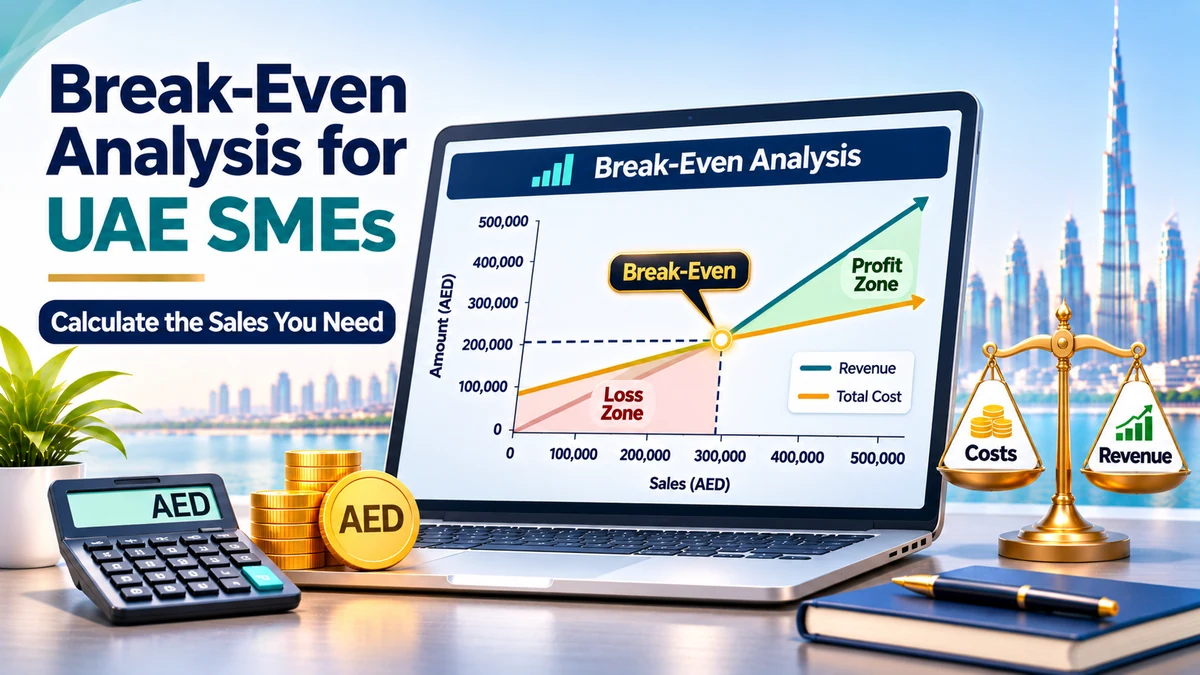
Break-even analysis UAE business owners use is a simple calculation that shows how much a company needs to sell to cover all its costs, the point where it makes neither a profit nor a loss. Every sale above that point contributes to profit, and every shortfall below it means a loss.
For startups and SMEs in Dubai, Abu Dhabi, Sharjah and the free zones, knowing your break-even point for small business planning is essential. It helps you set realistic sales targets, test pricing decisions, judge whether a new location or product is viable and understand how changes in rent, salaries or supplier costs affect profitability. This guide explains the break-even formula, fixed costs and variable costs, contribution margin, and walks through a complete break-even analysis example in AED with a calculation table and chart.
What Is Break-Even Analysis?
Break-even analysis is a financial planning tool that identifies the level of sales, in units or in dirhams, at which total revenue equals total costs. At the break-even point:
Total Revenue = Total Costs, so Profit = AED 0
It answers practical questions such as:
- How many units or orders must we sell each month to cover our costs?
- What monthly revenue do we need before we start making a profit?
- How would a price increase or discount change our break-even point?
- How much can sales fall before we start losing money?
- How many sales do we need to reach a specific profit target?
What Are Fixed and Variable Costs?
Break-even analysis depends on separating fixed costs and variable costs correctly.
| Cost Type | Definition | Typical UAE Examples |
|---|---|---|
| Fixed costs | Costs that stay largely the same regardless of how much you sell, within a normal range of activity | Office or shop rent, staff salaries, trade licence renewal, visa and Emirates ID costs, insurance, accounting software, marketing retainers, loan repayments |
| Variable costs | Costs that increase or decrease directly with each unit sold | Product or raw material cost, packaging, delivery charges, sales commissions, payment gateway fees, marketplace commissions |
| Semi-variable costs | Costs with both a fixed and a variable element | Utilities (DEWA/ADDC/SEWA), phone and internet packages, part-time staff |
Annual costs such as trade licence renewals, visa costs or insurance should be spread across 12 months to calculate a monthly fixed cost. Semi-variable costs should be split into their fixed and variable portions for accurate results.
Important: Use VAT-exclusive figures for selling prices and costs in your break-even calculations, as VAT collected on sales belongs to the Federal Tax Authority and recoverable input VAT is not a business cost.
What Is Contribution Margin?
Contribution margin is the amount each sale contributes towards covering fixed costs and then generating profit, after deducting its variable costs.
Contribution Margin per Unit = Selling Price per Unit – Variable Cost per Unit
Contribution Margin Ratio = Contribution Margin per Unit ÷ Selling Price per Unit
The higher the contribution margin, the fewer units a business needs to sell to break even.
What Is the Break-Even Formula?
There are two main versions of the break-even formula:
Break-Even Point in Units
Break-Even Units = Total Fixed Costs ÷ Contribution Margin per Unit
Break-Even Point in Sales Value (AED)
Break-Even Sales = Total Fixed Costs ÷ Contribution Margin Ratio
The first tells you how many units to sell. The second tells you how much revenue you need, which is especially useful for businesses selling many different products or services.
Break-Even Analysis Example in AED
Let us look at an illustrative UAE e-commerce business selling a single product online from Dubai.
Step 1: Identify the Selling Price and Variable Costs per Unit
| Item (per unit, excluding VAT) | AED |
|---|---|
| Selling price | 120 |
| Product purchase cost | 60 |
| Packaging | 4 |
| Delivery cost | 6 |
| Payment gateway fee (approximate) | 2 |
| Total variable cost per unit | 72 |
Step 2: Calculate the Contribution Margin
- Contribution margin per unit = 120 – 72 = AED 48
- Contribution margin ratio = 48 ÷ 120 = 40%
Every unit sold contributes AED 48 towards fixed costs and profit.
Step 3: Calculate Monthly Fixed Costs
| Monthly Fixed Cost | AED |
|---|---|
| Warehouse and office rent | 12,000 |
| Staff salaries | 24,000 |
| Trade licence and visa costs (annual cost ÷ 12) | 2,500 |
| Software, utilities and internet | 3,500 |
| Marketing retainer | 6,000 |
| Total monthly fixed costs | 48,000 |
Step 4: Perform the Break-Even Point Calculation
- Break-even units = 48,000 ÷ 48 = 1,000 units per month
- Break-even sales = 48,000 ÷ 40% = AED 120,000 per month
Check: 1,000 units × AED 120 = AED 120,000 revenue. Variable costs = 1,000 × 72 = AED 72,000. Total costs = 72,000 + 48,000 = AED 120,000. Profit = AED 0.
Break-Even Calculation Table
The table below shows revenue, costs and profit at different monthly sales volumes.
| Units Sold | Revenue (AED) | Variable Costs (AED) | Fixed Costs (AED) | Total Costs (AED) | Profit / (Loss) (AED) |
|---|---|---|---|---|---|
| 0 | 0 | 0 | 48,000 | 48,000 | (48,000) |
| 250 | 30,000 | 18,000 | 48,000 | 66,000 | (36,000) |
| 500 | 60,000 | 36,000 | 48,000 | 84,000 | (24,000) |
| 750 | 90,000 | 54,000 | 48,000 | 102,000 | (12,000) |
| 1,000 | 120,000 | 72,000 | 48,000 | 120,000 | 0 (Break-even) |
| 1,250 | 150,000 | 90,000 | 48,000 | 138,000 | 12,000 |
| 1,500 | 180,000 | 108,000 | 48,000 | 156,000 | 24,000 |
Each additional 250 units changes profit by AED 12,000 (250 × AED 48 contribution margin).
Break-Even Chart
A break-even chart shows the same information visually. The point where the revenue line crosses the total cost line is the break-even point. Break-even: 1,000 units / AED 120,000 Revenue Total costs Fixed costs Profit zone Loss zone 0 500 1,000 1,500 Units sold per month 0 60k 120k 180k AED Illustrative break-even chart: revenue (green) crosses total costs (red) at 1,000 units, or AED 120,000 in monthly sales.
How Do You Calculate Break-Even Sales for a Profit Target?
Break-even analysis can be extended to calculate the sales needed to achieve a specific profit:
Target Units = (Fixed Costs + Target Profit) ÷ Contribution Margin per Unit
If the owner wants a monthly profit of AED 12,000:
- Target units = (48,000 + 12,000) ÷ 48 = 1,250 units
- Target sales = 1,250 × 120 = AED 150,000
What Is the Margin of Safety?
The margin of safety shows how far sales can fall before the business reaches break-even:
Margin of Safety % = (Actual Sales – Break-Even Sales) ÷ Actual Sales × 100
If the business actually sells 1,300 units (AED 156,000):
- Margin of safety = (156,000 – 120,000) ÷ 156,000 × 100 = 23.1%
Sales could fall by about 23% before the business starts making a loss. A low margin of safety signals higher risk.
How Does Pricing Affect the Break-Even Point?
Pricing has a powerful effect on the break-even sales calculation, because it changes the contribution margin on every unit.
| Scenario | Price (AED) | Variable Cost (AED) | Contribution Margin (AED) | Break-Even Units |
|---|---|---|---|---|
| Price cut to AED 110 | 110 | 72 | 38 | 1,264 |
| Current price | 120 | 72 | 48 | 1,000 |
| Price increase to AED 130 | 130 | 72 | 58 | 828 |
| Supplier cost rises by AED 6 | 120 | 78 | 42 | 1,143 |
A discount of just AED 10 per unit (about 8%) increases the break-even point by 26%, from 1,000 to 1,264 units. This is why discounting should always be tested against break-even before launching promotions.
How Can Businesses Use Break-Even Analysis for Planning?
- Starting a business: estimate whether expected demand can realistically cover costs before signing a lease or hiring staff.
- Setting sales targets: translate break-even and profit targets into monthly or daily sales goals.
- Pricing decisions: test how discounts or price increases affect profitability.
- Cost control: see how reducing rent, renegotiating supplier costs or cutting delivery charges lowers the break-even point.
- Expansion decisions: assess the extra sales needed to justify a new branch, warehouse or employee.
- Product decisions: compare the contribution margins of different products and focus on the most profitable.
- Financing: show banks or investors a clear path to profitability.
Break-Even Analysis for Multiple Products or Services
Most businesses sell more than one product. In that case, use a weighted average contribution margin ratio based on your expected sales mix, then apply the sales-value formula:
Break-Even Sales = Total Fixed Costs ÷ Weighted Average Contribution Margin Ratio
For service businesses, the “unit” may be a billable hour, a project, a client or a subscription, and variable costs may include freelancer fees, commissions and software usage costs.
Limitations of Break-Even Analysis
- It assumes selling prices and variable costs per unit stay constant.
- Fixed costs may increase once activity passes a certain level, for example needing a larger warehouse.
- Sales mix changes can shift the break-even point for multi-product businesses.
- It measures profit, not cash. A business can be above break-even and still face cash shortages if customers pay late.
For this reason, break-even analysis works best alongside budgeting, cash flow forecasting and regular KPI monitoring. Our guide on financial KPIs for UAE SMEs explains which other metrics to track.
Common Break-Even Analysis Mistakes
- Including VAT in prices or costs
- Forgetting annual costs such as licence renewals, visas and insurance
- Classifying variable costs as fixed, or vice versa
- Ignoring payment gateway, marketplace or delivery fees
- Using an unrealistic selling price that ignores regular discounts
- Not updating the analysis when rent, salaries or supplier prices change
Frequently Asked Questions
How do you calculate the break-even point for a small business?
Divide total fixed costs by the contribution margin per unit (selling price minus variable cost per unit). The result is the number of units needed to cover all costs. To find break-even sales in AED, divide fixed costs by the contribution margin ratio.
How many units must a business sell to break even?
The number of units equals fixed costs divided by contribution margin per unit. In our example, AED 48,000 of fixed costs divided by an AED 48 contribution margin means 1,000 units per month.
How do fixed and variable costs affect break-even sales?
Higher fixed costs increase the break-even point because more contribution is needed to cover them. Higher variable costs reduce the contribution margin per unit, which also increases the break-even point.
How often should break-even analysis be updated?
Review it at least quarterly, and whenever prices, supplier costs, rent, salaries or your product mix change significantly.
Conclusion
A clear break-even analysis UAE SMEs can rely on shows exactly how much they need to sell to cover costs, how pricing and cost changes affect profitability, and how much risk the business carries. By separating fixed costs and variable costs correctly, calculating contribution margin and applying the break-even formula, business owners can set realistic targets and make confident decisions about pricing, costs and growth.
Accurate break-even analysis depends on accurate cost data. If you need help classifying costs, preparing management accounts or building financial models for your business, 360Bizs can help. Explore our accounting and bookkeeping services or contact our team today.