

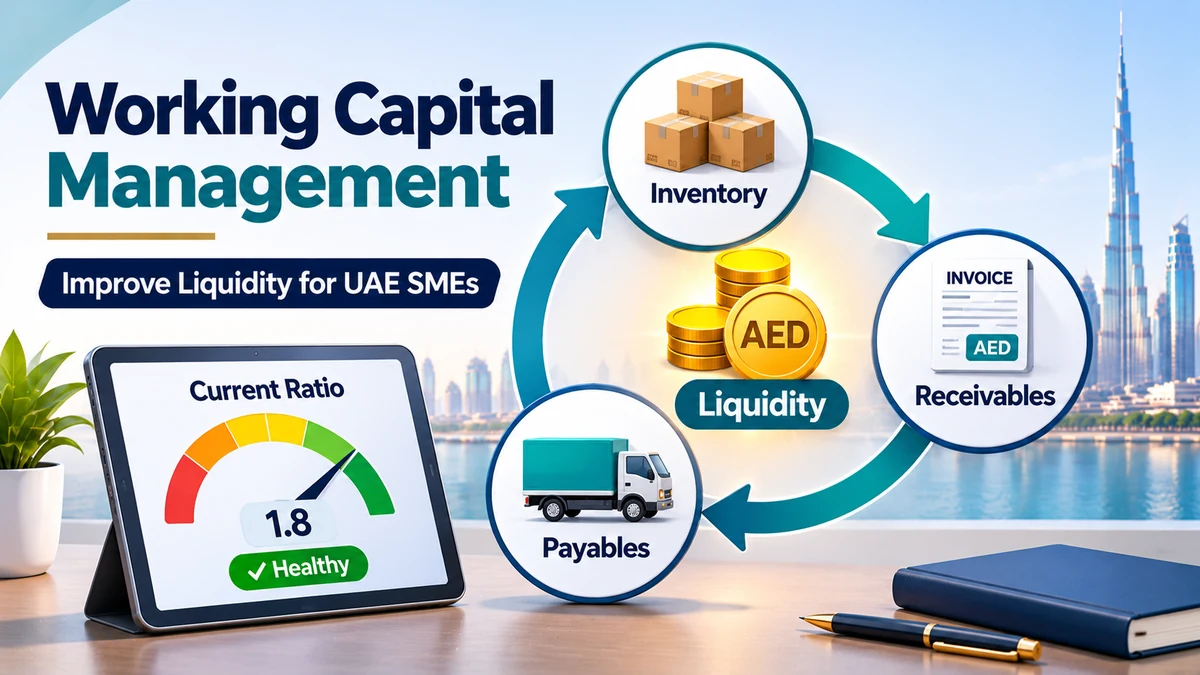
Working capital management UAE SMEs practise is the day-to-day control of a business’s short-term assets and liabilities, such as cash, receivables, inventory and supplier payables, so the company always has enough liquidity to run operations smoothly. Even a profitable business can struggle if too much of its money is tied up in unpaid invoices or slow-moving stock, while bills, salaries and rent keep falling due.
For small and medium-sized businesses in Dubai, Sharjah, Abu Dhabi and across the Emirates, strong SME liquidity management is essential. Long B2B payment terms, advance rent cheques, inventory-heavy trading models and quarterly VAT payments all put pressure on short-term cash. This guide explains what working capital is, how to calculate it, how the working capital cycle works, and the practical strategies UAE businesses can use to improve it.
What Is Working Capital?
Working capital is the difference between a business’s current assets and current liabilities. It shows how much short-term financial cushion a company has available to fund its daily operations.
- Current assets are resources expected to be converted into cash or used within 12 months, such as cash in bank, accounts receivable, inventory and prepaid expenses.
- Current liabilities are obligations due within 12 months, such as supplier payables, short-term loans, overdrafts, accrued salaries and VAT payable.
Positive working capital means the business has more short-term resources than short-term obligations. Negative working capital means short-term obligations exceed short-term resources, which may signal liquidity pressure.
How Is Working Capital Calculated?
The standard working capital formula UAE businesses use is the same internationally:
Working Capital = Current Assets – Current Liabilities
The related working capital ratio, also called the current ratio, measures how many dirhams of current assets a business has for every dirham of current liabilities:
Working Capital Ratio (Current Ratio) = Current Assets ÷ Current Liabilities
A stricter measure is the quick ratio, which excludes inventory and prepaid expenses because they cannot always be turned into cash quickly:
Quick Ratio = (Current Assets – Inventory – Prepaid Expenses) ÷ Current Liabilities
Working Capital Example in AED
Consider an illustrative Dubai-based trading SME with annual revenue of AED 1,800,000 and cost of goods sold of AED 1,260,000. Its balance sheet shows the following short-term position:
| Current Assets | AED | Current Liabilities | AED |
|---|---|---|---|
| Cash in bank | 85,000 | Trade payables (suppliers) | 210,000 |
| Accounts receivable | 240,000 | Short-term loan / overdraft | 60,000 |
| Inventory | 180,000 | Accrued salaries and staff costs | 25,000 |
| Prepaid rent | 30,000 | VAT payable | 20,000 |
| Total current assets | 535,000 | Total current liabilities | 315,000 |
Calculations:
- Working capital = 535,000 – 315,000 = AED 220,000
- Working capital ratio = 535,000 ÷ 315,000 = 1.70
- Quick ratio = (535,000 – 180,000 – 30,000) ÷ 315,000 = 325,000 ÷ 315,000 = 1.03
On the surface, the business looks healthy, with AED 1.70 of current assets for every AED 1 of short-term obligations. However, the quick ratio of 1.03 shows that much of that strength sits in inventory and prepaid rent. Only AED 85,000 is actually cash, while AED 240,000 is waiting to be collected from customers. This is a common pattern in working capital for small business trading companies in the UAE.
What Is a Good Working Capital Ratio for an SME?
There is no single ideal figure, as it depends on the industry, business model and payment cycles. As a general guide:
| Working Capital Ratio | What It Usually Indicates |
|---|---|
| Below 1.0 | Current liabilities exceed current assets. The business may struggle to meet short-term obligations without new funding or faster collections. |
| 1.0 to 1.2 | Tight liquidity. Bills can be covered, but there is little cushion for delays or unexpected costs. |
| 1.2 to 2.0 | Generally considered a comfortable range for many SMEs. |
| Above 2.0 | Strong liquidity, but it may also mean cash or inventory is sitting idle instead of being used productively. |
A retail or restaurant business that collects cash immediately may operate safely with a lower ratio, while a B2B contractor or distributor with long customer payment terms usually needs a higher ratio.
What Is the Working Capital Cycle?
The working capital cycle, also called the cash conversion cycle, measures how many days it takes for a business to turn cash spent on stock and operations back into cash received from customers. The shorter the cycle, the less money is tied up in operations.
The cycle has three components:
- Days Inventory Outstanding (DIO): how long stock sits before it is sold. Formula: (Inventory ÷ Cost of Goods Sold) × 365
- Days Sales Outstanding (DSO): how long customers take to pay. Formula: (Accounts Receivable ÷ Revenue) × 365
- Days Payables Outstanding (DPO): how long the business takes to pay suppliers. Formula: (Trade Payables ÷ Cost of Goods Sold) × 365
Working Capital Cycle = DIO + DSO – DPO
Working Capital Cycle Example
Using the same trading SME:
| Component | Calculation | Result |
|---|---|---|
| DIO | (180,000 ÷ 1,260,000) × 365 | 52 days |
| DSO | (240,000 ÷ 1,800,000) × 365 | 49 days |
| DPO | (210,000 ÷ 1,260,000) × 365 | 61 days |
| Working capital cycle | 52 + 49 – 61 | 40 days |
This means the business must fund roughly 40 days of operations from its own cash or borrowings before customer receipts catch up. Every day removed from this cycle releases cash back into the business.
What Causes Negative Working Capital?
Negative working capital occurs when current liabilities are greater than current assets. Common causes in UAE SMEs include:
- Using short-term debt to fund long-term assets: for example, financing a vehicle fleet, fit-out or machinery with an overdraft.
- Slow customer collections: receivables building up while supplier and payroll obligations continue.
- Operating losses: sustained losses gradually reduce cash and increase payables.
- Rapid growth: taking on larger orders that require more stock and staff before customers pay, often called overtrading.
- Excessive owner withdrawals: taking cash out of the business faster than it is generated.
- Large one-off outflows: annual rent cheques, licence renewals or tax payments without prior planning.
It is worth noting that some business models, such as supermarkets or subscription businesses that collect cash before paying suppliers, can operate with negative working capital deliberately. For most UAE SMEs, however, persistent negative working capital is a warning sign.
How Do Receivables Affect Liquidity?
Accounts receivable represent sales that have been made but not yet collected. Until customers pay, that money cannot be used to pay staff, suppliers or rent. In the UAE, where 60 to 90-day terms are common in B2B sectors such as construction, facilities management and distribution, receivables are often the largest drain on working capital.
In our example, if the business reduces its DSO by just 10 days, from 49 to 39 days, it would release approximately AED 49,300 in cash (AED 1,800,000 ÷ 365 × 10). That is cash generated without a single extra sale.
How Do Inventory Levels Affect Working Capital?
Inventory is cash sitting on shelves. Excess stock, slow-moving items and over-ordering tie up money that could be used elsewhere. At the same time, too little inventory can lead to lost sales and unhappy customers.
Using the same example, reducing DIO by 7 days, from 52 to 45 days, would release about AED 24,200 (AED 1,260,000 ÷ 365 × 7). Combined with the receivables improvement, the business would free up roughly AED 73,500 of cash, nearly doubling its current bank balance. This is the practical value of working capital optimization.
How Can SMEs Improve Working Capital? Practical Strategies
The following strategies are among the most effective for working capital management UAE businesses can apply.
1. Speed Up Customer Collections
- Issue accurate, VAT-compliant invoices immediately after delivery.
- Agree clear payment terms in writing before work begins.
- Request deposits or milestone payments on large projects.
- Send reminders before and on the due date, not only after it.
- Offer secure online payment options such as payment links and bank transfer details on every invoice.
- Review the receivables ageing report weekly and escalate overdue accounts early.
- Consider small early-payment discounts where the cost is lower than your borrowing cost.
2. Manage Inventory More Tightly
- Identify slow-moving and obsolete stock and clear it through promotions or bundles.
- Set reorder levels based on actual sales data rather than habit.
- Negotiate smaller, more frequent deliveries with suppliers.
- Use inventory or accounting software to track stock levels in real time.
3. Manage Supplier Payments Strategically
- Negotiate longer payment terms with key suppliers, especially as your purchase volume grows.
- Pay on the due date, not earlier, unless an early-payment discount makes it worthwhile.
- Maintain good supplier relationships. Paying late damages trust and may lead to stricter terms.
- Align supplier payment dates with your customer collection patterns where possible.
4. Plan for UAE-Specific Outflows
- Negotiate more rent cheques (for example, four or six instead of one or two) to spread the cost.
- Set aside VAT collected each month so the quarterly payment does not strain liquidity.
- Plan for corporate tax, licence renewals, visa renewals and end-of-service benefits in advance.
5. Use the Right Financing for the Right Purpose
- Fund long-term assets such as equipment or fit-outs with long-term finance, not short-term overdrafts.
- Arrange working capital facilities, trade finance or invoice discounting before you urgently need them.
- Compare the cost of financing against the benefit of faster growth or supplier discounts.
6. Monitor Working Capital Metrics Monthly
Track your working capital, working capital ratio, quick ratio, DSO, DIO and DPO every month. Trends matter more than a single month’s figure. A steadily rising DSO, for example, is an early signal of collection problems.
How Can Businesses Manage Supplier Payments and Customer Receivables Together?
The goal of effective SME liquidity management is to keep the gap between paying suppliers and collecting from customers as short as possible. If you pay suppliers in 30 days but collect from customers in 75 days, your business is funding a 45-day gap from its own cash. Closing that gap, whether by collecting faster, paying within agreed longer terms or holding less stock, directly improves working capital without needing additional revenue.
What Is the Difference Between Working Capital and Cash Flow?
Working capital and cash flow are related but measure different things:
| Aspect | Working Capital | Cash Flow |
|---|---|---|
| What it measures | Short-term financial position at a point in time | Movement of cash in and out over a period |
| Based on | Balance sheet (current assets and current liabilities) | Bank transactions and cash flow statement |
| Main question | Do we have enough short-term resources to meet short-term obligations? | Will we have enough cash on specific dates to pay our bills? |
| Typical use | Liquidity health check and operational efficiency | Timing, planning and forecasting |
A business can have positive working capital and still face a cash shortage if most of its current assets are tied up in receivables and stock. That is why working capital analysis should be combined with a forward-looking forecast. Our guide on how to build a cash flow forecast for a small business in the UAE explains that process in detail.
Common Working Capital Management Mistakes
- Focusing only on sales growth: growing revenue without managing receivables and stock can drain cash.
- Treating VAT collected as available cash: it belongs to the Federal Tax Authority and should be set aside.
- Funding long-term assets with short-term money: this weakens the working capital position.
- Ignoring the quick ratio: a good current ratio can hide heavy dependence on inventory.
- Not reviewing ageing reports: overdue invoices become harder to collect over time.
- Relying on outdated books: working capital figures are only reliable when bookkeeping and bank reconciliations are up to date.
Working Capital Management Checklist for UAE SMEs
- Calculate working capital, current ratio and quick ratio every month
- Track DSO, DIO and DPO and calculate the working capital cycle
- Review receivables ageing weekly and follow up overdue invoices
- Identify and clear slow-moving inventory
- Review supplier terms and renegotiate where possible
- Set aside VAT and plan for tax, rent, licence and visa payments
- Match long-term assets with long-term financing
- Keep bookkeeping and bank reconciliations up to date
Frequently Asked Questions
How do UAE businesses calculate working capital?
UAE businesses calculate working capital by subtracting total current liabilities from total current assets, using figures from an up-to-date balance sheet. The same formula applies across all emirates and free zones.
Is negative working capital always bad?
Not always. Some businesses that collect cash from customers before paying suppliers can operate safely with negative working capital. For most SMEs, however, it indicates liquidity risk and should be investigated.
How often should working capital be reviewed?
Most SMEs should review working capital monthly, after closing their books. Businesses that are growing quickly, have tight liquidity or depend on a few large customers may benefit from weekly monitoring of receivables and cash.
Can accounting software help with working capital management?
Yes. Modern accounting software can produce receivables and payables ageing reports, track inventory levels and generate balance sheet figures automatically, making it easier to monitor working capital metrics regularly.
Do banks look at working capital when approving finance?
Yes. Banks and lenders typically review the current ratio, receivables and overall liquidity position when assessing working capital facilities and other business finance applications.
Conclusion
Effective working capital management UAE SMEs adopt is one of the most direct ways to strengthen liquidity without increasing sales. By understanding the working capital formula, monitoring the working capital ratio, shortening the working capital cycle and actively managing receivables, inventory and supplier payments, business owners can free up cash, reduce reliance on borrowing and build a more resilient company.
Accurate working capital analysis starts with accurate books. If you need support with bookkeeping, receivables tracking, reconciliations or financial reporting, 360Bizs can help. Explore our accounting and bookkeeping services or contact our team to discuss your business needs.