

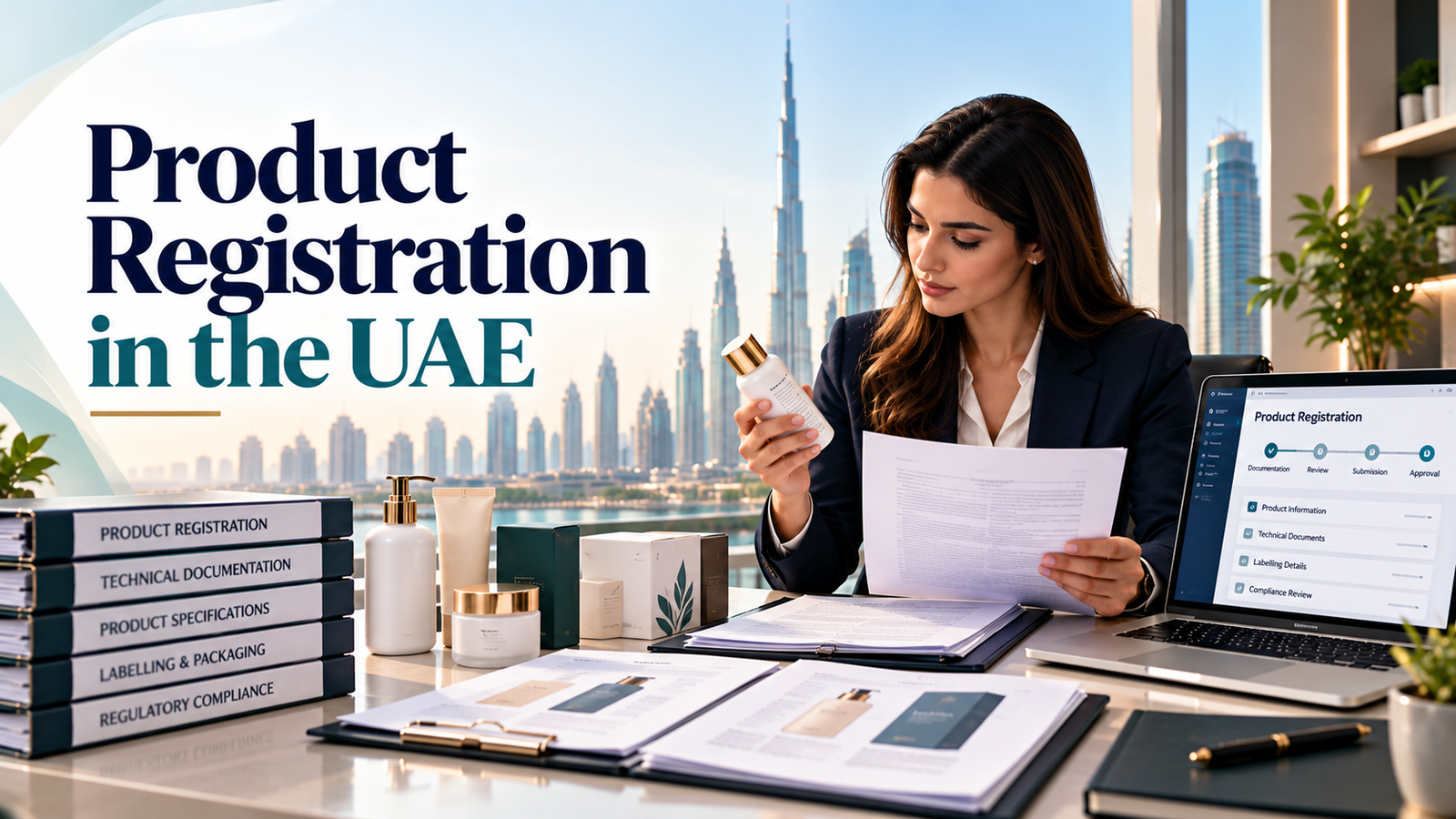
Businesses planning to import, manufacture, distribute, or sell products in the United Arab Emirates must understand the regulatory requirements that apply to their products. Depending on the product category, businesses may need product registration, conformity assessment, safety testing, specific certificates, or approval from the relevant authority before placing goods on the market.
Product registration in the UAE is the process of submitting product information and supporting documents to the relevant authority or regulatory system to establish that a product meets the applicable registration, safety, quality, or compliance requirements. The exact process depends on the product category, the emirate, and the regulatory framework involved.
For example, certain consumer products may require registration through Dubai Municipality’s Montaji system, while food products are subject to relevant food safety and registration requirements. Other regulated goods may require conformity assessment or certification through the Ministry of Industry and Advanced Technology (MoIAT) or another competent authority.
This guide explains how product registration works in the UAE, which products may need approval, what documents businesses should prepare, how to approach the registration process, and what to consider before importing or selling a product.
What Is Product Registration in the UAE?
Product registration is a regulatory process through which the relevant authority receives and assesses information about a product to determine whether it meets the requirements applicable to its category.
Depending on the product, the process may involve reviewing its composition, ingredients, technical specifications, safety characteristics, packaging, labelling, manufacturer details, or test reports.
Product registration and product certification are related but distinct concepts.
- Product registration generally involves recording and assessing a product through a designated regulatory system.
- Product certification involves demonstrating that a product meets specified standards or technical requirements through an applicable conformity assessment or certification process.
- Product approval is a broader term commonly used for permission or acceptance granted by a competent authority for a particular purpose.
- Product testing involves examining a product against specified technical, safety, or quality requirements.
A single product may be subject to more than one of these requirements. Registration in one system does not automatically replace every other certificate, import permit, or approval that may apply.
Businesses should therefore identify the exact regulatory pathway for their product rather than assume that every product follows the same registration process.
Which Products Need Registration in the UAE?
There is no single product registration checklist that applies identically to every product category across all UAE emirates. Requirements depend on the product’s intended use, composition, risk category, applicable standards, and the authority responsible for regulating it.
The following examples illustrate some of the categories that may be subject to registration, assessment, testing, or certification.
| Product category | Potential regulatory requirements |
|---|---|
| Cosmetics and personal care products | Applicable consumer product registration, ingredient and label review, and relevant safety requirements |
| Perfumes and fragrances | Product registration or assessment and applicable ingredient, labelling, and safety requirements |
| Food products | Applicable food registration, food safety, labelling, and import requirements |
| Dietary supplements and health-related products | Classification and approval requirements determined by the product’s ingredients, intended use, and applicable regulatory framework |
| Detergents and cleaning products | Applicable consumer product registration, safety assessment, and documentation |
| Food-contact materials | Relevant product registration or safety and conformity requirements |
| Electrical and electronic products | Applicable technical regulations, testing, and conformity assessment where required |
| Toys and children’s products | Applicable safety standards, testing, and conformity assessment where required |
| Building materials and industrial products | Product-specific technical standards, certification, or conformity assessment where applicable |
This table is illustrative, not an exhaustive list or a statement that every product in each category follows the same procedure.
For example, Dubai Municipality provides a service to register consumer products and food-contact materials through its Montaji system. Other products may fall under different regulatory frameworks.
The UAE Government’s official information on certificates and permits explains several types of conformity-related services, including National Marks for Conformity issued by MoIAT.
Before preparing an application, determine the exact product category and competent authority. This is the most important first step because it determines which documents, tests, fees, and approvals may be required.
Who Regulates Product Registration in the UAE?
Several authorities may be involved in product registration and compliance, depending on the product and its intended market.
1. Dubai Municipality
Dubai Municipality provides services for assessing and registering certain consumer products and food-contact materials through the Montaji system.
The system supports product-related processes and provides a way to verify information about registered consumer products. Relevant categories may include cosmetics, personal care products, perfumes, detergents, and other products within the authority’s scope.
Businesses should review the current requirements for the specific product category rather than rely on a general list.
Official resource: Dubai Municipality Services.
2. Ministry of Industry and Advanced Technology (MoIAT)
MoIAT is responsible for relevant national standards, conformity assessment schemes, and conformity marks.
Depending on the applicable technical regulation, a product may require a certificate of conformity or another form of regulatory evidence before it can be marketed or used.
The applicable scheme and requirements depend on the product. Businesses should not assume that all products need the same certificate or that one certification scheme covers every consumer good.
Official resource: UAE Government — Obtaining Certificates and Permits.
3. Food Safety Authorities
Food products are subject to food safety requirements and relevant registration procedures.
The competent authority can vary according to the product, import arrangements, and emirate. Dubai Municipality and the relevant authorities in other emirates oversee applicable local food safety functions, while federal frameworks also apply.
The UAE Government’s guidance on the National Food Accreditation and Registration System explains that food products covered by the applicable rules must be registered in the relevant system before being handled in the UAE market.
Food businesses should confirm the current registration system and import requirements applicable to their products.
4. Other Competent Authorities
Certain products, particularly those with specialised health, safety, technical, or industrial uses, may fall under additional regulatory frameworks.
The relevant authority depends on the product’s classification and intended use. Businesses should establish the correct regulatory pathway before importing goods, commissioning tests, or paying for certification.
What Documents Are Required for Product Registration in the UAE?
The required documents vary according to the product category, registration system, manufacturer, importer, and applicable regulations.
Some applications may require only a defined set of registration documents, while others involve technical documentation, laboratory testing, certificates, and detailed product information.
The following are common examples of documents businesses may need to prepare.
1. Valid Trade Licence
The applicant may need a valid UAE trade licence that permits the relevant business activity.
Depending on the procedure, the licence may need to cover activities related to importing, trading, distributing, manufacturing, or selling the relevant products.
Check that the company name, legal details, and licensed activities are consistent with the application.
2. Company Registration and Importer Information
Depending on the authority, the applicant may need company registration details, importer information, an importer code, or registration within the relevant online system.
For certain Dubai Municipality procedures, business registration requirements may include a valid licence and relevant importer details.
These requirements should be confirmed for the specific service and product category.
3. Product Specifications
Product specifications describe the item being submitted for assessment.
They may include:
- Product name and brand.
- Model or product identification.
- Intended use.
- Manufacturer details.
- Country of origin.
- Product composition or ingredients, where relevant.
- Technical specifications.
- Packaging information.
- Product variants, sizes, or formulations.
The information should be consistent with the product being manufactured, imported, or marketed.
4. Product Label and Packaging Artwork
The authority may require a copy of the proposed label, packaging artwork, or photographs showing the product and its packaging.
The purpose is to assess whether the information presented to consumers complies with the applicable requirements.
Depending on the category, the review may cover ingredients, warnings, directions for use, manufacturer or importer details, country of origin, batch information, expiry dates, or other required particulars.
The exact labelling rules differ by product type. Businesses should not assume that the same language or label format applies to all products.
5. Certificate of Free Sale
A Certificate of Free Sale may be required for certain products and registration pathways.
Such a document can provide evidence that a product is legally marketed or sold in the relevant country or jurisdiction, subject to the certificate’s scope and the authority’s requirements.
However, it is not a universal requirement for every UAE product registration application.
Confirm whether the certificate is required, which issuing authority is acceptable, and whether authentication or legalisation is necessary.
6. Laboratory Test Reports
Some products require test reports demonstrating compliance with relevant safety, composition, quality, or technical requirements.
The type of test depends on the applicable standard or regulation.
For example, a regulated electrical product may require evidence relating to electrical safety, while a cosmetic product may require different supporting information based on its category and applicable requirements.
Ask the competent authority or an appropriately qualified testing provider which tests and laboratory accreditations are accepted.
7. Manufacturer Certificates and Supporting Documents
Additional documents may include:
- Manufacturer declarations or authorisation letters.
- Relevant quality management or manufacturing certificates.
- Product safety information.
- Ingredient or composition reports.
- Applicable conformity certificates.
- Halal documentation where required.
- Other category-specific declarations or approvals.
Not every application requires every item on this list. A product-specific checklist should be obtained before documents are commissioned or submitted.
Step-by-Step: How to Register a Product in the UAE
Although the exact process differs between authorities, most product registration projects can be organised into the following stages.
Step 1: Identify the Product Category
Begin by establishing exactly what the product is, what it contains, and how it will be used or marketed.
A product’s brand name alone is not enough to determine its regulatory category. Ingredients, technical characteristics, intended use, and claims may influence its classification.
For example, products marketed as ordinary consumer goods may be treated differently if they make specific medical or therapeutic claims.
If the classification is unclear, seek clarification from the competent authority before selecting an application route.
Step 2: Identify the Relevant Authority
Once the product category is established, determine which authority or registration system applies.
For example:
- Certain consumer products and food-contact materials may fall under Dubai Municipality’s Montaji system.
- Food products may require registration through the applicable food safety system.
- Regulated technical products may require a conformity assessment through the relevant scheme.
The correct route depends on the product, intended market, and current regulatory requirements.
Step 3: Confirm Company Eligibility
Check whether the applicant needs a particular trade licence, business activity, importer registration, or other company-level prerequisite.
Some procedures require a licensed local business or an appropriately registered importer.
Where an agent or representative submits the application, confirm the authority’s rules for authorisation and representation.
Step 4: Prepare the Product Dossier
Create a structured file containing the product information and supporting documents required for the specific application.
Check that the product name, brand, manufacturer details, ingredients or specifications, label artwork, and other information are consistent.
If the authority requires testing or certification, arrange the appropriate assessment through an accepted provider.
Step 5: Submit the Application
Submit the required information through the relevant official portal or procedure.
For consumer products within Dubai Municipality’s scope, the Montaji system provides the relevant product registration service.
Review the application carefully before submission. Incorrect classification, missing documents, or inconsistent product details can lead to additional requests.
Step 6: Respond to Technical or Documentation Queries
The authority may request clarification, further documents, revised labels, additional testing, or other information.
Respond according to the instructions and deadlines provided.
If a label or product formulation changes, determine whether the change affects the application or requires an update to an existing registration.
Step 7: Obtain and Verify the Relevant Approval
If the application satisfies the applicable requirements, the authority may issue the relevant registration, approval, certificate, or other confirmation.
Review the issued document carefully, including the product identity, scope, validity, conditions, and any limitations.
Do not assume that an approval automatically covers every product variant, formulation, brand, or intended use.
Step 8: Confirm Import and Market-Release Requirements
Product registration may be only one part of the compliance process.
Depending on the product and shipment, additional requirements may apply, such as customs documentation, import permits, conformity documents, or consignment-release procedures.
Confirm the requirements before arranging shipment or placing the product on sale.
How Long Does Product Registration Take in the UAE?
There is no single processing time that applies to every product registration application in the UAE.
The timeline depends on the competent authority, product category, completeness of the application, testing requirements, and whether additional information or corrections are requested.
An application that requires only a defined administrative review may follow a different timeline from one requiring laboratory testing, technical assessment, or additional approvals.
Factors that can affect the process include:
- Missing or inconsistent documents.
- Incorrect product classification.
- Incomplete label or packaging information.
- Laboratory testing requirements.
- Delays in obtaining manufacturer documents.
- Requests for clarification from the authority.
- Additional approvals or import-related procedures.
Businesses should obtain the current estimated processing time from the relevant authority or accepted service provider.
Avoid making purchasing, shipping, or launch commitments based on an assumed approval date.
Does Every Product Require Registration or Approval?
No. It is not accurate to say that every product sold in every part of the UAE requires the same product registration procedure.
Some products are subject to specific registration or conformity requirements, while others may be governed by different safety, labelling, import, or general trading rules.
The correct approach is to identify the product category and verify the applicable requirements.
Before importing or selling a product, ask:
- Is this product covered by a mandatory registration or conformity scheme?
- Which authority is responsible for the product category?
- Is product registration separate from import clearance or customs documentation?
- Are laboratory testing or specific certificates required?
- Does the approval apply to the product, the manufacturer, the importer, or a particular model?
- Are there additional requirements in the intended emirate or sales channel?
Answering these questions early can help businesses avoid applying through the wrong system or paying for unnecessary services.
Do Imported Products Need Registration in the UAE?
Imported products may require registration, conformity assessment, or other approvals depending on their category and the applicable rules.
Importing a product that is legally sold in another country does not automatically mean it can be marketed in the UAE without further checks.
For example, certain consumer products may need registration or assessment through the relevant local system, while some technical products may require evidence of conformity with applicable UAE standards.
Businesses importing goods should review both product compliance and shipment-related requirements.
A useful preparation process includes:
- Identifying the product category and intended use.
- Confirming the applicable registration or conformity requirements.
- Checking whether the manufacturer has the required technical documents.
- Verifying label and packaging compliance.
- Confirming any necessary importer registration or customs code.
- Checking whether an import permit or consignment-release procedure applies.
- Confirming that the product has the necessary approval before the relevant market activity begins.
For Dubai consumer product procedures, consult Dubai Municipality’s official services. The municipality also provides a service for permits relating to imported consumer product consignments, where applicable.
What Happens if a Product Is Sold Without Required Approval?
Selling or distributing a product without a required registration, certificate, or approval can expose a business to regulatory and operational risks.
The consequences depend on the product, applicable law, the nature of the non-compliance, and the action taken by the competent authority.
Potential consequences may include:
- Refusal of an application or shipment release.
- Delays in import or distribution.
- Restrictions on selling or distributing the product.
- Requests to correct labels or provide additional evidence.
- Product withdrawal, recall, or other corrective action where required.
- Administrative penalties or other legal consequences under the applicable rules.
- Commercial losses caused by delayed launches or unsellable inventory.
These are possible outcomes, not automatic consequences for every missing document.
The best way to reduce risk is to verify the applicable requirements before importing goods, distributing them, or launching a product.
If a product is already on the market and a compliance issue is discovered, the business should obtain appropriate professional guidance and follow the competent authority’s instructions.
Common Product Registration Mistakes Businesses Should Avoid
1. Choosing the Wrong Registration Authority
A business may assume that one general product registration process covers every category.
How to avoid it: Confirm the product classification and responsible authority before preparing the application.
2. Submitting Incomplete Documents
Missing manufacturer details, incomplete specifications, or absent supporting certificates may lead to additional requests.
How to avoid it: Use a checklist based on the actual application procedure and verify each document before submission.
3. Using Incorrect or Outdated Labels
Packaging may contain incomplete product information, unsupported claims, or details that do not match the submitted application.
How to avoid it: Review the current labelling requirements and ensure the submitted artwork matches the intended commercial product.
4. Assuming a Foreign Certificate Is Automatically Accepted
A certificate issued in another country may not meet the specific evidence or authentication requirements of the UAE authority.
How to avoid it: Confirm the accepted issuing bodies, document format, and any authentication requirements in advance.
5. Ignoring Product Variants
Different ingredients, formulations, models, sizes, or intended uses may affect the scope of an approval.
How to avoid it: Ask whether each variant requires a separate submission or can be included within one application.
6. Importing Before Checking Compliance
Arranging shipment before confirming the required approvals can create avoidable costs and delays.
How to avoid it: Complete the product classification and regulatory review before dispatching goods.
7. Assuming Registration Replaces All Other Approvals
Product registration may not replace customs registration, import permits, technical conformity requirements, or other applicable obligations.
How to avoid it: Prepare a compliance checklist covering the product, company, import process, and intended market.
Practical Checklist Before Applying for Product Registration in the UAE
Use this checklist to organise your preparation.
- Identify the product’s category, intended use, and composition or technical specifications.
- Confirm the competent authority and applicable registration system.
- Verify whether registration, conformity assessment, testing, or additional approval is required.
- Confirm the applicant’s trade licence and importer eligibility.
- Obtain the required manufacturer and company documents.
- Prepare accurate product specifications and supporting information.
- Check label and packaging requirements.
- Confirm whether a Certificate of Free Sale or other certificates are required.
- Determine whether laboratory testing is necessary and which reports are accepted.
- Verify the current fees and estimated processing time.
- Submit the application through the appropriate channel.
- Respond promptly to any requests for clarification.
- Verify the approval’s scope and conditions before marketing the product.
- Check any additional import and consignment-release requirements.
This checklist is a starting point. The final document list must be based on the relevant authority’s current requirements for the specific product.
How 360Bizs Can Help With Product Registration and Certification Support
Businesses entering the UAE market may need to coordinate product documentation, registration requirements, conformity assessment, and other compliance-related procedures.
360Bizs offers product certification support services in Dubai to assist businesses with understanding applicable product registration and certification processes.
Depending on the product category and agreed scope, relevant support may include helping organise documentation, identify applicable procedural requirements, and coordinate the registration or certification process with the appropriate parties.
Before proceeding, businesses should discuss their specific product, manufacturer, intended market, and existing certificates to establish which requirements apply.
It is important to distinguish between administrative assistance and regulatory approval: the competent authority or authorised certification body makes the relevant decision. Professional support does not guarantee that an application will be approved.
For businesses planning to import or distribute regulated products, addressing these requirements before shipment can help create a more organised market-entry process.
Frequently Asked Questions About Product Registration in the UAE
1. What is product registration in the UAE?
Product registration is the process of submitting product information and supporting documents to the relevant authority or registration system to meet the applicable requirements for a particular product category.
2. Which products need registration in the UAE?
Certain cosmetics, personal care products, food products, detergents, food-contact materials, and other regulated goods may require registration or approval. Requirements vary by product category, intended use, and competent authority.
3. Which authority handles product registration in Dubai?
Dubai Municipality provides product registration services for certain consumer products and food-contact materials through the Montaji system. Other products may fall under different authorities or conformity assessment schemes.
4. What documents are required for product registration in the UAE?
Depending on the product, documents may include a valid trade licence, company or importer information, product specifications, label artwork, manufacturer details, test reports, and relevant certificates. The final checklist depends on the applicable procedure.
5. How does the product registration process work?
The process generally involves identifying the product category, confirming the competent authority, checking applicant eligibility, preparing documents, submitting the application, responding to queries, and obtaining the relevant approval or registration where the requirements are met.
6. Does every product require approval before being sold in the UAE?
No. Requirements vary by product category and regulatory framework. Businesses should verify whether their specific product requires registration, conformity assessment, import approval, or another form of compliance.
7. How long does product registration take in the UAE?
Processing times vary according to the authority, product category, documentation, and testing requirements. Businesses should obtain a current estimate for their specific application.
8. Do imported products need registration in the UAE?
Some imported products require registration or conformity assessment before they can be marketed, while others may be subject to different requirements. Importers should verify the applicable rules before shipping goods.
9. What happens if a product is sold without required approval?
Depending on the applicable rules, non-compliance may lead to restrictions on sale, shipment delays, corrective action, product withdrawal, or administrative penalties. The actual consequences depend on the circumstances and competent authority.
10. Can a product registration consultant guarantee approval?
No. A consultant may help prepare documents and coordinate the application, but the relevant authority or certification body determines whether the product meets the applicable requirements.
Conclusion
Product registration in the UAE requires businesses to understand the regulatory framework applicable to their products before importing, manufacturing, distributing, or selling them.
The process may involve company documentation, product specifications, label review, testing, certificates, and approval from the relevant authority. However, the exact requirements depend on the product category and intended market.
The most effective starting point is to identify the product correctly, confirm the competent authority, obtain the current document checklist, and address any testing or certification requirements before committing to a launch or shipment.
For businesses that need assistance navigating these procedures, 360Bizs provides product certification support services in Dubai. The appropriate support depends on the product and its specific regulatory requirements.
Disclaimer: This article provides general educational information and is not legal or regulatory advice. UAE product registration, technical standards, documentation requirements, and approval procedures may change and can differ between product categories and emirates. Verify current requirements with the competent authority before importing or selling a product.