
Table of Contents
- The Wrong Question Most Founders Are Asking
- What a Dubai Free Zone Company Actually Gives You
- What a US LLC Actually Gives You
- The Key Differences Side by Side
- When You Need a Dubai Free Zone Company
- When You Need a US LLC
- When You Need Both — and How the Structure Works
- The UAE Tax Risk Nobody Mentions About a US LLC
- Compliance: What Each Structure Requires Ongoing
- Which One Should You Set Up First?
- Frequently Asked Questions
- Final Thoughts
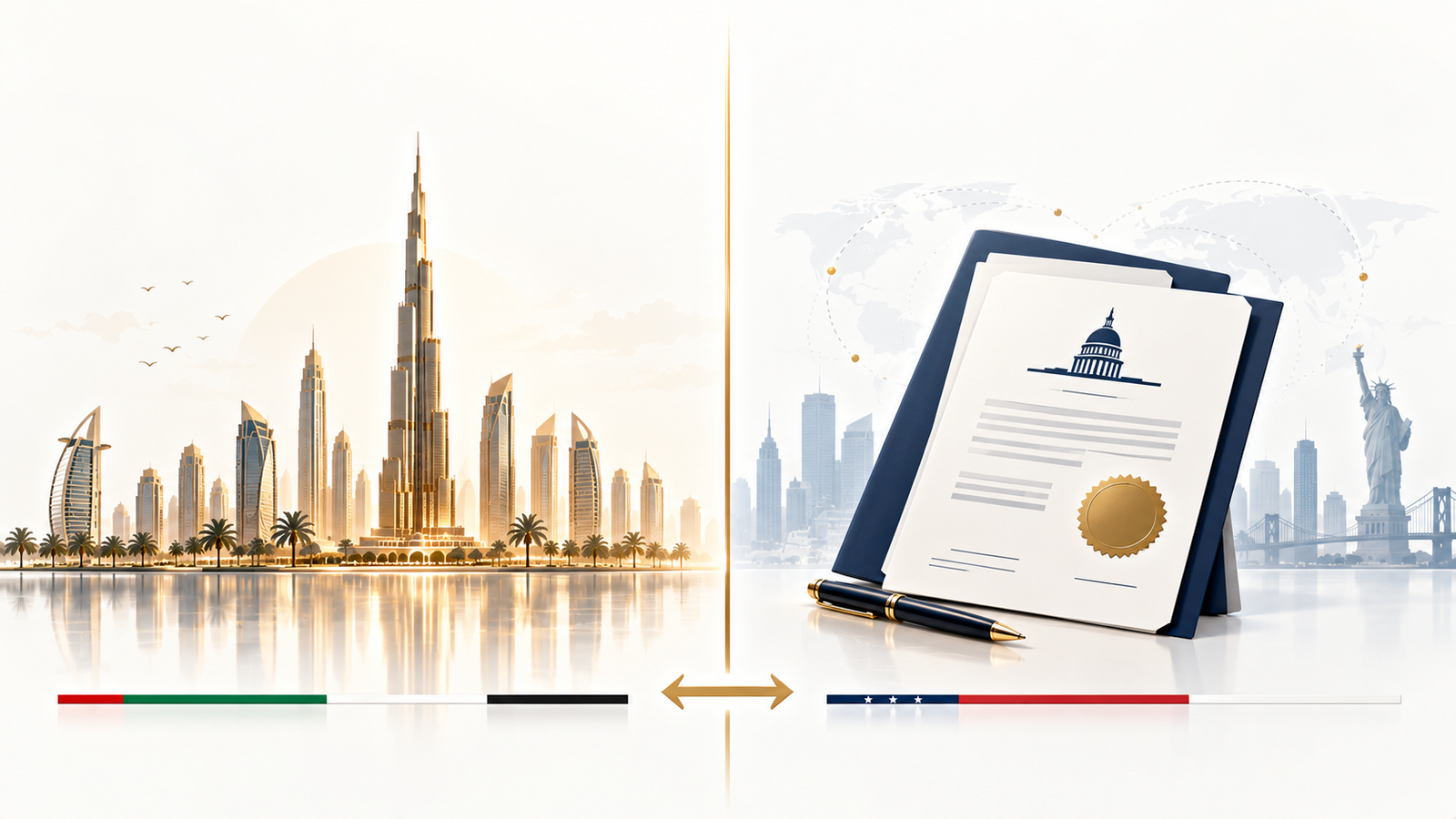
Dubai free zone vs US LLC is one of the most searched business structure comparisons online, and almost every article covering it gets the framing wrong before the first paragraph ends. The comparison implies these two structures are competing answers to the same question. They are not. A Dubai free zone company and a US LLC formed by a non-US resident answer two entirely different questions — and understanding that distinction is the only starting point that leads to a useful decision.
This guide explains what each structure actually does, where each one is the right tool for the job, and why a growing number of internationally mobile founders end up using both rather than choosing between them.
1. The Wrong Question Most Founders Are Asking
The comparison usually starts with: “Which one has better tax?” That is the wrong starting point for two reasons.
First, the tax position of a US LLC for a non-US resident is not primarily about a rate — it is about whether a structure is correctly set up and maintained, and whether your home country’s rules on the income still apply regardless. Second, the UAE corporate tax position for a free zone company is not automatically 0% for all income — it is conditional on the Qualifying Free Zone Person regime and all its conditions being met simultaneously.
A better starting question is: what problem am I actually trying to solve? A Dubai company solves where you base your life, your residency, and your tax position. A US LLC solves how your business interacts with US financial infrastructure — payment processors, US banking, and US-facing platforms. Those are two different problems, and conflating them is what leads founders to set up the wrong structure, expect the wrong outcome, and be surprised when neither delivers what the other was supposed to.
2. What a Dubai Free Zone Company Actually Gives You
A Dubai free zone business setup is a decision about where you base your business and your life. Here is what it actually delivers:
A UAE trade licence and legal operating entity. 100% foreign ownership, no requirement for a UAE national partner, and a trade licence covering your specific business activity — established in three to seven business days for most standard activities.
A UAE residency visa and Emirates ID. The free zone company sponsors you for a two-year renewable investor visa. This is genuine UAE residency — you can open personal bank accounts, sign lease agreements, access healthcare, and sponsor family members. It is not a mailbox or a nominee arrangement.
A pathway to genuine UAE tax residency. UAE personal income tax is 0% and there is no capital gains tax on individuals. Establishing genuine UAE tax residency — separate from the immigration visa and assessed by the Federal Tax Authority on its own qualifying criteria — is the foundation of the tax position many founders are seeking.
UAE corporate banking. A UAE corporate bank account, in a respected, internationally connected financial centre with SWIFT access, multi-currency capability, and integration with major payment networks.
A route to the UAE Golden Visa. Founders who later purchase UAE property above AED 2,000,000 can upgrade from a company-sponsored two-year visa to a ten-year Golden Visa — one of the most secure long-term residency pathways available globally.
What it does not give you: native Stripe access as a US merchant, a US business bank account, or the ability to bill clients who require a US entity on their invoices. A Dubai free zone company is excellent at solving the residency, tax-base, and banking problems. It does not solve the US payment infrastructure problem.
3. What a US LLC Actually Gives You
A US LLC formed by a non-US resident is a decision about commercial infrastructure, not about where you live or what your tax base is. Here is what it actually delivers:
Access to US payment processing. Stripe, PayPal, Shopify Payments, and most major US payment platforms approve US-registered entities at significantly higher rates and lower friction than non-US entities. If your business has hit a wall on Stripe as a non-US entity, a US LLC is the structural fix.
A real US business bank account. With an EIN (Employer Identification Number) and a US LLC, online US banks including Mercury, Relay, and Wise Business allow non-US residents to open genuine US business accounts remotely — USD wires, debit card, integration with US payment platforms.
Access to US marketplace platforms. Amazon US, TikTok Shop, Shopify Payments, and US affiliate networks that pay only to US bank accounts all become accessible with a properly formed US LLC and US banking in place.
A US business identity. Some clients, particularly US corporates, prefer or require a US entity on their invoices. A US LLC provides that identity without requiring you to relocate, become a US tax resident, or change anything about your personal life.
What it does not give you: UAE residency, a UAE bank account, UAE corporate structure, or any tax benefit in the UAE. A US LLC managed from Dubai does not reduce your UAE tax obligations — a point covered in full in Section 8, because it is the most commonly misunderstood aspect of the entire comparison.
4. The Key Differences Side by Side
| Factor | Dubai Free Zone Company | US LLC (Non-Resident) |
|---|---|---|
| Primary purpose | Life base, residency, tax position | US commercial infrastructure |
| UAE residency visa | Yes — 2-year renewable investor visa | No |
| UAE tax residency pathway | Yes — via FTA qualifying criteria | No |
| UAE personal income tax | 0% (UAE residents) | Not applicable |
| Corporate tax (UAE) | 0% qualifying / 9% standard | May apply if managed from UAE |
| US Stripe and PayPal access | Limited friction as non-US entity | Yes — domestic US merchant |
| US bank account | No | Yes — Mercury, Relay, Wise Business |
| 100% foreign ownership | Yes | Yes |
| Formation timeline | 3–7 business days | 5–10 business days |
| Annual compliance | Licence renewal, audited accounts, UAE CT | Form 5472 + pro-forma 1120 (mandatory) |
| Long-term residency pathway | Yes — Golden Visa route | No |
| Best suited to | Founders relocating or basing life in UAE | Founders needing US payment access regardless of where they live |
5. When You Need a Dubai Free Zone Company
A free zone company setup is the right starting structure when:
You want to relocate to the UAE or establish genuine UAE-based residency. The two-year investor visa that comes with a free zone company is a genuine immigration status, not a nominal arrangement. If UAE residency is on your list, the free zone company is the most accessible and cost-effective way to obtain it.
Your home country tax rate is taking a significant share of income and you want to restructure around a lower-tax base. The UAE’s 0% personal income tax becomes meaningful once your revenue reaches a level where the setup and annual maintenance costs are clearly outweighed by the tax saving. The case is compelling at higher revenue levels and more marginal at lower ones — be honest about which side of that line you are on.
Your business serves international clients and is not dependent on UAE local trading. Most free zone companies cannot trade directly with UAE mainland customers without a distributor arrangement or a separate mainland entity. If your clients are predominantly outside the UAE, this is typically not a limitation.
You want a stable, long-term base with genuine substance. A free zone company requires real engagement with UAE residency — it works best as a genuine operating base, not a nominal address.
6. When You Need a US LLC
A US LLC is the right structure when:
You keep running into payment processing friction as a non-US entity. This is the most common trigger. Stripe declines, PayPal limitations, Amazon seller account restrictions, and affiliate network payout requirements that mandate US banking all point to the same solution: a US-registered entity with a US business bank account.
Your clients or platforms expect a US entity on invoices. Some US corporates, agencies, and platforms have procurement or compliance requirements that favour or require US-registered counterparties. A US LLC satisfies this without relocating.
You need US banking infrastructure regardless of where you live. A UAE company cannot open a US business bank account. A US LLC can, and for founders whose business depends on USD payment rails, this is a structural necessity rather than a preference.
You do not need or want to relocate. A US LLC requires no US presence, no US address, and no change to your personal life. It is a commercial tool that works from wherever you are — including Dubai.
7. When You Need Both — and How the Structure Works
The most common structure for internationally mobile digital founders is not a choice between the two — it is both, with each doing its specific job:
You (UAE resident) → owns → UAE Free Zone Company → owns → US LLC
This ownership structure matters. When the UAE company owns the US LLC rather than the founder personally holding both separately, the profit distribution from the US LLC flows up to the UAE entity, where it is assessed under UAE corporate tax rules. The US LLC files its annual compliance forms and typically generates no US federal tax liability for a non-US resident with no US-source effectively connected income.
The practical flow:
- US customers and platforms pay into the US LLC, which holds a US bank account and Stripe account
- Profits distribute upward from the US LLC to the UAE free zone company
- The UAE entity holds the economic substance of the business, maintains UAE banking, and is the home for ongoing compliance
- The founder draws salary or dividends from the UAE entity, paying 0% UAE personal income tax on those distributions
This structure works cleanly when set up correctly. Two conditions need to be maintained: the US LLC files its annual Form 5472 and pro-forma 1120 regardless of tax owed (the penalty for missing this is $25,000 per failure), and the management and control of the US LLC genuinely sits with the UAE entity rather than creating a permanent establishment question that the next section covers.
8. The UAE Tax Risk Nobody Mentions About a US LLC
This is the most commonly omitted point in every Dubai-vs-LLC comparison, and it matters enough to deserve its own section.
A US LLC is a US legal entity. Its US federal tax position as a foreign-owned disregarded entity is well understood — no US federal income tax on profits where there is no US-source effectively connected income and no US physical presence. However, the UAE side of the equation is separate.
If a founder is based in Dubai and actively managing a US LLC from there — making decisions, running operations, directing activity — the UAE’s corporate tax rules can treat the LLC as having a permanent establishment in the UAE. Where a permanent establishment exists, UAE corporate tax applies to the profits attributable to that establishment, regardless of where the entity is incorporated.
The practical implication: a US LLC set up by a Dubai-based founder, managed from Dubai, and used as the primary trading entity is not automatically outside UAE corporate tax. The structure described in Section 7 — where the UAE company owns the LLC and the LLC operates as a commercial front rather than the controlling entity — is specifically designed to address this risk. Simply owning a US LLC personally while living and working in Dubai without a UAE entity in the chain above it leaves the permanent establishment question open and unresolved.
This is not a reason to avoid a US LLC. It is a reason to structure it correctly from the start rather than discovering the issue when a UAE VAT and corporate tax advisory review surfaces it later.
9. Compliance: What Each Structure Requires Ongoing
Both structures have ongoing compliance obligations that must be managed actively. Neither is a set-and-forget arrangement.
Dubai Free Zone Company:
- Annual trade licence renewal — mandatory, and a lapsed licence puts the linked residency visa at risk
- Audited financial statements — required in most free zones annually, regardless of turnover
- UAE corporate tax registration — mandatory for all entities regardless of expected liability
- VAT registration — mandatory once taxable supplies exceed AED 375,000 over 12 months
- Residency visa renewal — every two years for the standard investor visa
US LLC (Non-Resident Owned):
- Form 5472 and pro-forma Form 1120 — mandatory annually regardless of revenue or tax owed; $25,000 penalty per missed filing
- Registered agent renewal — annual, typically $50–$200 depending on provider
- State annual report — Wyoming’s is approximately $60; Delaware’s franchise tax is $300
- EIN maintained and correctly reflected on all filings
For founders running both structures, having one advisory relationship that understands how the two entities interact — rather than two separate advisors treating each in isolation — is what keeps the compliance calendar manageable and the risks identified before they become penalties.
10. Which One Should You Set Up First?
The answer depends on the problem you need to solve most urgently.
If you need UAE residency or want to relocate: set up the Dubai free zone company first. Once the company exists and you are in the UAE, the residency visa process begins from day one of your arrival rather than waiting while a US LLC is being formed.
If you are hitting a Stripe or payment processing wall right now and cannot wait: form the US LLC first. It is operational with banking in place within seven to ten business days. UAE residency can follow.
If you are planning both: the most common sequence is UAE company first (to establish residency), then US LLC shortly after (to solve the payment infrastructure problem), with the US LLC owned by the UAE company from the outset rather than restructuring ownership later.
What does not work: setting up a US LLC first, personally, and then trying to restructure it under a UAE company after the fact when banking and Stripe are already live. This creates unnecessary complexity. Ownership structure is considerably easier to get right at the start than to change once accounts are open and relationships are established.
11. Frequently Asked Questions
What is the difference between a Dubai free zone company and a US LLC? A Dubai free zone company gives you a UAE legal entity, UAE residency, UAE banking, and a pathway to UAE tax residency. A US LLC gives a non-resident access to US payment processing, US banking, and US commercial infrastructure. They solve different problems — one is about where you base your life and business, the other is about accessing the US financial system from wherever you are.
Can a US LLC give me UAE residency? No. UAE residency requires a UAE-based entity — a free zone or mainland company that sponsors an investor visa — or a qualifying UAE property purchase. A US LLC, regardless of where it is managed from, confers no UAE immigration status.
Does a Dubai free zone company give access to Stripe and PayPal? Not on the same terms as a US entity. Stripe and PayPal apply different approval processes and fee structures to non-US entities. A US LLC with a US bank account and EIN is the structural solution for founders who need native US merchant access.
Do I need both a Dubai company and a US LLC? Many founders do. A Dubai free zone company handles residency, UAE banking, and the tax base. A US LLC handles US payment processing, US banking, and US platform access. Neither does what the other does, and for internationally oriented digital businesses, both are often necessary rather than optional.
Does a Dubai free zone company always pay 0% corporate tax? No. The 0% rate applies to qualifying income earned by a Qualifying Free Zone Person that meets all six QFZP conditions simultaneously, every tax period. Non-qualifying income is taxed at 9%. Free zone registration alone is not sufficient — the conditions must be assessed and maintained.
Is a US LLC managed from Dubai subject to UAE corporate tax? Potentially yes. Where a founder based in Dubai actively manages a US LLC from the UAE, UAE corporate tax rules can treat the LLC as having a permanent establishment in the UAE, making its profits subject to UAE corporate tax. Structuring the US LLC under a UAE entity rather than holding it personally is the standard way to address this risk.
What does a US LLC give a non-resident that a Dubai company does not? A US LLC gives a non-US resident access to Stripe, PayPal, Amazon US, TikTok Shop, Shopify Payments, and a real US business bank account — all of which are either unavailable or significantly restricted for non-US entities. It also provides a US business identity for clients who prefer or require US counterparties on invoices.
Which structure should I set up first? If UAE residency is the priority, set up the Dubai free zone company first. If Stripe or US payment access is the urgent problem, form the US LLC first. If you are planning both, the most practical sequence is UAE company first, then US LLC owned by the UAE entity.