
Table of Contents
- Why the “0% vs 9%” Debate Misses the Point
- Three Things People Wrongly Bundle Together
- The Tiered System: How UAE Corporate Tax Actually Works
- The 0% Tier: Who Pays Nothing and Why
- The Qualifying Free Zone Person Regime
- The QFZP Conditions: All of Them, Not Just the Easy Ones
- The De Minimis Limit and the Five-Year Penalty
- Dividends and Capital Gains: The Participation Exemption
- Small Business Relief: The AED 3 Million Route
- Natural Persons and Freelancers: The AED 1 Million Line
- The 15% Tier: Almost Certainly Not Your Problem
- Registration, Filing and Penalties
- Frequently Asked Questions
- Final Thoughts
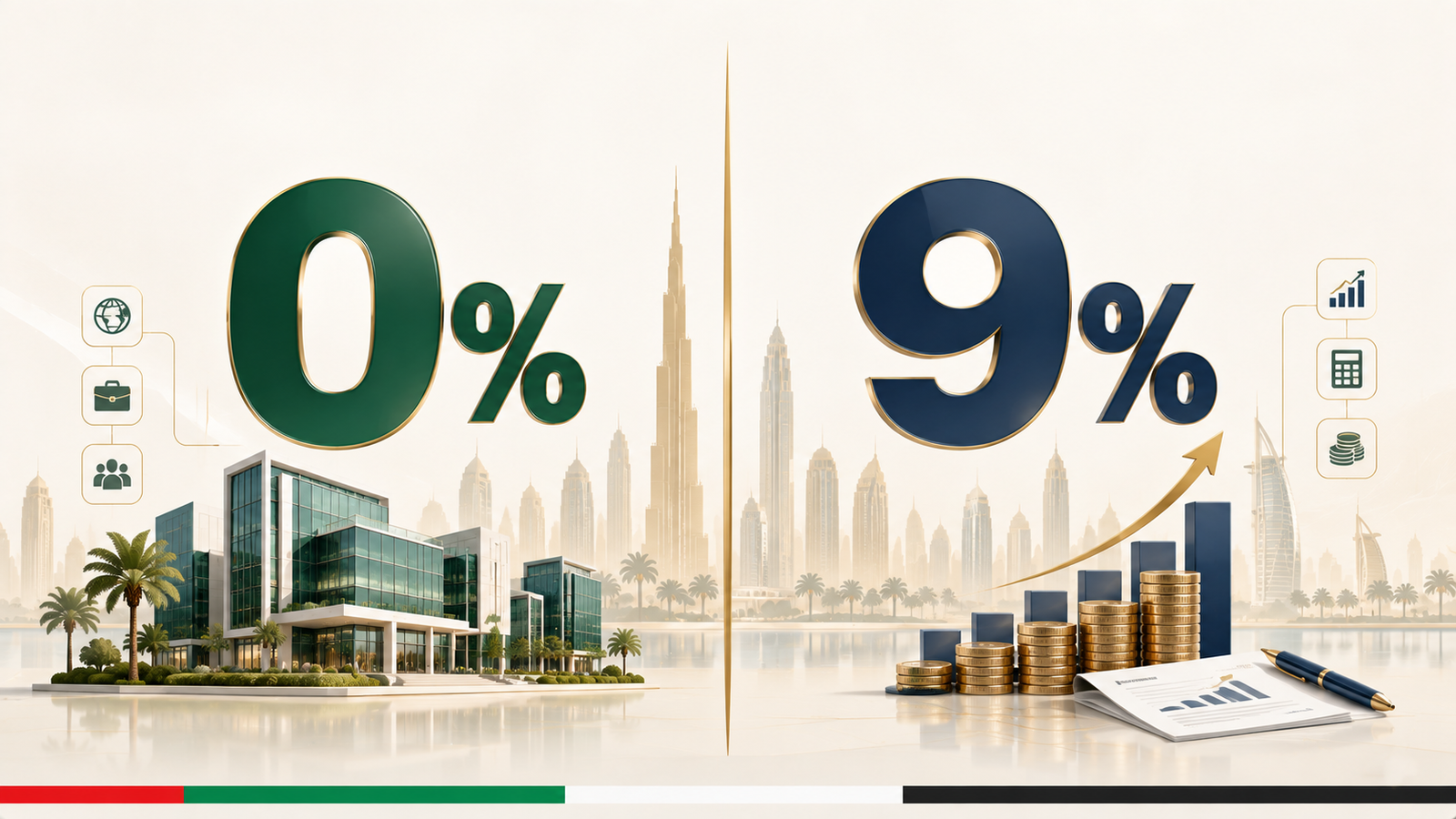
UAE corporate tax is not a single rate. Ask ten founders what they pay on their Dubai company’s profits and you will get two answers that directly contradict each other — half will say zero, the other half will say 9%. Both are describing one part of a tiered system and ignoring the rest. The rate that actually touches your company depends on what you are, where you are registered, what your income comes from, and which reliefs you qualify for.
This guide takes the law as it stands, explains each tier plainly, and makes clear which one applies to which kind of business — without simplifying to the point of being wrong.
1. Why the “0% vs 9%” Debate Misses the Point
The shorthand that “Dubai is tax-free” is outdated since June 2023, when Federal Decree-Law No. 47 of 2022 came into effect. The shorthand that “Dubai now taxes you 9% and the advantage is gone” is equally wrong as a blanket statement. Both circulate because each captures one tier of a three-tier system and presents it as the whole picture.
The correct framing: UAE corporate tax is a tiered structure with different outcomes depending on your company type, income source, and the reliefs you claim. Many businesses pay nothing, because the law provides several routes to 0%. Others pay 9% on the portion above AED 375,000. A very small number of very large multinationals face a 15% minimum top-up. Once you see the tiers clearly, the right structure for your situation becomes obvious.
2. Three Things People Wrongly Bundle Together
Almost every misconception about UAE corporate tax comes from collapsing three separate concepts into one. Separating them first makes everything else simpler.
Personal income tax is what an individual pays on salary, personal investment returns, and money drawn personally. In the UAE this remains 0%. Nothing in the corporate tax legislation changed that. A founder living in Dubai drawing a salary from their company pays no personal income tax on it.
Corporate tax is what a business pays on its taxable profits. This is the tax introduced by Federal Decree-Law No. 47 of 2022, effective for financial years starting on or after 1 June 2023. It runs at 0%, 9%, or in rare cases 15%, and the rest of this article covers how those tiers work.
Reliefs and exemptions are the carve-outs within the law that can bring taxable profit back to zero even where the 9% rate would otherwise apply. The Qualifying Free Zone Person regime, Small Business Relief, and the participation exemption for dividends and capital gains all operate here. Most businesses that structure properly end up paying considerably less than the 9% headline suggests, and many pay nothing, precisely because these reliefs apply.
Treating the 9% headline as the universal answer, rather than the starting point for a specific tier, is the single most common mistake.
3. The Tiered System: How UAE Corporate Tax Actually Works
Under Federal Decree-Law No. 47 of 2022, a UAE business faces one of three effective outcomes:
| Tier | Rate | Who It Applies To |
|---|---|---|
| 0% tier | 0% | First AED 375,000 of taxable income for every business; qualifying income of a QFZP; income exempt under the participation exemption; Small Business Relief electors |
| 9% tier | 9% | Taxable income above AED 375,000 for mainland companies; non-qualifying income of free zone companies |
| 15% tier | 15% | Members of multinational enterprise groups with global revenue of approximately US $870 million — Domestic Minimum Top-up Tax only |
These tiers do not blend into an average. Each applies to a specific category of income or a specific type of entity. Knowing which one touches your company is the foundational structuring question.
4. The 0% Tier: Who Pays Nothing and Why
The 0% tier is not a single exemption — it has four separate entry points, and a company can qualify through one or more of them simultaneously.
Entry point one: the AED 375,000 threshold. Every UAE business, mainland or free zone, pays 0% on the first AED 375,000 of taxable income in any tax period. This applies universally and does not require any election or application.
Entry point two: the Qualifying Free Zone Person regime. A free zone company that meets all the QFZP conditions pays 0% on its qualifying income. This is the primary route for internationally oriented businesses and is covered in full in the next two sections.
Entry point three: the participation exemption. Qualifying dividends and capital gains are exempt from corporate tax under Articles 22 and 23 of the law, regardless of whether the company is mainland or free zone. This route is explained in Section 8.
Entry point four: Small Business Relief. A UAE resident business with revenue at or below AED 3 million can elect to be treated as having no taxable income for the period, effectively paying nothing. This is covered in Section 9.
5. The Qualifying Free Zone Person Regime
The QFZP regime is the most widely used route for founders relocating internationally and is also the most widely misunderstood. The core misconception: that registering a company in a UAE free zone automatically delivers a 0% corporate tax rate. It does not.
The 0% rate is conditional and applies only to qualifying income earned by a company that meets all QFZP conditions simultaneously. Non-qualifying income earned by a QFZP is taxed at 9%, not blended into the 0% rate. The two are assessed and taxed separately.
Qualifying income is defined by Cabinet Decision No. 100 of 2023 as amended, together with Ministerial Decision No. 229 of 2025, which replaced the earlier Ministerial Decision No. 265 of 2023 and applies retroactively from 1 June 2023. The list is closed — income that does not appear on it is non-qualifying by definition. In broad terms, qualifying income includes income from transactions with other free zone persons and income from a defined list of qualifying activities, including commodity trading and treasury and financing services for the company’s own account — categories widened by the 2025 update.
Whether your specific business activity generates qualifying income is the question that determines whether the QFZP route is worth pursuing, and it needs a proper assessment rather than an assumption. Our VAT consultancy and advisory team assesses this as part of structuring the right entity from the outset.
6. The QFZP Conditions: All of Them, Not Just the Easy Ones
A free zone company must satisfy all of the following conditions simultaneously to be treated as a QFZP. Missing any single one removes the 0% rate.
Condition one: juridical person. The company must be a legal entity with its own legal personality — a registered company, not an individual trading in their own name. A natural person cannot be a QFZP.
Condition two: adequate substance. The core income-generating activity must genuinely take place in the UAE. This means real staff, real premises, and real operational spending behind the company’s activities — not a nameplate registration with no presence behind it. The UAE’s substance requirements are enforced, not aspirational.
Condition three: qualifying income only, or within de minimis. The company must earn only qualifying income, or keep any non-qualifying income within the de minimis threshold described in the next section.
Condition four: transfer pricing compliance. The company must comply with the transfer pricing rules in the corporate tax law, covering transactions with related parties and connected persons.
Condition five: audited financial statements. The company must prepare audited financial statements — confirmed by Ministerial Decision No. 84 of 2025 as a mandatory condition for QFZP status rather than a general recommendation. This is where accounting and bookkeeping set up from day one matters most: reconstructing records for an audit after the fact is considerably harder than maintaining clean books from the start.
Condition six: no standard rate election. A free zone company is legally permitted to elect to be taxed at the standard 9% rate if it chooses simplicity over the 0% regime. If it makes that election, it cannot simultaneously claim QFZP status.
All six conditions must be met in every tax period the company claims QFZP status. This is not a one-time qualification — it is an ongoing compliance position.
7. The De Minimis Limit and the Five-Year Penalty
The de minimis limit allows a QFZP to earn a small amount of non-qualifying income without losing the 0% rate. Under Cabinet Decision No. 100 of 2023, the threshold is the lower of 5% of total revenue or AED 5 million in the tax period. Stay within this ceiling and the non-qualifying income is taxed at 9% while the qualifying income remains at 0%.
Cross the ceiling and the consequence is disproportionately severe: the company loses QFZP status entirely for that tax period and for the following four tax periods — a five-year lockout during which the standard 9% rate applies to all taxable income, not just the slice that caused the breach.
This is not a partial penalty. The entire company’s income is taxed at 9% for five consecutive years. The de minimis math and the activity mix need to be correct from the outset, and monitored every year thereafter, rather than reviewed retrospectively after a filing. Getting this wrong is one of the costliest structuring errors available in the UAE corporate tax system.
8. Dividends and Capital Gains: The Participation Exemption
For founders who hold operating companies or investments, the participation exemption is often the most valuable part of the entire corporate tax regime — because it directly addresses the tax that most high-tax home countries would have taken on dividends and share sale proceeds.
Article 22: UAE-source dividends. Dividends and profit distributions received from a UAE resident company are exempt from corporate tax with no further conditions required. A UAE holding company receiving dividends from a UAE subsidiary pays no tax on them.
Article 23: the participation exemption. This extends the same logic internationally and to capital gains. Dividends, capital gains, and liquidation proceeds from a qualifying shareholding — called a Participating Interest — are exempt from corporate tax. A Participating Interest qualifies where:
- The UAE company holds at least 5% of the shares, or an ownership interest that cost at least AED 4 million
- The interest has been held for an uninterrupted period of at least 12 months
- The investee company is subject to a qualifying tax rate of at least 9%, or meets the related prescribed conditions
The current rules are set by Ministerial Decision No. 302 of 2024, which replaced Ministerial Decision No. 116 of 2023 for tax periods from 1 January 2025.
The practical effect: a founder who builds operating companies and later sells them, or who receives dividends up through a UAE holding structure, can arrange those flows to be exempt from UAE corporate tax rather than taxed at 9%. Combined with 0% personal income tax on amounts subsequently drawn personally, this creates a genuinely low effective rate that is difficult to match through structuring in any major economy.
9. Small Business Relief: The AED 3 Million Route
Alongside the QFZP regime, there is a simpler path to 0% for smaller businesses that do not need or qualify for the free zone structure.
Under Article 21 of the corporate tax law and Ministerial Decision No. 73 of 2023, a UAE resident business with revenue at or below AED 3 million in the current tax period — and in every prior period since 1 June 2023 — can elect to be treated as having no taxable income and pay no corporate tax for that period.
Three points about this relief are consistently misunderstood:
It must be actively claimed. Small Business Relief is not automatic. It is an election made on the corporate tax return for each year the company wants it. Failing to claim it means the standard rates apply.
It is a revenue test with a memory. The AED 3 million figure is total revenue, not profit, and the test looks at every tax period since June 2023. A single year above the threshold permanently closes the door for subsequent years, even if revenue later falls back below it.
It suspends certain carryforwards. Electing Small Business Relief for a period suspends the ability to carry forward tax losses and certain excess interest costs from that period. This is a genuine trade-off for a business investing heavily and expecting to generate losses it would want to offset against future profits.
The relief was originally scheduled to end with tax periods closing on 31 December 2026. Ministerial Decision No. 131 of 2026 extended it so that eligible businesses can continue to claim through tax periods ending on or before 31 December 2029, with the AED 3 million threshold unchanged.
Two important exclusions: Small Business Relief is not available to a Qualifying Free Zone Person, and it is not available to a member of a multinational enterprise group.
10. Natural Persons and Freelancers: The AED 1 Million Line
Corporate tax does not only reach companies. Under Cabinet Decision No. 49 of 2023, a natural person is subject to corporate tax where the total turnover from their business activities exceeds AED 1 million within a Gregorian calendar year.
What sits outside the count matters as much as the threshold. Employment income, personal investment income, and real estate investment income held in a personal capacity without a licence are all disregarded and do not count toward the AED 1 million. A salaried executive or someone earning rent on personally held property is not pulled into corporate tax by that income.
Once a natural person crosses the AED 1 million threshold on genuine business activity, the same tiered structure applies: 0% on the first AED 375,000 of taxable income and 9% above that. The QFZP regime is not available to natural persons — it applies to juridical persons (companies) only — so a freelancer operating in their own name is assessed under these natural-person rules regardless of which free zone they are registered with.
11. The 15% Tier: Almost Certainly Not Your Problem
A significant number of founders became alarmed in late 2024 and early 2025 when headlines announced a 15% tax in the UAE. For the overwhelming majority, it does not apply and never will.
The 15% figure is the Domestic Minimum Top-up Tax, introduced by Cabinet Decision No. 142 of 2024, effective for financial years starting on or after 1 January 2025. It implements the OECD’s Pillar Two global minimum tax framework and ensures that members of very large multinational enterprise groups pay a minimum effective rate of 15% in the UAE.
The threshold: it applies only to groups with consolidated global revenue of approximately US $870 million in at least two of the four preceding fiscal years. The UAE adopted only this top-up tax component of Pillar Two and did not implement the wider collection rules.
If your business group is nowhere near US $870 million in global revenue, the 15% tier does not exist for you. Your position is governed entirely by the 0% and 9% tiers described in this article.
12. Registration, Filing and Penalties
Whatever tier you land in, the administrative baseline is the same.
Registration is mandatory. Every taxable person — mainland or free zone company, QFZP or not — must register for corporate tax through the Federal Tax Authority’s EmaraTax portal and obtain a registration number. The AED 375,000 threshold affects what you pay, not whether you register. Missing the registration deadline carries a penalty of AED 10,000.
The FTA has offered a penalty waiver initiative under which the AED 10,000 is waived, or refunded if already paid, where the business files its first corporate tax return or annual declaration within seven months of the end of its first tax period. This waiver is not guaranteed to continue indefinitely and should not be relied upon as a substitute for timely registration.
Filing and payment deadlines. The corporate tax return must be filed within nine months of the end of the tax period. Any tax due is payable by the same deadline.
Audited accounts. As confirmed by Ministerial Decision No. 84 of 2025, free zone companies claiming QFZP status must prepare and file audited financial statements. This is a QFZP condition, not merely a best-practice recommendation. Accounting and bookkeeping in place from the first month of trading is the practical foundation of this obligation.
Corporate tax deregistration. Where a company is dissolved, merged, or otherwise ceases to be a taxable person, corporate tax deregistration must be completed through EmaraTax. This is a separate step from trade licence cancellation and cannot be skipped on the assumption that one automatically resolves the other.
13. Frequently Asked Questions
How does UAE corporate tax work? It is a tiered system under Federal Decree-Law No. 47 of 2022, effective from June 2023. The first AED 375,000 of taxable income is taxed at 0% for every business. Income above that is taxed at 9%. A Qualifying Free Zone Person pays 0% on qualifying income. Dividends and qualifying capital gains can be exempt. Small businesses under AED 3 million revenue can elect to pay nothing through 2029. A 15% tier applies only to very large multinationals.
Does a Dubai free zone company always pay 0% corporate tax? No. A free zone company pays 0% only on qualifying income, and only while it meets every Qualifying Free Zone Person condition — real substance, audited financial statements, qualifying activities within the de minimis limit, and transfer pricing compliance. Non-qualifying income is taxed at 9%. A breach of any condition removes the 0% rate for five years.
What is the AED 375,000 corporate tax threshold? It is the baseline below which taxable income is taxed at 0% for every UAE business, mainland or free zone. Above it, the standard 9% rate applies. It is a taxable income threshold, not a revenue threshold — ordinary business costs reduce the figure the 9% is calculated on.
What is a Qualifying Free Zone Person? A juridical person registered in a UAE free zone that meets all six conditions: genuine legal personality, adequate UAE substance, qualifying income within the de minimis limit, transfer pricing compliance, audited financial statements, and no election for standard-rate taxation. Meeting all six allows 0% on qualifying income.
Are dividends and capital gains taxed in the UAE? Dividends from a UAE company are exempt with no conditions under Article 22. Dividends, capital gains, and liquidation proceeds from a qualifying shareholding are exempt under the Article 23 participation exemption, provided the 5% or AED 4 million ownership test, the 12-month holding period, and the subject-to-tax test are met.
What is Small Business Relief? A UAE resident business with revenue at or below AED 3 million can elect to pay no corporate tax for that period. It must be claimed on the return each year, it is a revenue test that looks at every period since June 2023, and it has been extended through tax periods ending on or before 31 December 2029. It is not available to QFZPs or large multinational group members.
Do freelancers and natural persons pay UAE corporate tax? Only where business turnover exceeds AED 1 million in a calendar year. Employment income, personal investment income, and personally held real estate income do not count toward that threshold. The QFZP 0% regime is not available to natural persons — only to registered companies.
Does the 15% global minimum tax apply to my company? Only if your business is part of a multinational enterprise group with consolidated global revenue of approximately US $870 million or more. For founders and SMEs, the 15% Domestic Minimum Top-up Tax does not apply.
What is the penalty for late corporate tax registration? AED 10,000. A waiver initiative has been available where the first return is filed within seven months of the first tax period end, but this should not be relied upon as a substitute for timely registration. Every taxable person must register regardless of expected tax liability.
Do I need to register for corporate tax if I expect to pay nothing? Yes. Registration is mandatory for all taxable persons, including those expecting 0% liability. The registration obligation is separate from the payment obligation and carries its own penalty for non-compliance.
14. Final Thoughts
UAE corporate tax is not a single rate and it is not a simple story. It is a tiered system with multiple routes to 0%, a clear 9% standard rate for income above the threshold, and a 15% tier that applies only to the world’s largest multinationals. Understanding which tier touches your specific company — and which reliefs are available to bring it lower — is the structuring question that determines your actual tax position, rather than the headline number you read in a summary.
Getting the structure right from the start matters enormously in a system where a QFZP breach carries a five-year penalty, where Small Business Relief requires an annual election, and where audited financial statements are a legal condition rather than a recommendation. These are not details to revisit after the first filing — they are the foundation the position sits on.
If you want a proper assessment of which UAE corporate tax tier applies to your company and which reliefs you qualify for, 360bizs’s VAT consultancy and advisory team can walk through your specific situation. Get in touch for a free consultation.