
Business Setup Cost in Sharjah 2026: Free Zone License and Company Setup Fees
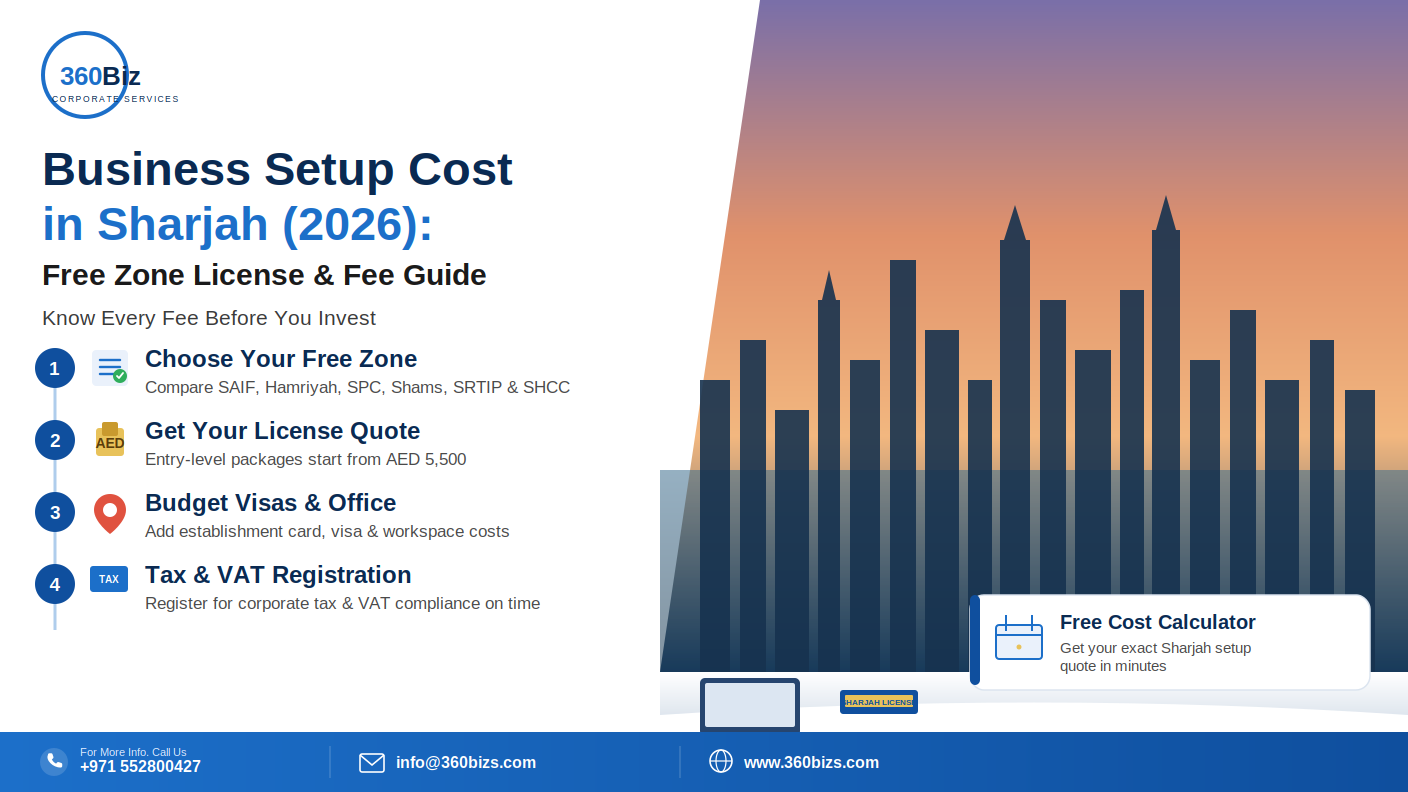
If you’re an investor weighing your options across the UAE, the business setup cost in Sharjah is one of the first numbers you need on the table. In 2026, a basic free zone license without a visa can be secured from around AED 5,500, while a fully loaded package with one or two visas, a workstation, and a niche activity typically lands between AED 12,000 and AED 28,000 for year one.
That range is wide because Sharjah isn’t a single free zone it’s home to six independent authorities, each with its own fee structure, target industries, and visa rules. For a foreign entrepreneur comparing this against setting up a mainland company or a Dubai free zone, Sharjah’s appeal comes down to one thing: you get comparable ownership rights and market access at a noticeably lower entry cost. This guide breaks down every fee category, compares the free zones on offer, and flags the tax and compliance obligations that founders often discover too late.
Why Investors Are Looking at Sharjah in 2026
Sharjah sits directly next to Dubai, shares Sharjah International Airport, and gives businesses sea access through Khorfakkan and Hamriyah ports a real advantage for anyone in trading or logistics who still wants proximity to the Dubai market. As the UAE’s third-largest emirate, it has deliberately positioned itself as the value option: lower license fees, lower office rents, and lower day-to-day operating costs than Dubai or Abu Dhabi, without sacrificing 100% foreign ownership in its free zones.
For a business owner evaluating where to put capital, that combination matters more than headline GDP numbers. It means a leaner first-year budget, more runway before you need to break even, and the flexibility to upgrade your setup more visas, a bigger office, an additional activity once revenue justifies it.
Free Zone vs. Mainland: How the Route You Choose Changes Your Cost
Before pricing anything, decide which legal structure fits your business model, because the two routes carry very different cost profiles.
A mainland company, licensed through the Sharjah Department of Economic Development (DED), lets you trade anywhere in the UAE, bid on government contracts, and open branches across emirates without restriction. It generally requires a physical commercial address and, depending on your activity, external approvals both of which push the setup cost higher. If your business model depends on direct access to the UAE market, our mainland company formation service walks through the exact licensing path.
A free zone company, registered under one of Sharjah’s six independent authorities, is built for speed and low entry cost. Most zones bundle a flexi-desk into the license fee, which is the biggest reason Sharjah’s free zone packages stay cheap. The trade-off: a pure free zone license cannot invoice the UAE mainland directly for goods it needs a distributor or a mainland branch for that. Services and international trade, however, face no such restriction. If flexibility and cost control matter more than direct mainland access right now, our free zone business setup team can map this against your specific activity.
For founders who don’t plan to operate physically inside the UAE at all holding companies, international consultants, IP structures an offshore company is worth comparing too, though it can’t sponsor UAE residency visas or trade locally.
What Actually Makes Up the Sharjah Business Setup Cost
“Business setup cost” isn’t one invoice it’s a stack of separate line items. Here’s what typically appears in a Sharjah free zone quote:
| Cost Component | Typical Range (AED) | Notes |
|---|---|---|
| Trade license (entry level) | 5,500 – 15,000 | Core legal permit to operate |
| Registration & incorporation | 1,000 – 3,500 | One-time setup fee |
| Establishment/immigration card | 1,500 – 2,500 | Required before sponsoring visas |
| Residency visa (per person) | 3,500 – 5,500 | Entry permit, medical, Emirates ID, stamping |
| Flexi-desk / shared workspace | Often bundled | Up to AED 6,000 if purchased separately |
| Private office (annual) | From 15,000+ | Scales with size and location |
| Additional business activity | 1,000 – 2,500 | Per activity outside your main group |
Treat these as planning figures every free zone authority revises pricing and promotions through the year, so confirm the exact quote before you commit. If you’d rather model a few scenarios before speaking to anyone, our cost calculator gives you a working estimate in minutes.
Sharjah’s Six Free Zones Which One Fits Your Investment
Unlike Dubai, Sharjah doesn’t run its free zones under one umbrella body. Each has its own authority, its own fee schedule, and its own industry focus, so picking the wrong one can mean paying for space or activities you’ll never use.
SAIF Zone (Sharjah Airport International Free Zone). Positioned beside Sharjah International Airport, SAIF Zone is built for trading, logistics, light manufacturing, and aviation support, with warehousing and land plots available. Because most packages here bundle visa allocation, entry pricing tends to sit higher commonly from around AED 10,800 for a package with visa eligibility but for an import-export business, the airport proximity often justifies it.
Hamriyah Free Zone (HFZA). Sharjah’s industrial powerhouse, sitting on the Gulf coast with its own deep-water port. Hamriyah is the go-to for manufacturing, petrochemicals, shipbuilding, and heavy trading. License fees themselves are modest; the real cost driver is the industrial plot or facility you lease, so budgets vary widely by project scale.
SPC Free Zone (Sharjah Publishing City). A digital and service-friendly zone covering publishing, e-commerce, IT, and consultancy, with over 1,500 permitted activities. Entry packages commonly start from around AED 5,750, and SPC is one of the few Sharjah zones authorized to issue a dual license covering both mainland and free zone activity a genuine differentiator for founders who want both markets under one structure.
Sharjah Media City (Shams). A lean, remote-registration-friendly zone for media, creative, and digital businesses, with entry packages typically from AED 5,750. Shams is popular with solo founders and freelancers because the whole process can often be completed without a UAE visit until the visa stage.
SRTIP (Sharjah Research, Technology and Innovation Park). Built for tech startups, R&D, renewable energy, and smart manufacturing, with some of the lowest entry packages in the emirate often from around AED 5,500. A strong fit for early-stage, innovation-led ventures looking to minimize first-year burn.
Sharjah Healthcare City (SHCC). A specialised zone for clinics, hospitals, diagnostic centres, and health-tech companies. Because medical activities also require Sharjah Health Authority approval on top of the free zone license, costs here are scoped project by project rather than quoted as a flat package.
Matching your activity to the right zone is where most founders either save or waste money a consultant paying for industrial land in Hamriyah, or a manufacturer trying to squeeze into a Shams flexi-desk, are both expensive mistakes. This is usually the first conversation we have with a new client.
Hidden and Recurring Costs Founders Forget to Budget For
The number on your first invoice is not your only cost. Plan for these from day one:
- Annual license renewal, usually close to your original setup fee.
- Visa renewals, due every two to three years per sponsored employee.
- Mandatory health insurance for every visa holder, renewed annually.
- Office upgrades moving from a flexi-desk to a private office as headcount grows raises both rent and, in most zones, your visa quota.
- Corporate tax and VAT compliance, which becomes a recurring obligation the moment you’re licensed, regardless of whether tax is actually due.
Founders who budget for these in year one avoid the scramble that hits at renewal time. Our accounting and bookkeeping team typically gets brought in around this stage, once the license is live and the books need to start moving.
Tax Obligations for a Sharjah Free Zone Company
A common misconception among first-time investors is that a free zone license is automatically tax-free. It isn’t, and getting this wrong is expensive.
Under Federal Decree-Law No. 47 of 2022, UAE corporate tax applies at 0% on taxable income up to AED 375,000 and 9% above that threshold. A Sharjah free zone company can access a preferential 0% rate on qualifying income, but only if it meets the conditions to be recognised as a Qualifying Free Zone Person maintaining real substance in the UAE, earning qualifying income under the law, following arm’s-length transfer pricing, and keeping audited accounts. Every free zone entity must register for corporate tax regardless of the rate that applies to it; skipping registration is a compliance failure in its own right, not just a tax one.
Smaller entities get some relief: businesses with revenue at or below AED 3 million can elect Small Business Relief and be treated as having no taxable income, for tax periods available up to the end of 2026.
VAT is separate. Registration becomes mandatory once taxable supplies and imports cross AED 375,000 in a 12-month period, with voluntary registration available from AED 187,500. Given how directly VAT and corporate tax status affect your free zone benefits, most investors bring in specialist support early rather than risk it our VAT registration and filing service is built for exactly this stage of a new company’s life.
How to Bring Your Sharjah Setup Cost Down
- Match the zone to your actual activity. A digital consultant on a flexi-desk in Shams or SPC pays a fraction of what an industrial operator in Hamriyah needs don’t overpay for capacity you won’t use.
- Start lean on visas. Apply for what you need today, not a projected headcount for next year. Each visa is a recurring, not one-time, cost.
- Take the flexi-desk where your activity allows it. A private office is one of the largest line items in any UAE setup.
- Keep activities within one licence group. Mixing unrelated activities triggers extra activity fees.
- Get your structure right the first time. Amending activities, shareholding, or license type after the fact costs money and can stall your bank account and visa approvals this is where working with an experienced consultant tends to pay for itself many times over.
Setting Up a Sharjah Free Zone Company: The Process
- Choose your free zone based on activity, budget, and visa needs.
- Decide your legal structure a single-owner Free Zone Establishment or a multi-shareholder Free Zone Company.
- Reserve your trade name and secure initial approval.
- Submit documents passport copies, shareholder details, and your activity list.
- Pay the license fee and receive your license, often within days.
- Apply for your establishment card and residency visas.
- Open your corporate bank account and register for corporate tax and VAT where applicable.
Each of these steps has small requirements that are easy to get wrong on your own an incorrect activity code or an incomplete document set is the most common reason licenses and bank accounts get delayed.
How 360bizs Supports Your Sharjah Company from Day One
Beyond the license itself, most founders need a handful of things sorted in the first few months: government paperwork through our corporate PRO services, workspace through our business centre and office solutions, and if your activity involves a regulated product product certification support before you can legally sell. If you’re launching as a solo seller rather than a full company, our e-trader license route is often faster and cheaper than a full free zone setup.
And on the other end of the business lifecycle, if a venture needs to wind down, our company closure and liquidation team handles that cleanly too, so your exit doesn’t create compliance problems years later.
If you want an itemised quote based on your specific activity, visa count, and budget rather than the general ranges above, talk to our business setup team before you file your trade name application.
FAQs: Business Setup Cost in Sharjah
How much does business setup in Sharjah cost in 2026?
Entry-level free zone licenses start from around AED 5,500 with no visa, rising to roughly AED 12,000–28,000 for a package with one or two visas, and higher still with a private office or specialised activity.
What is the cheapest free zone in Sharjah?
SRTIP, Shams, and SPC Free Zone typically offer the lowest entry packages, often from AED 5,500 to AED 5,750, largely because they bundle a flexi-desk and offer zero-visa options.
Is a Sharjah free zone company tax-free?
Not automatically. A Sharjah free zone company can access a 0% corporate tax rate on qualifying income only if it meets Qualifying Free Zone Person conditions under Federal Decree-Law No. 47 of 2022. Every free zone company must still register for corporate tax, even at a 0% rate.
Can a Sharjah free zone company do business in Dubai?
Yes for services and international trade, which can be invoiced without restriction. For selling physical goods directly into the UAE mainland, the company needs a licensed distributor or a mainland branch.
How long does it take to get a Sharjah free zone license?
Most licenses are issued within a few working days once documents are complete; some zones can issue within 24 hours. Adding visas typically extends the full timeline to one to two weeks.
Do I need to visit the UAE to set up a Sharjah free zone company?
Not always several zones, including Shams, support remote registration. A visit is usually still needed later for medical screening and Emirates ID biometrics during the visa stage.
Disclaimer: This article is for general informational purposes only and does not constitute legal, tax, or financial advice. Fee figures are indicative planning estimates and should be confirmed with the relevant free zone authority. Consult a licensed business setup advisor for guidance specific to your company.
Ye ab seedha copy-paste ho sakta hai links normal clickable hyperlinks ki tarah hain, koi HTML code visible nahi. WordPress ke visual editor mein paste karte waqt links automatically carry ho jayenge.