

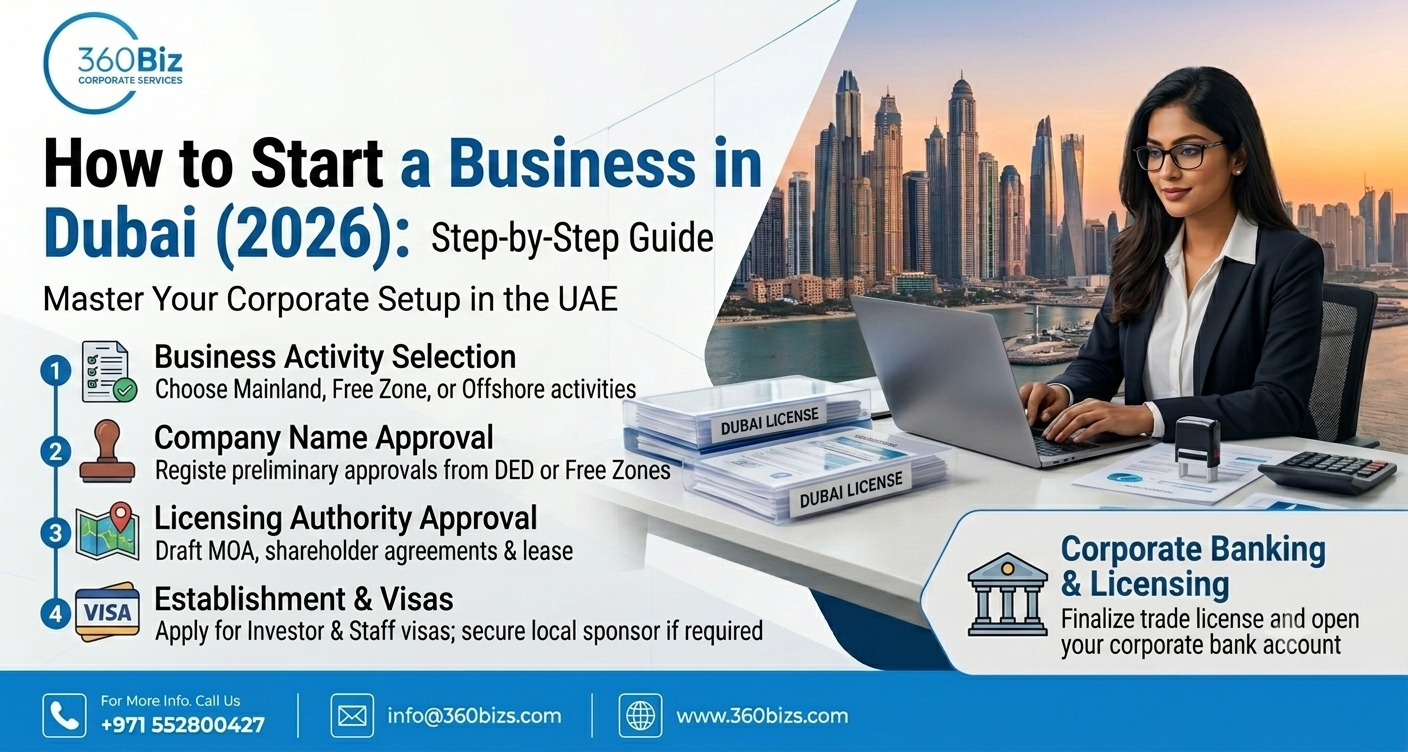
How to Start a Business in Dubai (2026): Complete Step-by-Step Guide & Costs
Starting a business in Dubai has become one of the most profitable investments for foreign entrepreneurs, South Asian business owners, and global expats. Positioned as a premier commercial hub, Dubai offers tax efficiency, 100% foreign ownership options, robust physical infrastructure, and direct access to emerging markets across the Middle East, Africa, and Asia.
However, navigating the structural decisionssuch as choosing between Dubai Mainland, Free Zones, or Offshore jurisdictionsrequires clarity regarding local laws, licensing fees, and compliance frameworks.
This detailed guide outlines the complete process of how to start a business in Dubai in 2026, breaking down exact setup costs in AED, step-by-step registration processes, legal requirements, and key insights for setting up your business smoothly.
Why Set Up a Business in Dubai in 2026?
The United Arab Emirates (UAE) continues to update its business legislation to attract global venture capital, startups, and international enterprises.
- 100% Foreign Ownership: Under Federal Decree-Law No. 32 of 2021, foreign nationals can retain 100% ownership in over 1,000 commercial and industrial mainland activities without requiring an Emirati national partner.
- Competitive Tax Environment: The UAE maintains a zero-percent personal income tax structure. Corporate tax sits at a competitive 9% for annual taxable profits exceeding AED 375,000, while qualified free zone entities may enjoy zero-tax incentives on qualifying income.
- Strategic Regional Access: Operating from Dubai allows seamless trade logistics supported by world-class ports, airports, and modern digital ecosystems.
- Investor Residency & Golden Visa Pathways: Establishing a commercial entity allows company shareholders and executives to secure 2-year to 10-year renewable UAE residency visas for themselves and their families.
Step 1: Choose Your Jurisdiction Mainland vs Free Zone vs Offshore
Choosing the right business jurisdiction determines where you can conduct commercial activities, your physical office requirements, and how your business is taxed.
| Feature / Criteria | Dubai Mainland | Dubai Free Zone | Offshore Jurisdiction |
| Foreign Ownership | 100% for most activities | 100% foreign ownership | 100% foreign ownership |
| Trading Territory | Local UAE market + Global | Within Free Zone + Global | International only (No UAE trade) |
| Physical Office | Physical Office / Flexi-desk | Virtual desk or dedicated office | Registered Agent address only |
| Corporate Bank Account | Straightforward opening process | Straightforward with physical setup | Specialized compliance checks |
| DED / Authority | Dept. of Economy & Tourism (DET) | Specific Free Zone Authority | Offshore Registrar (e.g., JAFZA) |
1. Dubai Mainland
Setting up on the mainland grants you complete freedom to trade directly within the UAE market and bid for local government contracts without geographical limits. For complete corporate infrastructure support and licensing, exploring mainland company formation in Dubai ensures full compliance with local DET rules.
2. Dubai Free Zone
Free zones are specialized economic jurisdictions designed for international trade, consulting, technology, and e-commerce. They offer streamlined customs procedures, tax benefits, and zero currency restrictions. You can browse tailored solutions through Dubai free zone business setup services to compare regional options such as IFZA, Meydan, and DIEZ.
3. Offshore Setup
Offshore companies operate primarily as holding companies to manage international assets, holding intellectual property, or facilitating cross-border international investments. Discover structured international asset solutions via offshore company formation services in Dubai.
Step-by-Step Guide: How to Start a Business in Dubai (2026)
Step 1: Select Your Commercial Activities
Every license issued in Dubai must correspond to an official activity classification listed by the Department of Economy and Tourism (DET) or the selected Free Zone authority. You may select multiple commercial, professional, or industrial activities under a single trade license.
Step 2: Register Your Company Trade Name
Your trade name must comply with strict UAE naming regulations:
- It cannot violate public order or religious sentiments.
- It must reflect the legal structure of the business (e.g., LLC, FZE, or Branch).
- It must not contain established corporate trademarks or political references.
Step 3: Secure Initial Approval
Initial approval from DET or the relevant Free Zone authority confirms that the UAE government has no objection to establishing your enterprise. This step allows you to move forward with office leases and banking formalities.
Step 4: Finalize Lease Contract (Ejari or Smart Desk)
- Mainland Businesses: Require a registered physical commercial lease agreement registered in the municipal system known as Ejari. For cost-conscious investors, utilizing budget-friendly workspaces through affordable business centres in Dubai satisfies mandatory DET spatial standards.
- Free Zone Entities: Often utilize flexible hot-desking, shared desks, or dedicated private office solutions.
Step 5: Issue the Trade License and Pay Fees
Once trade approvals, legal articles, and tenancy contracts are uploaded, the licensing authority issues the final invoice. Upon payment, your official commercial trade license is issued within 24 to 72 hours.
Step 6: Process Visas and Corporate Bank Account Setup
With your trade license in hand, your company can issue establishment cards, apply for investor visas, and initiate corporate bank account procedures. Simplifying government document clearances via professional corporate PRO services company in Dubai UAE ensures efficient turnaround for visas, Emirates IDs, and medical fitness checks.
Realistic Dubai Business Setup Cost Breakdown (2026 Estimates)
Below is an indicative cost framework in United Arab Emirates Dirhams (AED) for establishing a commercial business in Dubai.
Important Budgeting Tip: Prices vary depending on chosen business activities, visa allocations, and municipal approval requirements. Obtaining tailored quotes through setup specialists prevents unexpected hidden fees during registration.
Special Business License Pathways in Dubai
For specialized trade models, standard business setups may not always apply. Dubai offers customized frameworks to fit specific operating needs:
1. Solo Entrepreneurs and Freelancers
If you run an online enterprise, home service, or freelance operations, full commercial offices may not be strictly required. You can review requirements for an e-trader license in Dubai to legally operate digital storefronts and social commerce channels.
2. Product Importation and Distribution Compliance
If your enterprise deals in importing physical products, foodstuff, beauty items, or consumer goods into the local market, product registration is required. Utilizing product certification support services in Dubai helps verify compliance with Dubai Municipality standards before distribution.
3. Corporate Financial Infrastructure & Banking
Securing institutional commercial banking accounts is a crucial operational step for new foreign businesses. Accessing specialized bank account opening assistance services helps organize compliance documentation, source source-of-funds validation, and navigate bank interviews.
4. Restructuring and Corporate Exit Strategies
If business pivots require closing operational structures, managing corporate wind-downs legally protects shareholders from compliance penalties. Obtaining structured guidance through company closure liquidation services in Dubai ensures clean tax deregistrations and government clearance certifications.
Legal and Regulatory Compliance for Dubai Companies
Maintaining business operations in the UAE requires continuous adherence to tax and corporate regulation laws:
- UAE Corporate Tax (9% Rate): Companies must register for Corporate Tax with the Federal Tax Authority (FTA). Taxable income below AED 375,000 is taxed at 0%, whereas taxable profits above AED 375,000 are taxed at 9%.
- Value Added Tax (5% VAT): Mandatory registration applies if taxable turnover exceeds AED 375,000 within a 12-month period. Voluntary registration is available at AED 187,500.
- UBO Declarations: Entities operating in the UAE must submit Ultimate Beneficial Owner records to prevent financial irregularities and comply with AML guidelines.
Frequently Asked Questions (PAA & AEO)
Can a Pakistani or South Asian investor open a business in Dubai?
Yes. Citizens of Pakistan, India, Bangladesh, and other South Asian countries can start businesses in Dubai. The process requires standard passport documentation, trade name reservations, and security approvals. Once the trade license is issued, foreign owners can secure investor residency visas and open local bank accounts.
What is the absolute minimum cost to open a business in Dubai?
The lowest setup cost for a zero-visa allocation free zone license starts around AED 12,500 to AED 15,000. Mainland business setups generally begin around AED 18,500, excluding variable commercial lease contracts (Ejari).
Do I need a local UAE partner or sponsor to hold 51% of my business?
No. Under the updated Commercial Companies Law, 100% foreign ownership is allowed across most mainland commercial and industrial activities, eliminating the traditional requirement for a local 51% Emirati sponsor.
How fast can I get a trade license issued in Dubai?
With instant free zone licensing procedures and DET digital processes, trade licenses can be issued in 3 to 7 working days, provided all identity verifications and name approvals are cleared promptly.
Strategic Summary for Foreign Investors
Starting a company in Dubai offers foreign investors access to global markets and strategic tax benefits. By selecting the optimal jurisdiction (Mainland vs. Free Zone), managing setup costs, and securing operational banking relationships, foreign entrepreneurs can build resilient commercial entities in the UAE.
To simplify legal clearances, streamline visa applications, and ensure smooth business setup, working alongside established corporate advisory teams helps save resources and ensures full local compliance.