
How to Open a Baqala in Abu Dhabi: Licence, Cost and Requirements (2026)
If you’re a foreign investor looking at retail in the UAE, a baqala is one of the most accessible entry points into Abu Dhabi’s commercial market and in 2026, it’s also one of the few retail activities where 100% foreign ownership is available through an LLC structure, with no local Emirati partner required.
To open a baqala in Abu Dhabi, you need a commercial trade licence from the Abu Dhabi Department of Economic Development (ADDED), food-safety clearance from the Abu Dhabi Agriculture and Food Safety Authority (ADAFSA), and a store fit-out that complies with the mandatory Project Baqala design and branding standards. Total setup cost typically runs AED 65,000 to AED 110,000 for a small to mid-sized store, depending on location, size and fit-out quality.
This guide breaks down the licence, the real 2026 cost structure, the ownership rules that matter most to foreign and South Asian investors, and the compliance steps that determine whether your baqala passes inspection on the first try.
Quick Checklist: Opening Your Baqala in Abu Dhabi
- Choose your business activity (“Grocery” / “Retail Sale of Food and Beverages”) and legal structure with ADDED.
- Register your tenancy contract through Tawtheeq on the TAMM portal before applying for any licence.
- Reserve a trade name that includes “Baqala,” following the Project Baqala signage format.
- Select a compliant, high-footfall location that meets the 5,000mm spacing rule from other grocery outlets.
- Fit out the store to Project Baqala specifications (non-wood shelving, approved signage, pest control).
- Pass ADAFSA/HACCP food-safety inspection and secure food-handler health certificates.
- Install a certified POS system and price-tag every product.
- Assess your VAT position against the AED 375,000 mandatory threshold.
- Budget 6–9 months of working capital and launch.
What Is a Baqala in Abu Dhabi?
“Baqala” (بقالة) is Arabic for a small neighbourhood grocery store the corner shop selling bread, milk, eggs, snacks, beverages and household basics. But in Abu Dhabi, the word carries legal weight. Since ADAFSA (then operating under the earlier ADFCA name) launched Project Baqala in 2013, every qualifying small grocery outlet in the emirate must operate under a unified brand identity, standardised store layout, and strict food-safety framework.
That matters for two reasons. First, it means the format is predictable a first-time investor competes on a level playing field because every operator follows the same rulebook. Second, it means non-compliance isn’t a minor cosmetic issue; a store built outside the Project Baqala spec can fail inspection and delay your licence indefinitely.
Baqalas aren’t a niche curiosity either. They make up more than 81% of all grocery retailers in the UAE, and roughly 59% of Abu Dhabi shoppers say they choose a baqala specifically for its proximity and convenience over larger supermarkets a preference that has held steady even with online grocery delivery expanding.
Why Foreign and South Asian Investors Are Choosing Baqalas in 2026
For Pakistani, Indian and other South Asian investors evaluating UAE business setup options, the baqala model has three specific advantages over other retail formats:
- 100% foreign ownership. Recent Abu Dhabi mainland reforms permit full foreign ownership of an LLC for the grocery retail activity no UAE national partner or equity split required, which was not always the case historically.
- Lower entry cost than a restaurant or supermarket. A baqala needs a smaller footprint, a leaner team, and simpler inventory than a full-service food business, while still tapping into non-seasonal, everyday demand.
- Community-anchored, repeat revenue. Groceries aren’t discretionary. A well-placed baqala earns from walking-distance, repeat customers rather than one-off shoppers, which gives it a more stable revenue pattern than trend-driven retail concepts.
Step-by-Step: How to Open a Baqala in Abu Dhabi
Step 1: Choose Your Business Activity and Legal Structure
Your baqala is licensed under a Standard Commercial Licence issued by ADDED, classified as a retail grocery / foodstuff trading activity. You’ll need to decide between two legal structures:
- Sole Establishment simplest for a single owner, though a Local Service Agent may still apply depending on nationality and activity.
- Limited Liability Company (LLC) the more common route for foreign investors, since it supports the 100% foreign ownership benefit currently available for this activity.
Because ownership rules and equity requirements are periodically updated by ADDED, always confirm the current position before committing to a structure this is exactly the kind of detail a licensed consultant should verify against live ADDED regulations rather than an old guide.
Step 2: Register Your Tenancy Through Tawtheeq Before You Apply
This step is where many first-time applicants lose weeks. Before you can submit anything to ADDED, your lease must be registered through Tawtheeq, Abu Dhabi’s official tenancy registration system managed via the TAMM portal. A lease that isn’t Tawtheeq-registered is not legally recognised and cannot support your trade licence application.
Practical tip: before you pay a security deposit, confirm directly with the landlord that the unit is zoned for commercial grocery retail and that they will permit Tawtheeq registration. Some units inside residential buildings carry restrictions that only surface after money has already changed hands.
Step 3: Reserve Your Trade Name (the “Baqala” Branding Rule)
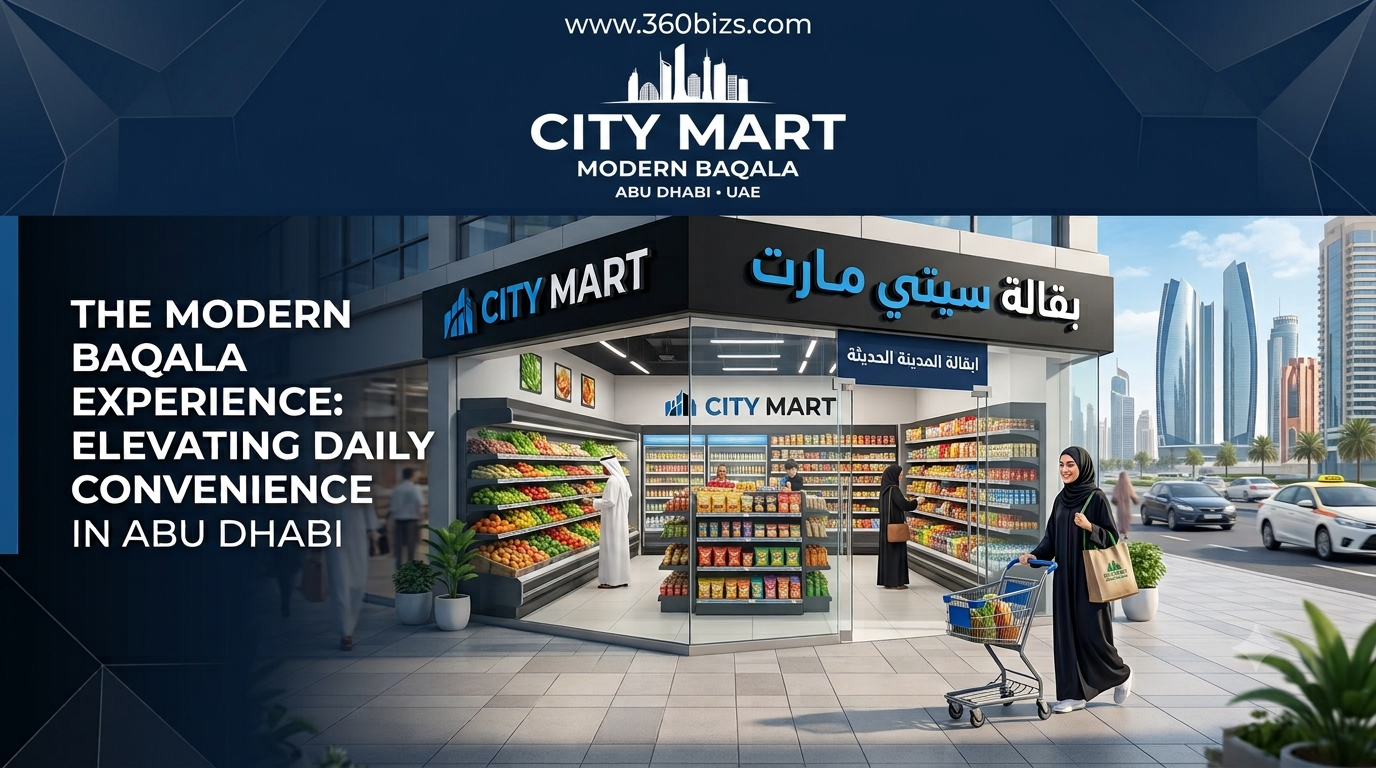
Under Project Baqala’s unified branding requirement, your storefront signage must prominently display “Baqala,” with your unique business name shown separately in a smaller font, in both Arabic and English, following the approved signboard layout. A name like “Al Noor Baqala” is compliant; a fully personalised brand that drops the Baqala identifier is not, and it will create problems at inspection. Reserve your trade name with ADDED with this format already built in.
Step 4: Secure a Compliant, High-Footfall Location
Location does double duty here it’s both a regulatory checkpoint and the single biggest driver of commercial success.
On the regulatory side, ADAFSA enforces a minimum 5,000mm (5-metre) spacing requirement between your baqala’s entrance and other grocery outlets, as well as separation from activities that pose food-safety risks auto repair shops, barbers, carpentry workshops and similar operations nearby can all trigger a rejection.
On the commercial side, footfall is everything. A baqala earns money from people who already walk past it daily a cheaper unit on a quiet street with weak residential density is rarely a bargain once you account for lost sales.
Step 5: Fit Out the Store to Project Baqala Specifications
Once your lease is registered, build to spec retrofitting after a failed inspection costs more than building correctly the first time. Key Project Baqala fit-out requirements:
- Non-wood fixtures only. All shelving and counters must be metal or food-grade polymer. Wooden fixtures are explicitly prohibited.
- Standardised signage and colour scheme. Store design must match the approved Project Baqala template.
- Certified pest control. An active pest-control service agreement is mandatory, not optional.
- Food-safety-ready layout. Proper refrigeration, separation of raw and ready-to-eat products, accessible handwashing stations, and easy-to-clean surfaces.
Step 6: Pass ADAFSA Food-Safety Approval (HACCP)
Because your baqala handles food, it must comply with the Hazard Analysis and Critical Control Point (HACCP) system. ADAFSA inspectors assess storage temperatures, product handling, hygiene practices and raw/ready-to-eat separation. Every staff member handling food must complete food-safety training and hold a valid health certificate before the store opens budget for this during your pre-launch phase, not after.
Step 7: Install a Compliant POS System and Price Every Item
Every transaction must generate a printed invoice from a certified POS system, and every product on your shelves needs a clearly visible price tag including unit pricing for anything sold by weight or volume. Inspectors check this routinely, and it’s one of the easiest compliance points to overlook when you’re focused on the bigger licensing steps.
Step 8: Assess Your VAT Position
Under the Federal Tax Authority (FTA), VAT registration becomes mandatory once your taxable supplies and imports exceed AED 375,000 over a rolling 12-month period (or are expected to within the next 30 days). Voluntary registration is available above AED 187,500, and the standard UAE VAT rate is 5%.
Many single-location baqalas stay under the mandatory threshold in their first year, but you’re required to track rolling turnover continuously crossing the line triggers a 30-day registration window, and missing it carries penalties.
How Much Does It Cost to Open a Baqala in Abu Dhabi in 2026?
Unlike guides that avoid giving a number, here’s a realistic 2026 cost breakdown for a small to medium baqala:
| Cost Item | Estimated Range (AED) |
|---|---|
| ADDED trade licence and government fees | 8,000 – 15,000 |
| Tawtheeq lease registration | 500 – 1,500 |
| Store fit-out (non-wood shelving, signage, refrigeration) | 20,000 – 45,000 |
| ADAFSA food-safety approval & food-handler certificates | 2,000 – 5,000 |
| POS system and invoicing setup | 2,000 – 6,000 |
| Opening inventory | 15,000 – 30,000 |
| Pest control contract (annual) | 2,000 – 4,000 |
| Total estimated setup cost | AED 65,000 – 110,000 |
Rent is typically the largest variable and isn’t included above since it depends entirely on location and unit size in Abu Dhabi, commercial rent is often demanded as one or two upfront cheques, so factor that into your opening cash position, not just your fit-out budget.
Beyond the one-time setup, plan for 6–9 months of working capital to cover rent, restocking and operating costs while the store builds a customer base. Well-located baqalas in Abu Dhabi typically break even within 12–15 months, with net profit margins of roughly 8–15% once established.
Baqala vs. Mini Mart: Which Licence Do You Actually Need?
A common point of confusion for new investors is whether their concept qualifies as a “baqala” or a “mini mart.” A baqala is specifically the small-format, Project Baqala-branded neighbourhood store it must follow the unified signage, fit-out and spacing rules described above. A mini mart is typically a larger-footprint retail format with broader product categories and different layout expectations, and it is not bound by the same Project Baqala branding requirements. If your concept is closer to a compact supermarket than a corner store, confirm your activity classification with ADDED before reserving a trade name, since applying under the wrong category can cost you time at the fit-out stage.
The Two Mistakes That Sink New Baqalas
Location and cash flow are where most new baqala owners run into trouble not licensing.
Mistake one: choosing rent over footfall. A baqala survives on captive, walking-distance, repeat demand. A cheap unit on a quiet street with no dense residential cluster nearby, and several competitors already within a few hundred metres, is rarely a real bargain it’s a slower failure.
Mistake two: under-budgeting for the cash-flow gap. New owners often spend everything on fit-out and opening stock, then can’t cover rent frequently demanded in one or two upfront cheques in Abu Dhabi during the months before the store builds supplier credit terms and steady footfall. Budget so that after opening and stocking the store, you can still absorb six to nine months of losses. If that buffer isn’t there, the business is already over-leveraged before day one.
Compliance discipline matters just as much as the numbers. Activity classification, ADAFSA approvals, signage rules and ownership structure all shift over time, and a food-safety stop-order can close a non-compliant store overnight faster than weak sales ever could.
Ready to Open Your Baqala the Right Way?
Opening a baqala in Abu Dhabi is genuinely achievable but the licence classification, Tawtheeq lease registration, ADAFSA food-safety approval, and the 100% ownership structuring are exactly where foreign and South Asian investors lose time and money without local guidance. The team at 360bizs.com handles Abu Dhabi and Dubai business setup, licensing, and ongoing compliance end to end, so your baqala launches on schedule and passes inspection the first time.
Talk to our business setup team about your baqala licence today
Frequently Asked Questions
What is a baqala in Abu Dhabi?
A baqala is a small neighbourhood grocery store selling everyday essentials like bread, milk, snacks and household items. In Abu Dhabi, it is also a regulated retail format governed by the Project Baqala framework under ADAFSA.
How much does it cost to open a baqala in Abu Dhabi in 2026?
A small to mid-sized baqala typically costs between AED 65,000 and AED 110,000 to set up, covering the trade licence, fit-out, food-safety approvals, POS system and opening inventory. Rent is separate and varies significantly by location.
Can a foreigner open a baqala in Abu Dhabi with 100% ownership?
Yes. Recent Abu Dhabi mainland reforms permit 100% foreign ownership for an LLC structured for the grocery retail activity, removing the earlier requirement for a UAE national partner.
What licence do I need to open a baqala?
You need a Standard Commercial Licence from the Abu Dhabi Department of Economic Development (ADDED) for the retail grocery activity, plus food-safety approval from ADAFSA.
How close can my baqala be to another grocery store?
ADAFSA requires a minimum spacing of 5,000 millimetres (5 metres) between your baqala’s entrance and any other existing grocery outlet.
Do I need to register for VAT as a baqala owner?
Only if you cross the threshold. VAT registration is mandatory once taxable supplies exceed AED 375,000 in a rolling 12-month period, with voluntary registration available above AED 187,500. The standard rate is 5%.
What is Project Baqala and is it mandatory?
Project Baqala is ADAFSA’s 2013 initiative standardising the branding, layout and food-safety standards of small grocery stores across Abu Dhabi. Compliance is mandatory for every qualifying baqala it is not optional signage guidance.
How long does it take to get a baqala licence approved?
Processing typically takes 3–10 working days once all documents, including your Tawtheeq-registered lease, are submitted correctly. Delays usually come from fit-out or food-safety remediation, not the licence application itself.
What is Tawtheeq and why do I need it before applying for a licence?
Tawtheeq is Abu Dhabi’s official tenancy registration system, managed through the TAMM portal. Your lease must be Tawtheeq-registered before it can be submitted as proof of premises in your ADDED trade licence application an unregistered lease is not legally recognised for licensing purposes.