
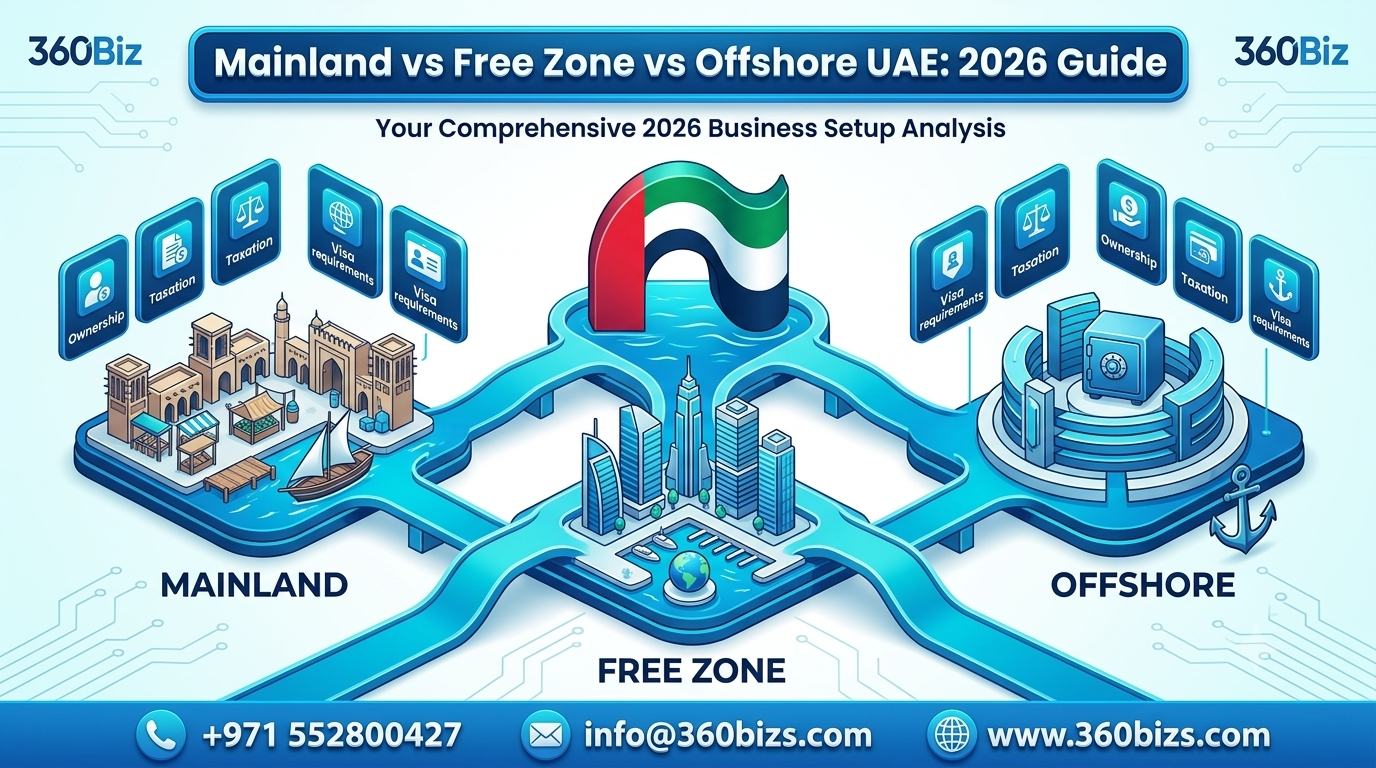
Mainland vs Free Zone vs Offshore Company UAE: The Complete 2026 Comparison Guide
Starting a business in the UAE means making one decision before anything else: which company structure fits your goals Mainland, Free Zone, or Offshore?
This single choice determines where you can legally sell, how much tax you’ll pay, whether you can sponsor visas, and how much your setup will actually cost. For foreign entrepreneurs, Pakistani and South Asian investors, and international founders eyeing Dubai, getting this wrong can mean an expensive restructure just months into operations.
In this guide, we break down all three UAE company structures in plain language with real AED figures, current UAE corporate tax rules, and practical guidance based on the type of business you’re running.
Quick Comparison Table
| Feature | Mainland | Free Zone | Offshore |
|---|---|---|---|
| Registering Authority | Department of Economy and Tourism (DET), formerly DED | Individual Free Zone Authority (FZA) | Offshore registrar (e.g., JAFZA, RAK ICC) |
| Market Access | Full UAE market + international | Free zone + international (mainland needs local distributor) | International only — no UAE trading |
| Foreign Ownership | 100% (most activities, post-2021 reform) | 100% (long-standing) | 100% |
| Corporate Tax | 9% on profits above AED 375,000 | 0% for Qualifying Free Zone Persons (QFZP); 9% otherwise | 9%, unless exempt as non-resident |
| Visa Eligibility | Unlimited, tied to office size | Limited, tied to office package (2–6 visas typical) | Not eligible |
| Office Requirement | Physical office, min. 200 sq. ft. | Flexi-desk to full office | None required |
| Setup Cost (approx.) | AED 15,000–40,000+ | AED 5,555–25,000+ | AED 8,000–25,000 |
| Setup Timeline | 5–15 working days | 3–7 working days | 1–3 working days |
| Government Contracts | Eligible | Not eligible | Not eligible |
What Is a Mainland Company in the UAE?
A mainland company (also called an onshore company) is registered directly with the Department of Economy and Tourism (DET) the authority formerly known as DED in whichever emirate you’re operating from. This is the only structure that lets you trade freely anywhere in the UAE: local retail, government contracts, and international business, all under one license.
Following Federal Decree-Law No. 32 of 2021, most mainland business activities now allow 100% foreign ownership, removing the older requirement for a UAE national to hold 51% of the company. This reform is a major reason mainland setups have become attractive again for foreign and South Asian investors who previously avoided them due to local sponsorship rules.
Key Advantages of Mainland Setup
- Unrestricted trade across all seven emirates
- Eligible to bid on UAE government contracts and tenders
- No cap on the number of residency visas limited only by office size
- Broadest range of permitted business activities
- Full access to the local UAE consumer market (retail, F&B, clinics, real estate)
Key Limitations
- Requires a physical office (virtual offices are not permitted); minimum 200 sq. ft.
- Higher overall setup and compliance costs
- Subject to 9% corporate tax on profits above AED 375,000, with no QFZP-style exemption
Who Should Choose Mainland?
If your business will sell directly to UAE consumers retail shops, restaurants, clinics, salons, real estate brokerages or if you plan to bid on government tenders, mainland is the only structure that gives you full legal access to that market.
What Is a Free Zone Company in the UAE?
The UAE has more than 45 designated free zones, each governed by its own Free Zone Authority (FZA), often with a specific industry focus technology, media, commodities trading, healthcare, or logistics. Popular options include DMCC (commodities and trading), IFZA Dubai, and Ajman Free Zone (budget-friendly entry).
Free zone companies have offered 100% foreign ownership since inception long before mainland reforms caught up which is why free zones remain the default choice for solo founders, digital agencies, consultants, and e-commerce businesses.
Corporate Tax and the QFZP Rule
This is where many first-time founders get confused. Free zone companies can access a 0% corporate tax rate, but only if they qualify as a Qualifying Free Zone Person (QFZP) under the UAE’s Corporate Tax Law (Federal Decree-Law No. 47 of 2022). To maintain QFZP status, a company must:
- Earn “Qualifying Income” as defined by the Federal Tax Authority (FTA)
- Maintain adequate substance in the UAE
- Prepare audited financial statements every year, regardless of revenue size
For very small startups, the audit cost required to maintain QFZP status can, in some cases, come close to what the company would have paid in corporate tax anyway on the mainland so the “0% tax” benefit isn’t automatic or free.
Key Advantages of Free Zone Setup
- 100% foreign ownership as standard
- Potential 0% corporate tax via QFZP status
- Fast, often pre-packaged setup as quick as 3–7 business days
- Industry-specific ecosystems (ideal for tech, trading, and media businesses)
- Setup costs starting from AED 5,555 at Ajman Free Zone, or AED 12,900 for a zero-visa package at IFZA Dubai
Key Limitations
- Cannot trade directly with UAE mainland customers without a local distributor or a separate mainland branch
- Activity list is restricted to what the specific free zone permits
- Visa quota is tied to office size typically 2 to 6 visas for standard packages
- Mandatory annual audit for QFZP status
Who Should Choose Free Zone?
If 80% or more of your revenue comes from international or B2B clients import/export trading, IT consulting, digital marketing, freelance services, or e-commerce a free zone gives you full ownership and lower running costs without needing UAE market access.
What Is an Offshore Company in the UAE?
An offshore company is a fundamentally different vehicle from mainland or free zone entities. It is not designed to operate a business inside the UAE at all. Instead, offshore structures commonly registered through JAFZA Offshore or RAK ICC (Ras Al Khaimah International Corporate Centre) exist for:
- International trading
- Asset and IP holding
- Wealth and estate planning
- UAE real estate holding structures
- Confidential, tax-efficient corporate structuring
Key Advantages of Offshore Setup
- Lowest setup cost of the three structures typically AED 8,000–25,000
- No office lease or physical presence required
- High confidentiality and asset protection
- Fast incorporation sometimes 1–3 business days
- Can own shares in other UAE companies or hold real estate
Key Limitations
- Cannot conduct business inside the UAE no local trading, no local clients
- No UAE residence visa eligibility offshore companies cannot sponsor investor or employee visas
- No physical UAE office or commercial address permitted
- Corporate bank account opening tends to require more documentation and time than mainland or free zone entities
Who Should Choose Offshore?
Offshore is the right fit if you want a holding company, need to protect intellectual property, are structuring international trade outside the UAE, or want to hold UAE property through a corporate vehicle but you do not need to physically operate or live in the UAE.
Mainland vs Free Zone vs Offshore: Which One Should You Choose?
Ask yourself these four questions:
- Do you need to sell directly to UAE customers or bid on government contracts? → Mainland is your only option.
- Is your business mostly international, B2B, or online and do you want full ownership with lower running costs? → Free zone is the strongest fit.
- Do you need a UAE residence visa? → Mainland or free zone. Offshore does not qualify.
- Do you just need a vehicle for holding assets, IP, or international trade with no UAE operations? → Offshore is the cheapest, fastest route.
Choosing a structure on cost alone is the most common mistake foreign investors make it often forces an expensive restructure once the business scales or the founder’s needs change (for example, needing a visa later, or wanting to sell to local UAE clients).
Cost Snapshot (2026 Figures)
| Structure | Typical Setup Cost | Annual Renewal |
|---|---|---|
| Mainland | AED 15,000–40,000+ | 70–80% of setup cost |
| Free Zone (Ajman) | From AED 5,555 | 70–80% of setup cost |
| Free Zone (IFZA, zero-visa) | From AED 12,900 | 70–80% of setup cost |
| Free Zone (DMCC, premium) | From AED 18,500 | 70–80% of setup cost |
| Offshore | AED 8,000–25,000 | Registered agent + renewal fees |
Additional costs to budget for across all structures: employee visas (AED 3,000–7,000 per visa for a 2-year visa), flexi-desk or office space (AED 15,000–20,000/year for free zone), mandatory QFZP audit fees, and corporate tax filing.
Frequently Asked Questions
What is the difference between mainland, free zone, and offshore companies in UAE?
Mainland companies can trade anywhere in the UAE and internationally; free zone companies operate within their zone and internationally but need a local distributor to sell on the mainland; offshore companies cannot trade inside the UAE at all and exist purely for holding and international structuring.
Which is cheaper: mainland or free zone company setup in Dubai?
Free zone setups are generally cheaper, starting from as low as AED 5,555 at budget-friendly zones like Ajman Free Zone, compared to AED 15,000+ for a typical mainland license with office requirements.
Can a free zone company do business on the UAE mainland?
Not directly. A free zone company must appoint a local distributor or open a separate mainland branch to sell to UAE-based customers.
Do offshore companies pay tax in the UAE?
Offshore companies are generally treated as non-resident entities with no local operations, so they typically fall outside standard UAE corporate tax obligations, though this depends on individual structuring and should be confirmed with a tax advisor.
Can I get a UAE residence visa with an offshore company?
No. Offshore companies are not eligible to sponsor investor or employee visas. If residency is a goal, mainland or free zone structures or a Golden Visa route are required.
Is 100% foreign ownership allowed in mainland companies now?
Yes. Since Federal Decree-Law No. 32 of 2021, most mainland business activities allow full foreign ownership without a local Emirati partner.
Which UAE company type is best for e-commerce or online business?
Free zone structures are typically the best fit for e-commerce, given full ownership, lower costs, and a setup process built for international and online-focused businesses.
What is a Qualifying Free Zone Person (QFZP)?
A QFZP is a free zone company that meets specific UAE Federal Tax Authority criteria including earning “Qualifying Income” and maintaining audited financial statements allowing it to benefit from a 0% corporate tax rate instead of the standard 9%.