

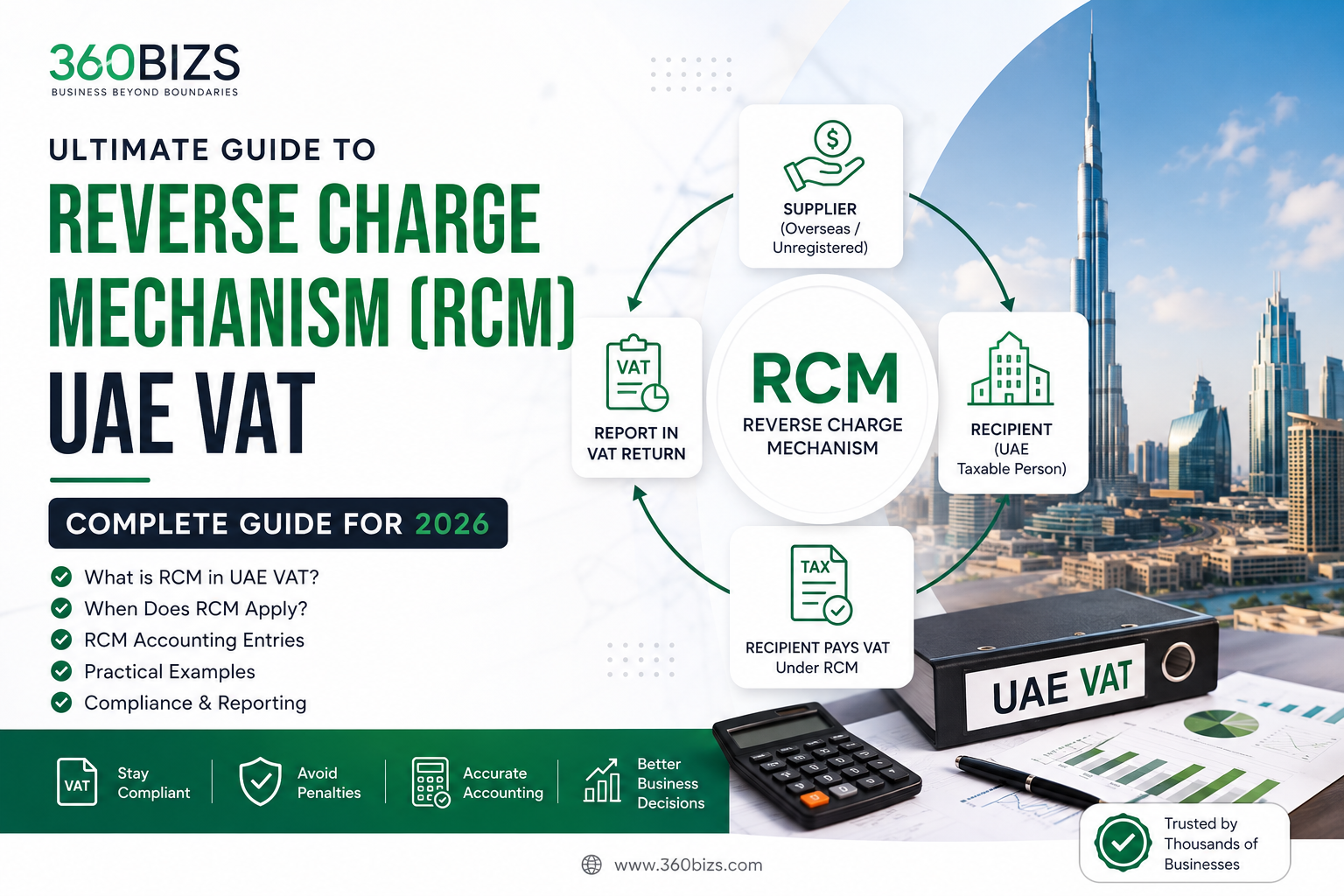
The Ultimate Guide to Reverse Charge Mechanism (RCM) under UAE VAT
Value Added Tax (VAT) in the UAE is generally straightforward: a registered supplier charges VAT to the customer, collects the tax, and pays it to the Federal Tax Authority (FTA). However, there is a major exception to this rule designed to keep international trade and specific local industries running smoothly the Reverse Charge Mechanism (RCM).
If your business imports goods or services, or deals in specific sectors like gold, oil, or electronics within the UAE, understanding RCM is critical for your tax compliance.
In this comprehensive guide by 360Bizs, we break down exactly how the Reverse Charge Mechanism works, when it applies, the latest compliance updates, and how to report it correctly on your VAT return.
What is the Reverse Charge Mechanism (RCM)?
Normally, the supplier is responsible for charging and accounting for VAT. Under the Reverse Charge Mechanism (RCM), this liability is flipped.
The recipient (buyer) of the goods or services becomes responsible for calculating, reporting, and accounting for the VAT instead of the supplier. The buyer acts as both the supplier and the customer for that specific transaction on paper.
Why does the FTA use RCM?
- Eliminates Foreign Registration Bureaucracy: It prevents non-resident international suppliers from having to register for VAT in the UAE just for a few B2B transactions.
- Level Playing Field: It ensures that local services/goods don’t become more expensive than imported ones due to tax differences.
- Reduces Tax Evasion: It minimizes fraud in high-risk sectors like gold, diamonds, and electronics.
When Does RCM Apply in the UAE?
The Reverse Charge Mechanism does not apply to every business transaction. Under the UAE VAT Decree-Law, RCM is strictly applicable to the following scenarios:
1. Import of Goods and Services
When a UAE-registered business imports services or goods from a supplier located outside the UAE (and outside the GCC implementing states), RCM applies. Because the foreign supplier cannot charge UAE VAT, the local UAE buyer must account for the 5% VAT.
2. Supply of Gold and Diamonds
To counter tax leakages, the FTA mandates RCM on B2B supplies of gold, diamonds, and products where the principal component is gold or diamonds. This applies if the buyer is registered for VAT in the UAE and intends to resell them or use them to manufacture other goods.
3. Pure Hydrocarbons, Crude Oil, and Natural Gas
B2B supplies of crude oil, natural gas, and pure hydrocarbons for resale or production purposes between UAE VAT-registered businesses fall under RCM.
4. Important Update: Electronic Devices (Cabinet Decision No. 91)
To curb VAT evasion in the tech sector, the UAE introduced RCM rules for Electronic Devices. If a VAT-registered business supplies mobile phones, smartphones, laptops, tablets, or electronic chips to another VAT-registered business for resale or manufacturing, RCM must be applied. The buyer must provide a written declaration to the supplier confirming their tax status and intent.
How Does RCM Work? (A Practical Example)
Let’s look at a clear practical example of how RCM balances out on your accounting books so that it doesn’t hurt your cash flow.
Scenario:
Your Dubai-based company, 360Bizs, hires an IT consultancy firm based in Europe to upgrade your digital platform. The invoice amount is AED 20,000. Because the consultant is outside the UAE, they send an invoice with 0% VAT.
The RCM Accounting Process:
- Calculate Output Tax: You calculate 5% VAT on the AED 20,000 invoice, which equals AED 1,000. You record this as Output VAT (tax you owe to the FTA).
- Calculate Input Tax: Since this IT service is used for your business activities, you are also entitled to recover this tax. You record the same AED 1,000 as Input VAT (tax you can reclaim).
- The Net Impact: When filing your VAT return, the AED 1,000 Output VAT and AED 1,000 Input VAT cancel each other out. The net cash outflow to the FTA for this transaction is AED 0.
How to Report RCM on UAE VAT Return (Form 201)
Even though the net financial impact is often zero, failing to report RCM transactions is a major compliance violation and can attract heavy penalties from the FTA.
Here is where it goes on your VAT Return Form 201:
| Transaction Type | Output VAT Reporting | Input VAT Recovery |
| Import of Goods | Box 3: Automatically populated via customs integration if your TRN is linked to your customs code. | Box 10: Manually enter the amount to reclaim the input tax. |
| Import of Services / Local RCM (Electronics, Gold) | Box 6: Manually declare the total value of services/goods and the calculated 5% VAT. | Box 10: Manually enter the amount in the input tax section to offset it. |
Common RCM Mistakes to Avoid
- Assuming No Reporting is Needed: Many businesses think that because the net tax impact is zero, they don’t need to put it in Form 201. This is incorrect and will cause mismatches during audits.
- Missing Electronic Declarations: For mobile phones and laptops, failing to exchange the mandatory written declaration before the supply takes place invalidates the RCM treatment, making the supplier liable.
- Not Linking TRN to Customs: If your Tax Registration Number isn’t linked with your UAE Customs code, your imports won’t auto-populate in Box 3, leading to severe filing delays.
Stay 100% Tax Compliant with 360Bizs
Navigating corporate taxes, VAT filing, and cross-border customs regulations in the UAE requires absolute precision. Small filing mistakes can result in avoidable legal complications and corporate fines.
At 360Bizs, we specialize in comprehensive business setup, corporate licensing, and tax compliance solutions across the UAE. Our financial specialists ensure your bookkeeping, RCM reporting, and VAT returns are completely accurate and fully aligned with the latest Federal Tax Authority directives.
Need help with your UAE VAT compliance or corporate tax filing? Contact the experts at 360Bizs today!
❓ Frequently Asked Questions (FAQ Section)
1. Does RCM apply if I am not registered for UAE VAT?
No. RCM only applies if the recipient is a taxable person registered for VAT in the UAE. If you are unregistered and import services from abroad, the international supplier might have to register or the transaction could face different tax treatments depending on the place of supply.
2. What is the difference between Normal VAT and Reverse Charge VAT?
Under Normal VAT, the seller collects the 5% tax from the buyer and pays it to the government. Under Reverse Charge VAT, the seller charges 0% tax, and the buyer directly calculates and reports the 5% tax to the government.
3. Do I need to keep invoices for RCM transactions?
Yes, absolutely. You must maintain all import invoices, customs declarations, shipping documents, and written declarations (for electronics/gold) for a minimum of 5 years as required by UAE tax law.