

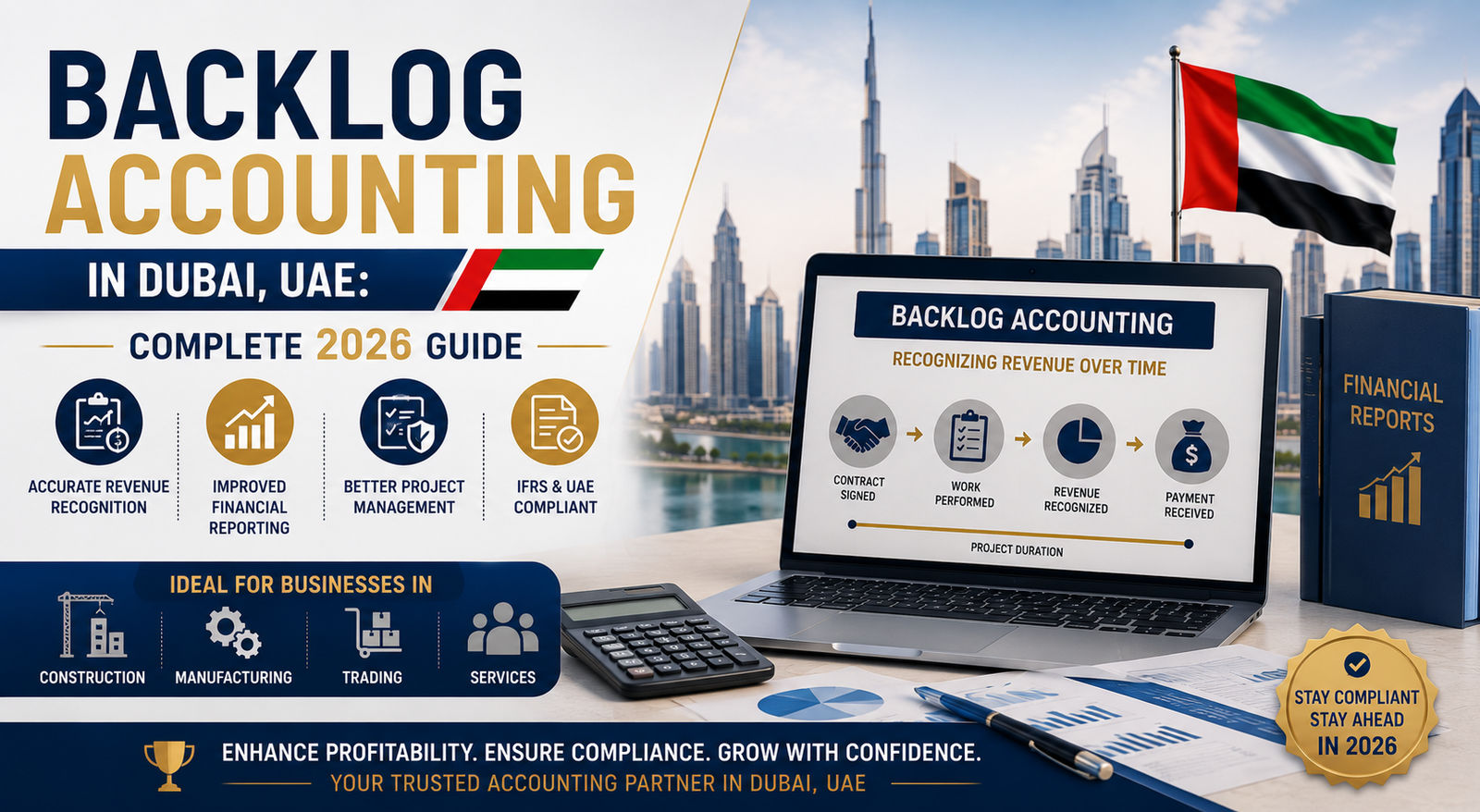
What Is Backlog Accounting?
Backlog accounting Dubai UAE refers to the practice of identifying, recording, and reconciling financial transactions that should have been entered into your company’s books at the time they occurred but were not — invoices never logged, bank transactions never reconciled, receipts never filed, payroll entries never posted. When these gaps accumulate over weeks, months, or years, your company’s financial records no longer reflect reality, making it impossible to assess true profitability, cash position, or tax liability with confidence.
In 2026, with the UAE’s regulatory environment more stringent than ever — UAE Corporate Tax, mandatory VAT compliance, and strict Commercial Companies Law record-keeping obligations all now firmly embedded in standard business operations — an unresolved accounting backlog is no longer simply an internal inconvenience. It is a direct compliance risk that exposes your business to FTA administrative penalties, audit complications, and flawed strategic decision-making.
In this guide, you will learn exactly what causes accounting backlogs, what UAE law requires of your financial records, the step-by-step process to clear a backlog correctly, and how 360bizs’ accounting and bookkeeping team restores order to your books — quickly, accurately, and compliantly.
Why Backlog Accounting Matters More Than Ever in 2026
The scale of the UAE’s small and medium enterprise sector makes backlog accounting a widespread challenge rather than an isolated problem. As of recent estimates, the UAE is home to over 557,000 SMEs, contributing approximately 63.5% of the country’s non-oil GDP. With such a vast number of growing, resource-constrained businesses, accounting backlogs are an almost inevitable byproduct of rapid expansion, lean staffing, and the operational pressure of running a business in one of the world’s most competitive markets.
What has changed since 2023 — and what makes backlog accounting a significantly higher-stakes issue in 2026 — is the introduction of UAE Corporate Tax under Federal Decree-Law No. 47 of 2022. Every UAE company must now be able to produce accurate financial statements to support its corporate tax return, calculate taxable profit correctly, and in the case of free zone companies claiming Qualifying Free Zone Person (QFZP) status, provide audited financial statements. A backlog in your books is no longer just a planning inconvenience — it is a direct obstacle to fulfilling a legal tax obligation.
Layer on top of this the ongoing VAT compliance cycle — quarterly returns, five-year record retention, and active FTA audits — and the cumulative effect of an unresolved backlog compounds rapidly. A business that falls six months behind on bookkeeping doesn’t just face a one-time catch-up cost; it faces missed VAT filing deadlines, incorrect corporate tax estimates, and a genuine risk of regulatory penalties stacking on top of each other.
Common Causes of Accounting Backlogs in UAE Businesses
Understanding why backlogs occur is the first step toward preventing them. In our experience managing accounting and bookkeeping for businesses across mainland and free zone jurisdictions, the same root causes appear consistently across industries and company sizes:
Rapid Business Growth Without Scaling Finance Function
A company that doubles its transaction volume in a year but keeps the same one-person finance team — or worse, no dedicated finance resource at all — will inevitably fall behind. Growth is a positive signal, but it directly increases the volume of invoices, receipts, payroll entries, and bank transactions that must be processed and reconciled.
Manual Bookkeeping Processes
Businesses still relying on spreadsheets, paper receipts, or fragmented manual processes are significantly more prone to backlogs than those using cloud accounting software. Manual data entry is slow, error-prone, and the first task to be deprioritised when business owners face competing operational pressures.
Lack of In-House Accounting Expertise
Many small businesses and startups in the UAE are led by founders skilled in their core business activity — sales, operations, product development — but without formal accounting training. Without expert oversight, transactions get missed, categorisation errors accumulate, and reconciliation simply doesn’t happen on a regular cadence.
Staff Shortages and Turnover
When a bookkeeper or finance team member departs without a proper handover, or when a business simply does not budget for adequate finance staffing, the inevitable result is a gap in transaction recording that grows wider the longer the position remains unfilled.
Technological Gaps
Businesses that have not adopted appropriate accounting software — whether due to cost concerns, lack of awareness, or resistance to change — face a structural disadvantage. The right software automates bank feeds, invoice matching, and recurring entries, dramatically reducing the manual workload that leads to backlogs in the first place.
The Real Cost of Ignoring an Accounting Backlog
An unresolved accounting backlog is not a passive problem that simply sits quietly until you have time to address it — it actively compounds and creates cascading risks across multiple areas of your business.
Financial Mismanagement
Without accurate, current records, it is genuinely impossible to know whether your business is profitable, cash-positive, or heading toward a liquidity crisis. Decisions made on outdated or incomplete numbers are decisions made blind.
Regulatory Penalties
The UAE imposes strict obligations on businesses to maintain proper financial records. Failure to do so can result in FTA administrative penalties of up to AED 20,000 for record-keeping violations, with additional penalties layered on for related VAT and corporate tax non-compliance.
Cash Flow Problems
Unrecorded transactions create discrepancies between what your books show and what your bank account actually reflects. This makes it difficult to manage payment timing, plan for upcoming obligations, or identify cash shortfalls before they become urgent.
Audit Complications
Whether facing a statutory audit, a bank’s due diligence review, or an FTA tax audit, incomplete or inaccurate records dramatically increase scrutiny, extend timelines, and raise the likelihood of adverse findings. A clean, current set of books is your single best defence in any audit scenario.
Damaged Vendor and Customer Relationships
A backlog in accounts payable means supplier payments get missed or delayed, eroding trust and potentially triggering late payment penalties or strained supplier terms. A backlog in accounts receivable means you lose track of who owes you money, directly damaging your cash collection and working capital position.
UAE Legal Record-Keeping Requirements You Must Know
UAE law is explicit about the financial record-keeping obligations placed on every registered business — and understanding these requirements is essential to recognising just how serious an unresolved backlog can be.
| Requirement | Legal Basis | Key Obligation |
|---|---|---|
| General Bookkeeping | UAE Commercial Companies Law (Federal Decree-Law No. 32 of 2021) | All UAE companies must maintain accurate accounting records reflecting their financial position |
| VAT Records | UAE VAT Decree-Law (Federal Decree-Law No. 8 of 2017) | Records must be retained for a minimum of 5 years from the end of the relevant tax period |
| Corporate Tax Records | UAE Corporate Tax Law (Federal Decree-Law No. 47 of 2022) | Financial statements must support the calculation of taxable income; records retained for 7 years |
| QFZP Audited Accounts | UAE Corporate Tax — Qualifying Free Zone Person conditions | Free zone companies claiming 0% tax must maintain audited financial statements annually |
| Record-Keeping Penalty | FTA Administrative Penalties Schedule | Failure to maintain proper accounting records can result in fines of up to AED 20,000 |
These are not optional best practices — they are binding legal obligations. A business carrying an unresolved backlog is, by definition, failing to meet these record-keeping standards in real time, even if the gap is eventually closed retrospectively. 360bizs’ accounting and bookkeeping team ensures all clients — mainland, free zone, and offshore — meet these standards continuously, not just at year-end.
Step-by-Step: How to Clear an Accounting Backlog
Resolving a backlog accounting situation requires a systematic, methodical approach. Rushing the process or attempting shortcuts typically introduces new errors that compound the original problem. Here is the process 360bizs follows for every backlog clean-up engagement:
Step 1: Assessment
Begin by establishing the full scope of the backlog. How far back does it extend? Which transaction types are affected — sales, purchases, payroll, bank transactions, petty cash? A clear assessment prevents surprises later in the process and allows accurate time and cost estimation for the clean-up project.
Step 2: Documentation Gathering
Collect every source document needed to reconstruct the missing period — bank statements, sales invoices, purchase invoices, expense receipts, payroll records, loan agreements, and any existing partial records. The completeness of this documentation directly determines the accuracy of the final reconstructed accounts.
Step 3: Prioritisation
Not all missing transactions carry equal urgency. Transactions affecting an imminent VAT return deadline, an upcoming corporate tax filing, or a pending bank facility renewal should be addressed first. 360bizs structures every backlog project around the client’s nearest compliance deadlines.
Step 4: Data Entry
Systematically input every missing transaction into the accounting system, ensuring correct categorisation, currency treatment, and VAT coding (standard-rated, zero-rated, exempt, or out of scope) for each entry. Accuracy at this stage is critical — incorrect categorisation here flows directly into incorrect VAT returns and tax calculations later.
Step 5: Reconciliation
Match every recorded transaction against bank statements, supplier statements, and customer records to confirm the books align with external, independently verifiable sources. Bank reconciliation is the single most important validation step in any backlog clean-up — discrepancies here indicate either missing transactions or data entry errors that must be resolved before proceeding.
Step 6: Review
Have a qualified accountant — ideally independent from the original data entry — review the reconstructed records for accuracy, completeness, and compliance with UAE accounting standards. This second-pair-of-eyes review catches errors that the person closest to the data entry may overlook.
Step 7: Controls Implementation
Clearing the existing backlog solves yesterday’s problem — but without implementing ongoing controls, the same situation will recur. 360bizs establishes monthly bookkeeping cadences, cloud software integration, and regular reconciliation checkpoints for every client following a backlog clean-up, specifically to prevent recurrence.
Backlog Accounting and UAE Corporate Tax Compliance
Since UAE Corporate Tax became effective for financial years beginning on or after 1 June 2023, the relationship between bookkeeping accuracy and tax compliance has become direct and inseparable. Every UAE company — mainland, free zone, and certain offshore structures — must register with the Federal Tax Authority (FTA) and file an annual corporate tax return calculated from accurate financial statements.
A company carrying an unresolved accounting backlog faces a specific and acute problem at tax filing time: it simply cannot calculate its taxable profit accurately, because its books do not reflect all actual income and expenses for the period. This creates two dangerous scenarios:
- Overstating taxable profit — by missing legitimate expense deductions that were never recorded — resulting in overpaying corporate tax unnecessarily
- Understating taxable profit — by missing recorded income, or through general inaccuracy — exposing the business to FTA penalties for underpayment upon eventual audit or correction
For free zone companies seeking to maintain Qualifying Free Zone Person (QFZP) status and benefit from the 0% corporate tax rate on qualifying income, the requirement for annually audited financial statements makes a clean, current set of books absolutely non-negotiable. An auditor cannot certify financial statements built on an unresolved backlog — the backlog must be cleared first, before any audit can even begin.
360bizs’ accounting and bookkeeping team coordinates directly with corporate tax filing deadlines, ensuring backlog clean-up projects are completed with sufficient runway before each client’s corporate tax return is due.
How Backlog Accounting Affects VAT Filing
UAE VAT compliance operates on a strict quarterly (or monthly, for higher-turnover businesses) filing cycle through the EmaraTax portal. A backlog in your underlying bookkeeping directly undermines the accuracy of every VAT return filed during the affected period.
Specific risks include:
- Incorrect output VAT calculation — missing sales invoices means understated output VAT, creating a future correction liability plus potential penalty exposure
- Missed input VAT recovery — unrecorded purchase invoices mean your business fails to claim legitimate input VAT credits it was entitled to, effectively overpaying VAT
- Reconciliation failures during FTA audit — if the FTA selects your business for a VAT audit and your bookkeeping backlog means your VAT returns don’t reconcile cleanly against your bank records and invoices, this significantly increases audit complexity and penalty risk
- Voluntary disclosure requirements — if a backlog clean-up reveals that previously filed VAT returns contained material errors, a Voluntary Disclosure may need to be filed with the FTA to correct the record — a process best managed by experienced VAT consultants
360bizs’ VAT consultancy and advisory team works in tandem with our accounting team during every backlog project to identify and correct any VAT filing discrepancies uncovered during the clean-up process, including managing Voluntary Disclosures where required.
Accounts Payable vs Accounts Receivable Backlogs
Backlogs typically manifest in two distinct but equally damaging forms — and each requires a slightly different remediation approach.
Accounts Payable Backlog
An accounts payable backlog occurs when supplier invoices have not been entered, tracked, or scheduled for payment. The consequences include:
- Missed payment deadlines, damaging supplier relationships and potentially triggering late payment penalties or interest charges
- Loss of visibility over total outstanding liabilities, undermining accurate cash flow forecasting
- Risk of duplicate payments or missed early-payment discounts due to lack of clear payment scheduling
Remediation approach: Compile a complete list of all unpaid supplier invoices, contact vendors to confirm outstanding balances where records are incomplete, establish a prioritised payment schedule based on cash availability and supplier importance, and implement an ongoing accounts payable tracking system going forward.
Accounts Receivable Backlog
An accounts receivable backlog occurs when customer invoices have been issued but not properly tracked, followed up on, or reconciled against payments received. The consequences include:
- Lost revenue from invoices that are simply forgotten and never collected
- Extended days-sales-outstanding (DSO), tying up working capital unnecessarily
- Difficulty identifying genuinely overdue accounts requiring collection action versus accounts already settled
Remediation approach: Reconstruct a complete aged receivables ledger, reconcile against bank deposits to confirm which invoices have actually been paid, initiate structured follow-up on genuinely outstanding balances, and implement automated invoice tracking and payment reminder systems for the future.
360bizs’ accounting and bookkeeping services include dedicated accounts payable and receivable management as part of our ongoing client support — preventing both types of backlog from recurring once the initial clean-up is complete.
Using Technology to Prevent Future Backlogs
The shift toward cloud-based accounting software is one of the most significant developments in UAE business finance in recent years. According to industry analysis, the UAE’s cloud accounting software market is projected to reach USD 65.58 billion by 2030, growing at a compound annual growth rate of approximately 14.94% — a clear signal that UAE businesses are increasingly recognising the value of automated, real-time financial management.
The core benefits of cloud accounting software in preventing backlog recurrence include:
- Real-time data access — transactions are visible and reconcilable as they occur, rather than accumulating for periodic batch entry
- Automation of repetitive tasks — recurring invoices, bank feed imports, and standard journal entries are automated, dramatically reducing manual workload and the human error that often causes backlogs
- Scalability — cloud systems adapt to growing transaction volumes without requiring a complete system overhaul, addressing one of the most common backlog triggers (rapid growth outpacing manual processes)
- Built-in compliance updates — leading UAE accounting platforms incorporate VAT and corporate tax rule updates directly into the software, reducing the risk of compliance errors from outdated manual processes
360bizs advises clients on appropriate cloud accounting software selection and implementation as part of our backlog clean-up and ongoing accounting and bookkeeping service — ensuring the systems put in place are correctly configured for UAE VAT and corporate tax requirements from day one.
How 360bizs Clears Your Accounting Backlog
At 360bizs, we treat every backlog accounting engagement as both an immediate clean-up project and a long-term systems fix. Our process is structured to deliver clarity quickly while building the foundation to prevent recurrence:
- Rapid assessment — we evaluate the scope and complexity of your backlog within days, providing a clear timeline and cost estimate before work begins
- Dedicated backlog specialists — our accounting and bookkeeping team assigns experienced professionals specifically to backlog reconstruction, separate from ongoing monthly bookkeeping resources
- Full reconciliation — every transaction is matched against bank statements, supplier records, and customer accounts before the project is considered complete
- VAT and corporate tax alignment — our VAT consultancy team reviews all backlog findings for any required Voluntary Disclosures or corporate tax adjustments
- Systems implementation — following clean-up, we implement cloud accounting software, monthly reconciliation cadences, and clear internal controls to prevent the backlog from recurring
- Jurisdiction expertise — whether your company operates as a mainland LLC, a free zone entity, or an offshore structure, our team understands the specific record-keeping obligations applicable to your jurisdiction
Common Mistakes to Avoid
- Attempting a DIY backlog clean-up without professional bank reconciliation — entering missing transactions without reconciling them against actual bank statements often introduces new errors rather than resolving the original problem.
- Prioritising recent transactions while ignoring older, harder-to-document periods — older backlogs are more difficult to reconstruct accurately, but they are equally subject to FTA record-keeping requirements. Address the full backlog scope, not just the easiest portion.
- Skipping VAT impact review — a backlog clean-up that doesn’t examine whether previously filed VAT returns require correction leaves a compliance gap that an FTA audit will eventually surface.
- Not engaging a qualified reviewer — reconstructed financial records should be reviewed by someone other than the person who performed the original data entry, to catch errors and ensure UAE accounting standards compliance.
- Failing to implement preventive controls after clean-up — clearing a backlog without addressing its root cause (manual processes, staffing gaps, lack of software) simply guarantees the same problem will recur within 12–18 months.
- Underestimating the corporate tax implications — a backlog clean-up that reveals previously unrecorded income or unclaimed deductions can materially change a company’s taxable profit calculation. This must be assessed before filing or amending a corporate tax return.
- Delaying the clean-up until immediately before a filing deadline — backlog reconstruction takes time to do properly. Starting the process only days before a VAT or corporate tax deadline forces rushed work and increases the risk of errors under time pressure.
Frequently Asked Questions
What is backlog accounting?
Backlog accounting refers to financial transactions — sales, purchases, payroll, bank entries — that were not recorded or reconciled at the time they occurred and have since accumulated as missing or incomplete entries in a company’s books. Left unaddressed, these gaps prevent accurate assessment of financial position, complicate tax filings, and expose the business to regulatory penalties under UAE law.
What causes accounting backlogs in UAE businesses?
The most common causes include rapid business growth without a proportionate increase in finance staffing, reliance on manual bookkeeping processes, lack of in-house accounting expertise, staff shortages or turnover in the finance function, and failure to adopt appropriate cloud accounting software. Each of these factors increases the likelihood of transactions being missed or delayed in recording.
What are the penalties for poor record-keeping in the UAE?
The UAE Federal Tax Authority (FTA) can impose administrative penalties of up to AED 20,000 for failure to maintain proper accounting and financial records, in addition to separate penalties that may apply for related VAT or corporate tax filing inaccuracies arising from the same underlying record-keeping failures.
How long must UAE businesses keep their financial records?
VAT records must be retained for a minimum of 5 years from the end of the relevant tax period under the UAE VAT Decree-Law. Corporate tax records must generally be retained for 7 years under the UAE Corporate Tax Law. Free zone companies claiming Qualifying Free Zone Person (QFZP) status must additionally maintain annually audited financial statements.
How do I clear an accounting backlog step by step?
The process involves: assessing the full scope of the backlog, gathering all relevant source documents (invoices, bank statements, receipts), prioritising transactions linked to upcoming tax or compliance deadlines, entering all missing data accurately, reconciling every entry against bank and supplier records, having the reconstructed accounts independently reviewed, and finally implementing ongoing controls to prevent recurrence. 360bizs’ accounting and bookkeeping team manages this entire process for clients.
How does a backlog affect my UAE corporate tax filing?
An unresolved backlog means your books do not accurately reflect actual income and expenses, making it impossible to calculate taxable profit correctly for your corporate tax return. This can result in either overpaying tax (by missing legitimate deductions) or underpaying tax (by missing recorded income) — both carrying financial and compliance risk. Free zone companies relying on QFZP status cannot obtain the required audited financial statements until the backlog is fully cleared.
Does an accounting backlog affect my VAT returns?
Yes, directly. A backlog can lead to understated output VAT (from missing sales invoices), missed input VAT recovery (from unrecorded purchase invoices), and reconciliation failures during an FTA VAT audit. In some cases, clearing a backlog reveals errors in previously filed VAT returns that require a formal Voluntary Disclosure to the FTA. 360bizs’ VAT consultancy team manages this correction process where needed.
Can I clear an accounting backlog myself without professional help?
For very small, recent backlogs with complete documentation, a careful business owner may be able to reconstruct records independently. However, for backlogs extending beyond a few months, involving significant transaction volume, or requiring VAT or corporate tax impact assessment, professional support is strongly recommended. Errors introduced during a DIY clean-up can be more difficult and costly to correct than the original backlog itself.
How much does backlog accounting clean-up cost in the UAE?
Costs vary significantly based on the length of the backlog period, transaction volume, the quality of available documentation, and whether VAT or corporate tax corrections are required alongside the bookkeeping clean-up. 360bizs provides a clear cost estimate following an initial assessment of your specific backlog scope — there is no one-size-fits-all pricing given the variability between businesses.
How can I prevent accounting backlogs from happening again?
The most effective prevention measures are implementing cloud accounting software with automated bank feeds and recurring entries, establishing a monthly bookkeeping cadence rather than periodic batch catch-ups, ensuring adequate finance staffing or outsourced support relative to your transaction volume, and conducting regular reconciliation reviews. 360bizs implements all of these measures as standard practice following every backlog clean-up project.
Conclusion
Backlog accounting is not simply an administrative inconvenience to be addressed whenever time allows — in 2026, with UAE Corporate Tax, mandatory VAT compliance, and strict Commercial Companies Law record-keeping obligations all firmly in force, an unresolved backlog is a direct and growing compliance risk. The penalties for poor record-keeping — up to AED 20,000 under FTA rules, with additional exposure through related VAT and corporate tax errors — make proactive resolution far cheaper than continued neglect.
Clearing a backlog correctly requires a systematic approach: full assessment, complete documentation gathering, accurate data entry, thorough bank reconciliation, independent review, and — critically — the implementation of preventive controls to ensure the same situation doesn’t recur within the next financial year.
At 360bizs, our accounting and bookkeeping team specialises in exactly this challenge — restoring clarity and compliance to businesses across mainland, free zone, and offshore jurisdictions throughout the UAE. We work alongside our VAT consultancy specialists to ensure every backlog clean-up correctly addresses any VAT filing implications, and we implement the cloud accounting systems and ongoing controls that keep your books current going forward.
👉 Book your free consultation with 360bizs today and let our accounting specialists assess your backlog, provide a clear remediation plan, and get your UAE business fully compliant — without the stress of managing it alone.