

Profit Margin Scheme UAE VAT: The Complete 2026 Guide
Table of Contents
- What Is the Profit Margin Scheme Under UAE VAT?
- Why the Profit Margin Scheme Exists — The Double Taxation Problem
- Which Goods Are Eligible for the UAE VAT Profit Margin Scheme?
- Three Conditions That Must All Be Met
- How to Calculate VAT Under the Profit Margin Scheme — With Worked Examples
- Invoicing Rules Under the Profit Margin Scheme
- Self-Billing When Purchasing from Unregistered Sellers
- Record-Keeping Requirements for FTA Compliance in 2026
- How to Notify the FTA That You Are Using the Scheme
- Profit Margin Scheme vs Standard VAT: A Full Comparison
- Industries and Businesses That Benefit Most
- Common Mistakes That Trigger FTA Penalties
- Frequently Asked Questions
- Conclusion
What Is the Profit Margin Scheme Under UAE VAT?
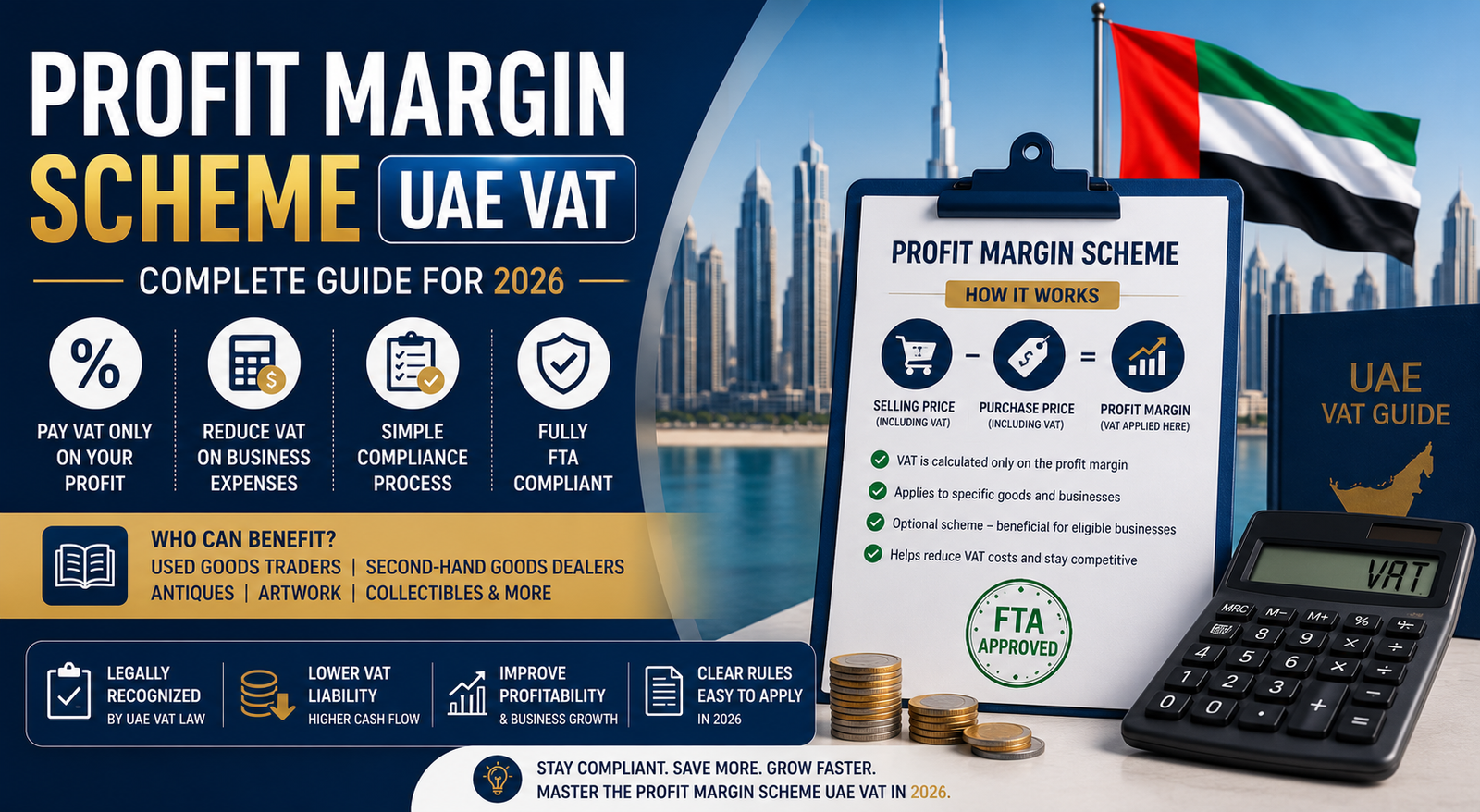
The profit margin scheme UAE VAT is a legally recognised, optional calculation method available to VAT-registered businesses in the United Arab Emirates under Article 43 of the UAE VAT Decree-Law (Federal Decree-Law No. 8 of 2017). Instead of calculating and paying UAE VAT at 5% on the full selling price of eligible goods, businesses applying this scheme pay VAT only on the profit margin — the difference between the purchase price and the selling price.
In 2026, the profit margin scheme remains one of the most commercially significant yet widely misunderstood provisions within the UAE’s VAT consultancy landscape. The Federal Tax Authority (FTA) continues to actively audit businesses operating in the second-hand goods market — including used vehicle dealerships, antique traders, and collectors’ item businesses — and non-compliance carries substantial administrative penalties.
Understanding this scheme correctly is not simply about saving money. It is about applying the right legal framework to your business operations, maintaining FTA-compliant records, and filing your VAT returns accurately through the EmaraTax portal. In this guide, you will learn exactly how the profit margin scheme works, which goods qualify, how to calculate and report VAT correctly, and what record-keeping the FTA requires. 360bizs’ VAT consultancy and advisory team manages this scheme for clients across Dubai, Abu Dhabi, Sharjah, and the wider UAE.
Why the Profit Margin Scheme Exists — The Double Taxation Problem
To understand the profit margin scheme, you must first understand the problem it was specifically designed to solve: double taxation on second-hand goods.
Consider a used car dealer in Dubai who purchases a pre-owned vehicle from a private individual. The private individual is not VAT registered — they are selling their personal vehicle, not conducting a business transaction. They charge no VAT on the sale. The used car dealer therefore pays no input tax on the purchase and cannot recover any input VAT credit.
Under standard UAE VAT rules, when that same dealer resells the vehicle, they must charge 5% VAT on the full selling price. The economic problem is clear: the vehicle was already subject to VAT when it was originally purchased new — the first buyer paid 5% VAT to the original dealer. Now, as a second-hand sale, it would effectively be taxed again at full value.
This is the double taxation scenario that Article 43 of the UAE VAT Decree-Law was enacted to prevent. The profit margin scheme resolves it by limiting the VAT liability to the value genuinely added by the second-hand dealer — their profit margin — rather than the full transaction value.
The FTA issued Public Clarification VATP002 to provide authoritative guidance on how this scheme operates and which goods qualify, with specific clarification on the transitional treatment of goods purchased before UAE VAT was introduced on 1 January 2018. 360bizs’ VAT advisory team applies VATP002 guidance in all client engagements involving second-hand goods transactions.
Which Goods Are Eligible for the UAE VAT Profit Margin Scheme?
Not all goods qualify. Under Article 29 of the UAE VAT Executive Regulations, the profit margin scheme applies only to three specific categories of goods. Applying the scheme to goods outside these categories is a compliance violation that may trigger an FTA administrative penalty.
1. Second-Hand Goods
Second-hand goods are defined as tangible movable property that is suitable for further use in its existing condition or after repair. This is the broadest and most commercially significant category, covering:
- Used vehicles — cars, motorcycles, commercial vehicles, boats
- Pre-owned electronics — mobile phones, laptops, cameras, audio equipment
- Refurbished furniture and home goods — sofas, appliances, kitchenware
- Used machinery and equipment — industrial tools, construction equipment
- Pre-owned clothing and luxury goods — designer items, watches, handbags
The goods must retain practical utility — items that are purely scrap, waste material, or have no residual use as their original product type generally do not qualify.
2. Antiques
Antiques under the UAE VAT Executive Regulations are goods that are more than 50 years old at the time of supply. Qualifying antiques include:
- Vintage and period furniture
- Historical decorative objects and artwork
- Archaeological artefacts with legitimate provenance
- Aged scientific instruments, maps, and documents with collector value
The age of the item must be verifiable through documentation, provenance records, or professional authentication. Items falsely presented as antiques expose the seller to FTA investigation and VAT recalculation at the standard rate.
3. Collectors’ Items
Collectors’ items specifically covers stamps, coins, currency, and items of scientific, historical, or archaeological interest. The defining characteristic is that the item carries value primarily as a collectible rather than for its intrinsic material composition or functional utility:
- Philatelic items — postage stamps, first-day covers, postal history
- Numismatic items — coins, bank notes, medallions with collector value
- Items of scientific interest — meteorite fragments, rare mineral specimens
- Items of historical or archaeological significance
Three Conditions That Must All Be Met
Selling eligible goods is necessary but not sufficient. The profit margin scheme UAE VAT rules require that all three of the following conditions be satisfied simultaneously for every transaction under the scheme. Failing any single condition means the standard 5% VAT rate applies on the full selling price.
Condition 1: The Goods Were Previously Subject to UAE VAT
This is the foundational condition — and the one most frequently misapplied. The goods must have been subject to UAE VAT at a prior point in the supply chain. This means the goods must have been sold with UAE VAT at 5% charged at least once before reaching the current dealer.
FTA Public Clarification VATP002 is explicit on the transitional treatment: goods purchased or acquired before 1 January 2018 — the date UAE VAT was introduced — cannot benefit from the profit margin scheme in 2026, because no UAE VAT was ever charged on them. Applying the scheme to pre-2018 stock without evidence of subsequent VAT-inclusive supply is a compliance error.
To apply the scheme, the VAT-registered dealer must obtain a copy of the original tax invoice from the earlier taxable supply as documentary evidence that UAE VAT was indeed charged on the goods at a prior stage.
Condition 2: The Goods Were Purchased From a Qualifying Supplier Type
The dealer must have acquired the goods from one of the following two supplier types only:
- A person not registered for UAE VAT — a private individual, an unregistered business, or any seller who did not charge VAT on the transaction because they were below the registration threshold or were selling a personal asset
- A VAT-registered taxable person who themselves applied the profit margin scheme — meaning they did not show VAT as a separate amount on their invoice to the current dealer
If a dealer purchases goods from a VAT-registered supplier who charged standard 5% VAT on the full sale price — and the dealer therefore received a standard tax invoice showing a separate VAT amount — the profit margin scheme cannot be applied to the onward sale of those goods. The dealer has already recovered (or is entitled to recover) input VAT, so applying the scheme on the resale would create a double benefit.
Condition 3: No Input Tax Was Recovered on the Purchase
As per Article 53 of the UAE VAT Executive Regulations, the taxable person must not have claimed or recovered any input VAT credit on the purchase of the goods for which they intend to apply the profit margin scheme. The logic is straightforward: the scheme compensates for the inability to recover input tax. If input tax was already recovered, the compensation mechanism is not needed and the scheme does not apply.
| Scenario | Prior VAT Charged? | Supplier Type | Input Tax Recovered? | Scheme Applicable? |
|---|---|---|---|---|
| Goods bought pre-January 2018 | No UAE VAT ever charged | Any | N/A | ❌ No — standard 5% VAT on full price |
| Goods bought post-2018 from unregistered seller, no prior VAT invoice available | Unverifiable | Unregistered | No | ❌ No — cannot confirm prior VAT |
| Goods bought post-2018 from unregistered seller, prior VAT invoice obtained | Yes — confirmed | Unregistered | No | ✅ Yes — scheme applies |
| Goods bought from VAT-registered dealer who applied profit margin scheme | Yes (in earlier supply) | Registered — profit margin scheme | No | ✅ Yes — scheme continues |
| Goods bought from VAT-registered dealer at standard rate with tax invoice | Yes | Registered — standard VAT | Yes (input recovered) | ❌ No — input already recovered |
How to Calculate VAT Under the Profit Margin Scheme — With Worked Examples
The profit margin scheme VAT calculation follows a specific formula that is fundamentally different from standard UAE VAT calculation. Understanding this formula is essential for correct VAT return filing through the EmaraTax portal.
The Core Formula:
- Profit Margin = Selling Price − Purchase Price
- VAT Due = Profit Margin ÷ 1.05 × 0.05
Critical rule: The profit margin is treated as VAT-inclusive. VAT is extracted from within the margin — you do not add VAT on top of the margin. If the selling price equals or is less than the purchase price (zero or negative margin), the VAT liability is zero — no VAT is payable, but equally no input tax refund arises.
Worked Example 1: Used Car Dealer in Dubai
A pre-owned vehicle dealership in Dubai purchases a second-hand SUV from a private individual (not VAT-registered) for AED 65,000. The private seller provides a copy of the original purchase invoice showing UAE VAT was charged when the vehicle was first sold new. The dealership later sells the SUV to a retail buyer for AED 82,000.
Profit Margin Scheme Calculation:
- Purchase Price: AED 65,000
- Selling Price: AED 82,000
- Profit Margin: AED 17,000
- VAT Due: AED 17,000 ÷ 1.05 × 0.05 = AED 809.52
Standard VAT Calculation (without scheme):
- Selling Price: AED 82,000
- VAT Due: AED 82,000 × 5% = AED 4,100.00
Saving through the profit margin scheme: AED 3,290.48 — entirely legitimate and fully compliant with UAE VAT law.
Worked Example 2: Antique Dealer in Sharjah
An antiques business operating in Sharjah purchases a 19th-century writing desk from an unregistered private collector for AED 12,000. The seller cannot provide any documentation showing prior UAE VAT was charged on the item. The dealer sells it for AED 19,500.
Result: Profit margin scheme cannot be applied — the dealer has no evidence that UAE VAT was charged at a prior supply stage. Standard VAT applies: AED 19,500 × 5% = AED 975 output VAT payable.
Worked Example 3: Coin and Stamp Dealer in Abu Dhabi
A numismatic dealer in Abu Dhabi purchases a certified rare coin collection from a VAT-registered dealer who applied the profit margin scheme on their sale. The purchase price paid is AED 8,500 (no separate VAT shown on the invoice — profit margin scheme invoice). The dealer later sells the collection for AED 11,200.
Profit Margin Scheme Calculation:
- Purchase Price: AED 8,500
- Selling Price: AED 11,200
- Profit Margin: AED 2,700
- VAT Due: AED 2,700 ÷ 1.05 × 0.05 = AED 128.57
Standard VAT (without scheme): AED 11,200 × 5% = AED 560.00
Saving: AED 431.43 — and the scheme correctly continues from the previous dealer’s supply chain. 360bizs’ VAT advisory team verifies these chain-of-supply eligibility conditions for clients operating in specialist markets.
Invoicing Rules Under the Profit Margin Scheme
The profit margin scheme imposes specific invoicing requirements that differ significantly from standard UAE VAT invoice rules. Issuing a standard tax invoice for a profit margin scheme supply is a compliance error — and it misleads the buyer into incorrectly believing they can claim input VAT on their purchase.
What a Profit Margin Scheme Invoice Must Include
- A clear statement that the supply is made under the UAE VAT profit margin scheme
- The name, address, and Tax Registration Number (TRN) of the supplying business
- The date of supply
- A description of the goods sufficient to identify them
- The total consideration payable by the buyer (the selling price)
- The VAT amount must NOT be shown separately on the invoice
Why VAT Must Not Be Shown Separately
Under the profit margin scheme, the VAT is embedded within the profit margin — it is extracted from the margin using the formula, not added on top of the selling price. Showing a separate VAT amount on the invoice would suggest to the buyer that they are being charged output VAT on their purchase — which would entitle them to claim input VAT credit. This is expressly not permitted: a buyer who purchases goods under the profit margin scheme cannot recover input VAT on that purchase. Showing VAT separately on the invoice is both legally incorrect and potentially misleading.
360bizs reviews and where necessary redesigns VAT invoice templates for all clients in the used goods, antiques, and collectibles sectors as part of our VAT consultancy service.
Self-Billing When Purchasing from Unregistered Sellers
One of the most practically important aspects of the profit margin scheme — and one frequently overlooked by dealers — is the requirement to issue a self-billed purchase invoice when buying eligible goods from a private individual or other unregistered seller.
When a VAT-registered dealer purchases goods from a person who is not registered for UAE VAT — a private individual selling a personal vehicle, for example — there is no supplier-issued tax invoice. The seller simply does not have the VAT registration to issue one. This creates an audit trail gap that the FTA addresses through the self-billing mechanism.
What a Self-Billed Purchase Invoice Must Include
- The dealer’s own name, address, and TRN
- The private seller’s name and address
- The date of purchase
- A clear description of the goods acquired
- The consideration paid (the purchase price)
- The signature of the private seller (or their authorised representative) confirming the transaction
The self-billed invoice serves as the documentary foundation for the dealer’s profit margin scheme eligibility claim for that specific item. Without it, the dealer has no compliant evidence trail for the FTA in the event of an audit. 360bizs prepares self-billing invoice templates and reviews purchase documentation for all clients operating under the profit margin scheme as part of our accounting and bookkeeping service.
Record-Keeping Requirements for FTA Compliance in 2026
The FTA conducts active audits of businesses in the second-hand goods market in 2026, and record-keeping quality is the primary differentiator between businesses that pass an audit cleanly and those that face penalty assessments. Inadequate records can result in the profit margin scheme being retrospectively disallowed for audited periods — with 5% VAT recalculated on full selling prices for all transactions, plus applicable penalties.
Mandatory records for profit margin scheme compliance:
- A detailed stock register or inventory book for all goods bought and sold under the scheme — listing each item individually with its purchase price, selling price, date of purchase, date of sale, and supplier/buyer details
- Purchase invoices for every item acquired — or self-billed purchase invoices where the seller was unregistered
- Evidence of prior UAE VAT for each item — typically a copy of the original tax invoice from an earlier supply showing that 5% UAE VAT was charged
- Sales invoices issued to buyers under the scheme — correctly formatted without a separately stated VAT amount
- VAT return records from the EmaraTax portal showing how profit margin transactions were reported in each period
- All records must be retained for a minimum of five years from the end of the tax period to which they relate
360bizs maintains all required profit margin scheme records for clients through our accounting and bookkeeping service, with a complete digital audit trail accessible at any time.
How to Notify the FTA That You Are Using the Scheme
Under Article 76 of the UAE VAT Decree-Law, every VAT-registered business applying the profit margin scheme is required to notify the FTA that they are using this calculation method. This notification is not discretionary — it is a legal obligation.
Failure to notify the FTA — even if the scheme is being applied correctly in every other respect — may result in an FTA Administrative Penalty Assessment. Running the scheme informally without formal notification does not provide any protection in the event of an audit.
In practice, the notification is typically completed through:
- Your initial VAT registration on the EmaraTax portal — selecting the profit margin scheme option where prompted
- A formal notification to the FTA through the EmaraTax portal if the scheme was not indicated at registration
- Your appointed VAT consultant or tax agent managing the notification as part of your VAT compliance setup
360bizs verifies FTA profit margin scheme notification status for all clients in applicable sectors and manages any retrospective notifications required where this step was overlooked. Contact our VAT advisory team if you are unsure whether your business has correctly notified the FTA.
Profit Margin Scheme vs Standard VAT: A Full Comparison
| Feature | Profit Margin Scheme | Standard UAE VAT |
|---|---|---|
| VAT Calculated On | Profit margin (selling price minus purchase price) | Full selling price |
| VAT Rate | 5% (extracted from margin — VAT-inclusive) | 5% (added on top of price — VAT-exclusive) |
| Formula | Margin ÷ 1.05 × 0.05 | Selling price × 0.05 |
| Eligible Goods | Second-hand goods, antiques, collectors’ items | All taxable supplies |
| Input Tax Recovery | ❌ Not permitted on scheme purchases | ✅ Permitted where input tax was charged |
| Invoice Requirements | VAT must NOT be shown separately | VAT must be shown separately |
| Buyer’s Input Tax | ❌ Buyer cannot recover input VAT | ✅ Buyer can recover input VAT (if registered) |
| FTA Notification Required | ✅ Yes — mandatory | No — standard default |
| Record-Keeping | Enhanced — per-item stock register required | Standard VAT records |
| Applicable If No Profit | Zero VAT due — no refund | VAT on full price always applies |
| Double Taxation Prevention | ✅ Yes | ❌ No — can result in double taxation |
Industries and Businesses That Benefit Most
The profit margin scheme UAE VAT has the most significant financial impact in sectors where dealers regularly purchase goods from private individuals or unregistered sellers and resell at a margin. In 2026, the key beneficiary industries across Dubai, Abu Dhabi, Sharjah, Ajman, and Ras Al Khaimah include:
Used Vehicle Dealerships
The UAE second-hand car market is one of the most active in the world. Dealerships that purchase vehicles from private sellers — particularly expatriates leaving the UAE and selling personal vehicles — benefit enormously from the profit margin scheme. A dealership trading 100 vehicles per month at an average margin of AED 15,000 per vehicle saves approximately AED 35,700 per month in VAT liability compared to the standard rate — an annual saving of over AED 428,000. Properly structuring the documentation for every purchase is critical. 360bizs manages this for dealership clients through our accounting and bookkeeping service.
Antique and Vintage Markets
Dubai’s antique markets — particularly in the Al Quoz industrial area and Deira — include numerous dealers in vintage furniture, period art, and historical artefacts who source from private collections, estate clearances, and overseas suppliers. The profit margin scheme allows these businesses to maintain competitive pricing while remaining fully FTA compliant.
Numismatic and Philatelic Dealers
Coin, stamp, and currency traders — operating across the UAE’s specialist markets and increasingly through online platforms serving the GCC — frequently trade in items whose UAE VAT provenance must be carefully documented. The profit margin scheme significantly reduces their output VAT liability when eligibility conditions are met.
Pre-Owned Electronics and Luxury Goods
Dubai’s thriving market in pre-owned smartphones, luxury watches, designer handbags, and high-end electronics increasingly operates through structured retail channels — both physical showrooms and online marketplaces. Dealers who correctly apply the profit margin scheme for eligible purchases gain a meaningful pricing advantage over competitors who over-report VAT. 360bizs provides VAT consultancy to businesses in this sector across all UAE emirates.
Common Mistakes That Trigger FTA Penalties
The FTA‘s audit focus on the second-hand goods market in 2026 means that the following mistakes are actively identified and penalised:
- Applying the scheme to pre-2018 stock — goods purchased or received before 1 January 2018 have never been subject to UAE VAT and therefore cannot qualify for the profit margin scheme under any circumstances. This is the single most commonly audited issue in the used goods sector.
- Showing VAT as a separate line item on profit margin scheme invoices — this is legally prohibited under the scheme’s invoicing rules. It creates a false entitlement for the buyer to claim input VAT and misrepresents the nature of the supply.
- Failing to obtain self-billed invoices for private purchases — without a properly completed, seller-signed self-billed purchase invoice for every eligible item purchased from an unregistered individual, the audit trail is incomplete and the FTA may disallow the scheme for those transactions.
- Claiming input VAT on purchases and then applying the profit margin scheme on the resale — these two treatments are mutually exclusive for the same item. A dealer who recovered input VAT on a purchase cannot apply the profit margin scheme on the subsequent sale.
- Not notifying the FTA — operating the scheme without the required formal FTA notification under Article 76 of the UAE VAT Decree-Law exposes the business to administrative penalties regardless of whether the scheme was applied correctly in all other respects.
- Inadequate stock register maintenance — failure to maintain an item-by-item stock register with purchase prices, selling prices, and prior UAE VAT evidence is the leading cause of FTA audit failures in the used goods sector. Standard bookkeeping records are insufficient — the profit margin scheme requires dedicated per-item documentation.
- Incorrectly reporting in the VAT 201 return — profit margin scheme transactions must be reported with the profit margin (not the full sale price) as the taxable value in the EmaraTax portal VAT 201 return. Reporting full sale values inflates VAT liability; reporting incorrectly triggers reconciliation errors. 360bizs’ VAT return filing team manages accurate EmaraTax reporting for all profit margin scheme clients.
- Extending the scheme to services or non-qualifying goods — the profit margin scheme applies exclusively to goods. It cannot be applied to services of any kind, nor to goods that do not fall within the three qualifying categories.
Frequently Asked Questions
What is the profit margin scheme under UAE VAT?
The profit margin scheme UAE VAT is an optional mechanism under Article 43 of the UAE VAT Decree-Law (Federal Decree-Law No. 8 of 2017) that allows VAT-registered businesses dealing in eligible second-hand goods, antiques, and collectors’ items to calculate UAE VAT at 5% on their profit margin — the difference between the purchase price and selling price — rather than on the full selling price. It prevents double taxation on goods that were already subject to UAE VAT at an earlier supply stage.
Which goods qualify for the UAE profit margin scheme?
Three categories of goods qualify under Article 29 of the UAE VAT Executive Regulations: second-hand goods (tangible movable property suitable for further use as-is or after repair), antiques (goods over 50 years old), and collectors’ items (stamps, coins, currency, and items of scientific, historical, or archaeological interest). The scheme does not apply to services or goods outside these categories.
What is the formula for calculating VAT under the profit margin scheme?
The profit margin is treated as VAT-inclusive. The formula is: VAT Due = (Selling Price − Purchase Price) ÷ 1.05 × 0.05. If the selling price does not exceed the purchase price — meaning there is no profit — the VAT liability is zero. No VAT is payable, and no input tax refund arises.
Can goods purchased before 2018 qualify for the UAE profit margin scheme?
No. FTA Public Clarification VATP002 is explicit: goods purchased or acquired before 1 January 2018 — before UAE VAT was introduced — cannot benefit from the profit margin scheme because no UAE VAT was ever charged on them at a prior supply stage. The eligibility condition requiring prior UAE VAT cannot be satisfied for pre-2018 goods.
Can a buyer purchase goods under the profit margin scheme and later resell them using the same scheme?
Yes. If a VAT-registered dealer purchases goods under the profit margin scheme — receiving an invoice without separately stated VAT — they satisfy the condition of having purchased from a supplier who applied the scheme. They may therefore apply the profit margin scheme to their own subsequent sale, provided all other eligibility conditions are met at the time of their resale. The scheme can continue through multiple supply chain stages.
Can a buyer who purchases under the profit margin scheme claim input VAT?
No. A buyer who purchases goods under the profit margin scheme cannot recover input VAT on that purchase. The invoice issued under the scheme does not show a separate VAT amount — because the VAT is embedded within the margin — and therefore there is no recoverable input tax for the buyer. This is a fundamental feature of the scheme and must be clearly understood before electing to apply it.
Do I need to notify the FTA to use the profit margin scheme?
Yes — notification is mandatory. Under Article 76 of the UAE VAT Decree-Law, every VAT-registered business applying the profit margin scheme must notify the FTA that they are using this calculation method. Failure to notify may result in an FTA Administrative Penalty Assessment even if the scheme is otherwise being applied correctly. 360bizs’ VAT advisory team manages FTA notification as a standard step for all applicable clients.
What records must I keep for the profit margin scheme?
Businesses must maintain a per-item stock register listing purchase prices, selling prices, dates, and supplier/buyer details for every transaction under the scheme; purchase invoices or self-billed invoices for all eligible goods purchased; evidence of prior UAE VAT for each item (typically a copy of the earlier supply’s tax invoice); correctly formatted sales invoices without separately stated VAT; and VAT return records from the EmaraTax portal. All records must be retained for a minimum of five years.
What happens if I sell a second-hand item at a loss?
If the selling price is equal to or less than the purchase price — resulting in zero or negative profit margin — the VAT liability under the profit margin scheme is zero. No output VAT is payable for that transaction. However, this does not entitle the dealer to a VAT refund on the transaction; the taxable value is simply reported as zero in the VAT 201 return.
Is there a minimum transaction value for the profit margin scheme?
No minimum transaction value applies to individual items under the profit margin scheme. The scheme is available for any eligible transaction regardless of value. However, to apply the scheme at all, the business must be VAT registered — meaning its annual taxable supplies must meet the mandatory registration threshold of AED 375,000, or it has voluntarily registered above the AED 187,500 voluntary threshold. 360bizs manages VAT registration for businesses approaching or exceeding these thresholds.
Conclusion
The profit margin scheme UAE VAT is one of the most commercially valuable yet frequently misapplied provisions within the UAE’s tax framework. For businesses in the second-hand vehicle market, antique trade, and collectors’ items sector across Dubai, Abu Dhabi, Sharjah, and the wider UAE, correctly applying this scheme can reduce output VAT liability by 60–85% per transaction — entirely legally, under a framework specifically enacted by the UAE legislature to prevent double taxation.
The three eligibility conditions — prior UAE VAT, qualifying supplier type, and no input tax recovery — are non-negotiable. The invoicing rules — no separately stated VAT on profit margin scheme invoices — are precise. The record-keeping requirements — per-item stock registers, self-billed invoices, prior VAT evidence — are stringent. And the FTA notification obligation under Article 76 of the UAE VAT Decree-Law is mandatory.
Getting these elements right from day one protects your business from FTA audit penalties, preserves your competitive pricing advantage in the used goods market, and ensures your VAT 201 returns filed through the EmaraTax portal are accurate and defensible.
At 360bizs, our VAT consultancy and advisory team provides end-to-end profit margin scheme compliance services — from FTA notification and invoice template design to per-item stock register maintenance, self-billed invoice preparation, and accurate VAT return filing. Our accounting and bookkeeping specialists maintain the full documentation trail required to withstand FTA audit scrutiny. Whether you operate a mainland trade business or a free zone entity in the used goods sector, 360bizs delivers the technical VAT expertise that protects your business and maximises your legitimate tax efficiency.
Book your free consultation with 360bizs today and let our UAE VAT specialists review your current approach to the profit margin scheme — ensuring full FTA compliance and maximum legitimate tax savings from day one.