
FZE vs FZCO in UAE: Key Differences and Which Is Right for You in 2026
Table of Contents
- What Is a UAE Free Zone Company and Why It Matters
- What Is a Free Zone Establishment (FZE)?
- What Is a Free Zone Company (FZCO)?
- FZE vs FZCO: Full Comparison at a Glance
- What Is an FZ-LLC and How Does It Differ?
- UAE Free Zone Benefits That Apply to Both FZE and FZCO
- Share Capital Requirements: FZE vs FZCO in 2026
- Corporate Tax and VAT Obligations for Free Zone Companies
- UBO Disclosure Requirements for FZE and FZCO
- FZE vs FZCO vs Mainland LLC: Which Jurisdiction Is Right?
- How to Convert an FZE to an FZCO
- Step-by-Step: How to Set Up an FZE or FZCO in Dubai
- Common Mistakes to Avoid When Choosing Between FZE and FZCO
- Frequently Asked Questions
- Conclusion
What Is a UAE Free Zone Company and Why It Matters
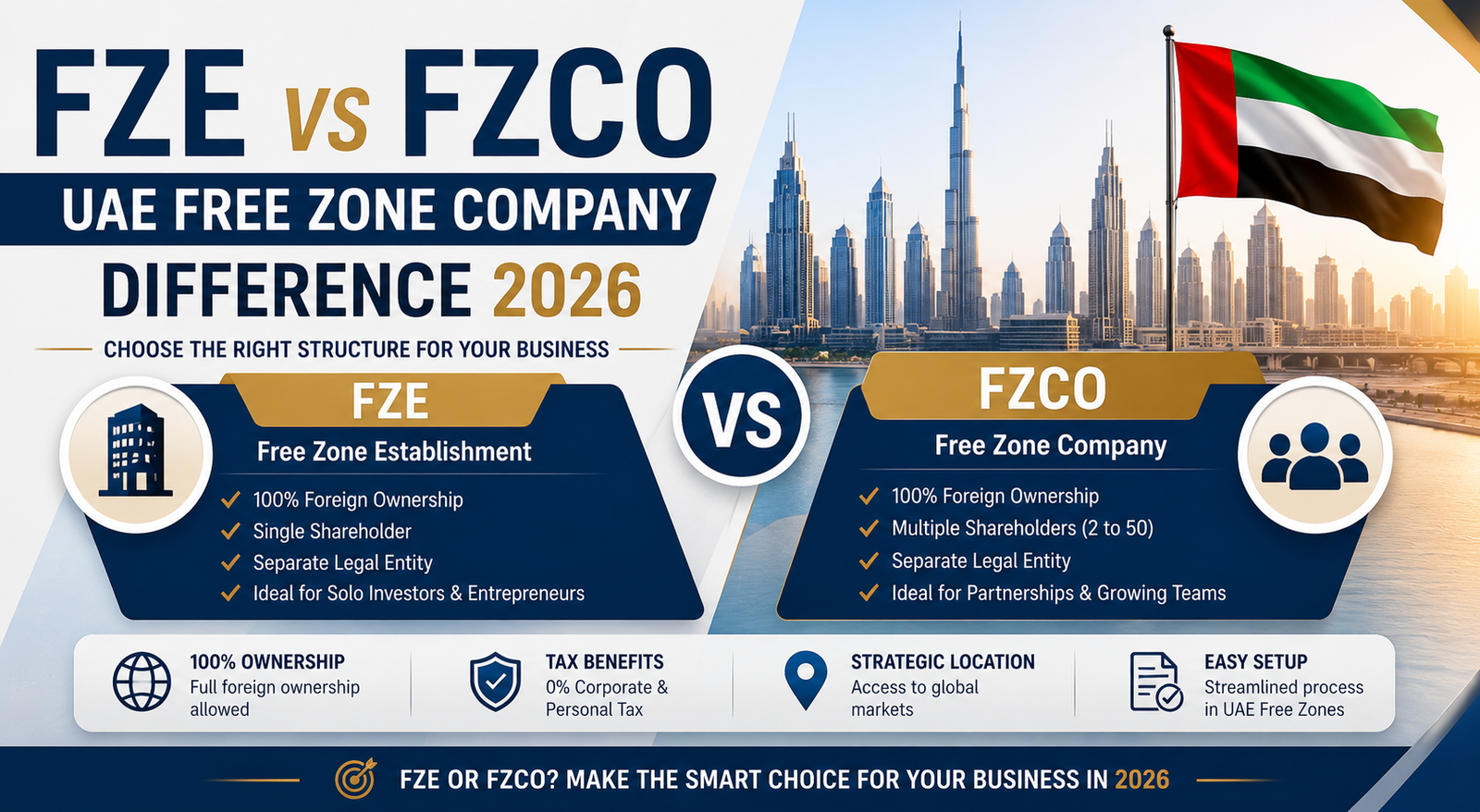
The FZE vs FZCO UAE free zone company difference in 2026 is one of the most common questions asked by entrepreneurs entering the UAE market — and getting the answer right before you register saves time, money, and costly restructuring down the line. Both the Free Zone Establishment (FZE) and the Free Zone Company (FZCO) are limited liability entities incorporated in a designated UAE free zone, offering 100% foreign ownership, full profit repatriation, and access to the UAE’s 0% corporate tax pathway for qualifying income.
The UAE operates more than 40 designated free zones — each with its own regulatory authority, permitted activities, and licensing framework. Whether you are setting up in DMCC, IFZA, JAFZA, SHAMS, RAKEZ, or any other zone, the choice between an FZE and an FZCO is fundamentally a question of one thing: how many shareholders your company will have.
In this guide, you will learn exactly what distinguishes an FZE from an FZCO, how each structure compares to a mainland LLC, what the tax obligations are under the UAE Corporate Tax Law, and how 360bizs determines the right structure for your specific business model as part of every free zone business setup engagement.
What Is a Free Zone Establishment (FZE)?
A Free Zone Establishment (FZE) is a limited liability entity incorporated within a UAE free zone that has exactly one shareholder. That shareholder may be an individual — a natural person of any nationality — or a corporate entity such as an existing company from any country. The FZE is the UAE free zone equivalent of a sole-owner limited liability company.
Key defining characteristics of an FZE:
- Single shareholder only — one individual or one corporate entity; no additional shareholders permitted
- Separate legal personality — the FZE is legally distinct from its owner; personal assets are protected from company liabilities
- Limited liability — the shareholder’s liability is capped at the value of their paid-up share capital
- Governed by the relevant free zone authority — not by the mainland Department of Economic Development (DED)
- Simple governance structure — the sole shareholder may also serve as director; no separate board of directors is required in most free zones
- Full control and fast decision-making — with one owner, there are no shareholder resolutions, no voting requirements, and no partner disputes
- Flexible share capital — most modern UAE free zones including JAFZA have removed fixed minimum capital requirements; capital must simply be sufficient for the company’s licensed activities
Who Is the FZE Best Suited For?
The FZE structure is ideal for:
- Solo entrepreneurs and individual founders establishing their first UAE company
- Freelancers and consultants who want a legitimate Dubai free zone business setup with full control
- Small e-commerce businesses and digital service providers operating as a single-owner entity
- Corporate investors setting up a UAE subsidiary wholly owned by a parent company
- International holding structures where a single offshore entity holds the UAE free zone company
- Entrepreneurs who want maximum confidentiality — with one shareholder, ownership disclosure is minimal
Documents Required for FZE Formation
The specific document requirements vary by free zone authority, but the standard checklist for most UAE free zones in 2026 includes:
- Completed application form from the relevant free zone authority
- Passport copy of the shareholder (and director/manager if different) — minimum 6 months’ validity
- No Objection Certificate (NOC) if the shareholder currently holds a UAE residence visa under another sponsor
- Business plan or project summary — typically a one-page overview
- KYC (Know Your Customer) form and UBO (Ultimate Beneficial Owner) disclosure form — mandatory under UAE Cabinet Decision No. 58 of 2020
- Appointment letter for director or manager (if different from shareholder)
For corporate shareholders (i.e., a company owning the FZE), additional documents are required:
- Parent company’s Certificate of Incorporation
- Parent company’s Memorandum and Articles of Association
- Board resolution authorising the UAE FZE formation and appointing directors
- Power of Attorney (POA) if a representative is signing on behalf of the parent company
- Certified or attested copies depending on the country of the parent company’s incorporation
What Is a Free Zone Company (FZCO)?
A Free Zone Company (FZCO) — also written as FZC, FZ Co., or in some free zones as FZ-LLC — is a limited liability entity incorporated in a UAE free zone that has between two and fifty shareholders. It is the UAE free zone equivalent of a partnership or multi-shareholder limited liability company.
Key defining characteristics of an FZCO:
- Two to fifty shareholders — individuals, corporate entities, or a combination of both
- Separate legal personality — distinct from its shareholders; liability is limited to paid-up capital
- Collective governance — decisions require shareholder resolutions; major matters may require a defined majority vote as specified in the Memorandum of Association
- At least one manager required — governance is more formalised than an FZE; some free zones (such as DWTC) allow appointment of up to five directors
- Shareholders’ agreement — typically drafted to govern voting rights, profit distribution, exit provisions, and dispute resolution between co-owners
- Flexible share capital — many free zones set a nominal minimum (often AED 50,000), though physical deposit at formation is not always required; the capital must be adequate for the company’s activities
- Growth-ready structure — new shareholders can be added (subject to authority approval) without dissolving and re-forming the company
Who Is the FZCO Best Suited For?
The FZCO structure is ideal for:
- Co-founders and business partners establishing a UAE venture together
- Joint ventures between two companies — for example, a UAE entity and a foreign corporate partner
- Family businesses where siblings, spouses, or relatives hold equity
- Startups seeking external investment — the FZCO share structure allows new investors to acquire equity without restructuring
- Businesses with short-to-medium-term plans to add shareholders or raise capital
- Companies where shared governance and accountability between partners is commercially important
Documents Required for FZCO Formation
The FZCO documentation requirements mirror the FZE process but must be replicated for each shareholder:
- Application form and free zone authority-specific forms (e.g., EHS form for JAFZA)
- Passport copies of all shareholders and directors/managers
- KYC and UBO forms for every shareholder — mandatory under UAE Cabinet Decision No. 58 of 2020
- NOC for any shareholders or directors currently holding UAE residence visas under another sponsor
- Shareholders’ agreement (recommended for all FZCOs with two or more individual shareholders)
- Board resolution and appointment letters for directors/managers
For corporate shareholders, the same additional documents required for FZE corporate shareholders apply — Certificate of Incorporation, MOA, board resolution, and POA — for each corporate entity holding shares in the FZCO.
FZE vs FZCO: Full Comparison at a Glance
| Feature | FZE (Free Zone Establishment) | FZCO (Free Zone Company) |
|---|---|---|
| Number of Shareholders | Exactly one (individual or corporate) | Two to fifty (individuals, corporates, or mixed) |
| Legal Liability | Limited to paid-up share capital | Limited to paid-up share capital |
| Foreign Ownership | 100% ✅ | 100% ✅ |
| Governance | Shareholder may act as director — simple, fast | Requires at least one manager; shareholder resolutions needed |
| Share Capital | No fixed minimum (must be sufficient for activities) | Nominal minimum (often AED 50,000); varies by free zone |
| Decision-Making | Sole shareholder decides unilaterally | Requires majority or unanimous shareholder vote (per MOA) |
| Adding Shareholders | Not possible — must convert to FZCO | ✅ Yes, subject to authority approval |
| Shareholders Agreement | Not required | Strongly recommended — governs rights and exit |
| Best For | Solo founders, consultants, corporate subsidiaries | Co-founders, JVs, family businesses, startups |
| Setup Cost | Lower — single set of shareholder documents | Slightly higher — multiple shareholder document sets |
| Conversion | Can convert to FZCO if needed | Can consolidate to FZE by buying out co-owners |
| Confidentiality | Higher — single owner | Lower — multiple owners, UBO disclosures for all |
| Corporate Tax (UAE) | 0% on qualifying income (QFZP); 9% above AED 375,000 otherwise | 0% on qualifying income (QFZP); 9% above AED 375,000 otherwise |
What Is an FZ-LLC and How Does It Differ?
Several UAE free zones — most notably DMCC and RAKEZ — use the term FZ-LLC (Free Zone Limited Liability Company) rather than FZCO. The practical differences are minimal:
- An FZ-LLC functions similarly to an FZCO — it is a limited liability entity with one or more shareholders
- DMCC allows both single-shareholder and multi-shareholder FZ-LLCs — making it functionally equivalent to both an FZE and an FZCO under a single entity type
- RAKEZ and some other zones use FZ-LLC exclusively, with no separate FZE classification
- The legal protections, tax treatment, and operational rules are identical to those of FZE and FZCO structures in other zones
When 360bizs recommends a free zone for your Dubai free zone business setup, the specific entity type available in that zone is clearly explained upfront so you know exactly what structure you are forming.
UAE Free Zone Benefits That Apply to Both FZE and FZCO
Regardless of whether you choose an FZE or FZCO, all UAE free zone companies benefit from the same core incentives that make the UAE one of the world’s most attractive business jurisdictions in 2026:
- 100% foreign ownership — no UAE national partner or sponsor required, in contrast to the historic mainland requirement (now largely removed under the UAE Commercial Companies Law amendment of 2021)
- Full profit and capital repatriation — 100% of profits and capital can be transferred out of the UAE without restriction
- 0% personal income tax — no tax on salaries, dividends, or personal returns for UAE residents
- 0% corporate tax on qualifying income — free zone companies that meet the conditions of a Qualifying Free Zone Person (QFZP) pay 0% corporate tax on qualifying income under UAE Federal Decree-Law No. 47 of 2022
- No customs duty within the free zone and between free zones — import and export within the UAE’s designated free zones is duty-free
- Fast digital company formation — most free zone business setups complete in 2–7 business days with e-signing and digital document submission
- UAE residence visas — both FZE and FZCO structures allow shareholder and employee visa sponsorship, with quotas linked to leased workspace size
- Prestigious business addresses — free zones such as DMCC (Jumeirah Lakes Towers), DIFC, and Dubai Internet City offer internationally recognised business addresses
Share Capital Requirements: FZE vs FZCO in 2026
One of the most misunderstood aspects of UAE free zone company formation is share capital. In 2026, the position across most major UAE free zones is as follows:
JAFZA (Jebel Ali Free Zone): Prior to 2017, JAFZA imposed minimum share capital requirements of AED 1,000,000 for FZEs and AED 500,000 per shareholder for FZCOs. These requirements were abolished in 2017. Today, both FZE and FZCO structures in JAFZA require only that the share capital be sufficient for the company’s intended business activities — there is no fixed minimum amount.
DMCC: Typically requires a nominal minimum share capital of AED 50,000 for FZ-LLC entities, though physical deposit is not always required at formation.
IFZA: No mandatory minimum share capital for most activity categories — making it one of the most accessible free zone business setup options for budget-conscious entrepreneurs.
SHAMS: No minimum share capital requirement — particularly attractive for freelancers and consultants establishing FZE structures.
RAKEZ: Nominal minimums apply in some categories; confirm with the authority at the time of application.
Important: Even where no minimum is legally required, your company’s Memorandum of Association (MOA) should declare a share capital figure that is credibly proportionate to your business activities. UAE banks and corporate bank account opening processes examine your declared share capital as part of their KYC assessment. 360bizs advises on the appropriate share capital declaration for every free zone formation we manage.
Corporate Tax and VAT Obligations for Free Zone Companies
Both FZE and FZCO entities are subject to UAE tax law — and this is an area where many entrepreneurs make dangerous assumptions about what “free zone” actually means for their tax position.
UAE Corporate Tax (9%)
Under UAE Federal Decree-Law No. 47 of 2022, the Federal Tax Authority (FTA) applies a 9% corporate tax on taxable profits exceeding AED 375,000 per financial year, effective from June 2023. This applies to all UAE companies — including free zone FZEs and FZCOs.
However, a free zone company that qualifies as a Qualifying Free Zone Person (QFZP) may apply a 0% corporate tax rate to all qualifying income. The QFZP conditions require:
- Adequate UAE substance — real employees, operations, and expenses in the free zone
- Qualifying income only — primarily from other free zone persons or international (non-mainland) sources
- Non-qualifying income below the 5% de minimis threshold
- Annually audited financial statements
- Transfer pricing compliance for related-party transactions
Registration for UAE corporate tax is mandatory for all UAE companies — including FZE and FZCO structures — regardless of expected tax liability. Failure to register attracts FTA administrative penalties. 360bizs’ accounting and bookkeeping team handles FTA corporate tax registration and annual return filing for all clients.
UAE VAT (5%)
UAE VAT at 5% applies to most goods and services supplied by UAE companies. Mandatory VAT registration is triggered when your annual taxable supplies exceed AED 375,000. Both FZE and FZCO entities are subject to the same VAT rules, with certain designated free zone areas qualifying for specific customs and VAT suspension benefits on goods.
360bizs provides full VAT consultancy and advisory services for all free zone company clients — including registration, quarterly return preparation, invoice compliance review, and FTA correspondence management.
UBO Disclosure Requirements for FZE and FZCO
Under UAE Cabinet Decision No. 58 of 2020 and subsequent regulatory updates, all UAE companies — including FZE and FZCO entities in all free zones — must maintain a Ultimate Beneficial Owner (UBO) register and disclose all natural persons who ultimately own or control 25% or more of the company.
For an FZE with a single individual shareholder, the UBO is straightforward — the sole owner is the UBO. For an FZCO with multiple shareholders, UBO disclosure must be completed for every shareholder holding 25% or above, and in cases where corporate entities hold shares, the UBO analysis must pierce through the corporate structure to identify the underlying natural persons.
Key compliance requirements:
- UBO forms must be submitted with the initial formation application
- The UBO register must be updated within 15 days of any ownership change
- Non-compliance with UBO obligations attracts significant administrative penalties
- All free zone authorities — including DMCC, JAFZA, IFZA, and SHAMS — enforce UBO compliance as a condition of licence renewal
360bizs reviews UBO obligations for every free zone business setup and mainland company formation as part of our standard formation service.
FZE vs FZCO vs Mainland LLC: Which Jurisdiction Is Right?
For many entrepreneurs, the choice is not just between FZE and FZCO — it is also between a free zone structure and a mainland LLC or an offshore company. Here is how the structures compare:
| Feature | FZE / FZCO (Free Zone) | Mainland LLC (DED) | Offshore (RAK ICC / JAFZA) |
|---|---|---|---|
| Foreign Ownership | 100% ✅ | 100% (most activities since 2021) ✅ | 100% ✅ |
| UAE Market Access | ⚠️ Via distributor only | ✅ Unrestricted | ❌ Not permitted |
| Government Contracts | ❌ | ✅ | ❌ |
| UAE Residence Visa | ✅ | ✅ | ❌ |
| Physical Office Required | Flexi desk accepted | Ejari tenancy mandatory | ❌ |
| Setup Timeline | 2–7 days | 7–14 days | 3–5 days |
| Min. Licence Cost | From AED 5,750 (SHAMS) | From AED 15,000 (DED) | From AED 8,000 (RAK ICC) |
| Corporate Tax | 0% (QFZP qualifying) / 9% | 9% above AED 375,000 | Generally not subject |
| Best For | International trade, consulting, digital | UAE domestic market, retail | Asset holding, IP, invoicing |
For entrepreneurs primarily serving international clients, a free zone FZE or FZCO is almost always the most cost-effective structure. For those targeting the UAE domestic market, mainland company formation provides cleaner market access. For asset holding and international structures, offshore company formation offers the most tax-efficient and privacy-conscious option. 360bizs advises on jurisdiction selection as the first step in every engagement.
How to Convert an FZE to an FZCO
A common scenario in growing UAE businesses is an FZE that needs to bring on a second founder, investor, or corporate partner. Fortunately, most UAE free zone authorities allow conversion from FZE to FZCO — though the process involves regulatory steps that must be followed carefully:
- Prepare a shareholders’ agreement — governing the rights, voting thresholds, profit distribution, and exit provisions of all incoming shareholders
- Draft an amended Memorandum of Association (MOA) — updated to reflect the new ownership structure, share allocation, and shareholder details
- Submit a conversion application to the relevant free zone authority — along with the amended MOA, KYC and UBO forms for all new shareholders, and the existing company’s trade licence
- Pay conversion fees — each free zone sets its own fee schedule for entity type amendments
- Receive the updated trade licence — reissued in the company’s name with the FZCO designation and updated shareholder register
The reverse conversion — from FZCO to FZE — is also possible when one shareholder buys out the other(s), but involves the same regulatory amendment process. 360bizs manages all free zone entity conversions and amendments as part of our free zone business setup service.
Step-by-Step: How to Set Up an FZE or FZCO in Dubai
Step 1: Choose Your Free Zone and Entity Type
Select the free zone that best fits your business activity, budget, and operational requirements — then confirm whether an FZE or FZCO is the right structure based on your shareholding. 360bizs conducts a free zone and entity-type assessment for every client before any application is submitted. [INTERNAL LINK: https://360bizs.com/dubai-free-zone-business-setup-services/]
Step 2: Reserve Your Trade Name
Submit your proposed company name to the free zone authority for approval. The name must comply with UAE naming conventions — no offensive content, no duplication of existing registered names, and no references to government or religious entities. For FZCOs, the name must be followed by “FZCO” and for FZEs by “FZE” in most free zones.
Step 3: Prepare and Submit Your Documents
Compile your complete document pack — application forms, passport copies, KYC/UBO forms, business plan, and any corporate shareholder documents. For FZCOs, this process must be completed for every shareholder. 360bizs prepares and reviews your full document pack before submission to eliminate rejection risk.
Step 4: Select Your Registered Address
Choose your workspace within the free zone — flexi desk (from AED 3,500/year at SHAMS), serviced office, dedicated office, or warehouse. Your chosen workspace determines your UAE residence visa quota. For most solo FZE owners, a flexi desk is sufficient for initial setup.
Step 5: Pay Your Fees and Receive Initial Approval
Pay the free zone authority’s licence registration fees, workspace fees, and any applicable government charges. Upon payment, the authority issues an initial approval confirming your application is accepted for processing.
Step 6: Receive Your Trade Licence and Certificate of Incorporation
Your UAE trade licence and certificate of incorporation are issued upon completion of the review process — typically within 2–7 business days for most UAE free zones. For FZCOs, ensure the trade licence correctly reflects all shareholders’ names and shareholding percentages.
Step 7: Register for Corporate Tax and VAT
Register your FZE or FZCO with the Federal Tax Authority (FTA) for UAE corporate tax — mandatory for all UAE companies. If your taxable supplies are expected to exceed AED 375,000, also register for UAE VAT. 360bizs’ VAT consultancy team and accounting specialists manage both registrations as part of our post-formation compliance service.
Step 8: Apply for UAE Residence Visas
With your trade licence in hand, apply for UAE investor visas for shareholders and employee visas for staff. The free zone authority processes visas through its internal immigration system. Physical presence in the UAE is required for the medical fitness test and Emirates ID biometrics.
Step 9: Open Your UAE Corporate Bank Account
Use your trade licence, certificate of incorporation, MOA, and Emirates ID to open a UAE corporate bank account. 360bizs pre-qualifies your company profile with suitable UAE banking partners to maximise approval probability and reduce opening timelines. [INTERNAL LINK: https://360bizs.com/]
Step 10: Annual Renewal and Compliance
Renew your free zone trade licence and workspace lease annually. File UAE corporate tax returns and VAT returns on schedule. Update your UBO register immediately upon any ownership change. Maintain audited financial statements if claiming QFZP status. 360bizs provides a 12-month compliance calendar and manages all ongoing obligations on a retained basis through our accounting and bookkeeping service.
Common Mistakes to Avoid When Choosing Between FZE and FZCO
- Choosing FZE when you have a co-founder — if you and a partner intend to jointly own the business, an FZE cannot accommodate two shareholders. Starting with an FZE and converting later involves fees, regulatory delays, and amended documentation. Select FZCO from the outset if co-ownership is planned.
- Underestimating the governance requirements of an FZCO — multiple shareholders means decisions require formal resolutions, records must be maintained, and a shareholders’ agreement should be in place. Skipping the shareholders’ agreement is a leading cause of FZCO disputes.
- Assuming no share capital means no financial commitment — even where free zones impose no minimum capital, declaring an unrealistically low share capital in your MOA can complicate UAE bank account opening, as banks assess declared capital during KYC.
- Ignoring QFZP eligibility conditions — many free zone company owners assume 0% corporate tax is automatic. It is not. If your company conducts non-qualifying activities or serves UAE mainland clients beyond the 5% de minimis threshold, the 0% rate does not apply. 360bizs’ accounting team monitors qualifying income percentages throughout the year.
- Failing to complete UBO disclosure for all shareholders — in an FZCO with corporate shareholders, the UBO analysis must trace through the corporate structure to the underlying natural persons. Incomplete UBO filings trigger regulatory penalties and can block licence renewal.
- Not registering for UAE corporate tax — all UAE companies must register with the FTA, regardless of expected tax liability. Non-registration is a compliance violation. 360bizs handles FTA registration as a standard step in every formation.
- Choosing the wrong free zone for your activity — not every activity is permitted in every free zone. Financial services, healthcare, legal advisory, and education all require additional regulatory approvals from sector-specific authorities. Always confirm your specific activity is permitted before committing to a free zone.
- Delaying VAT registration — once your FZE or FZCO’s taxable supplies exceed AED 375,000, mandatory VAT registration applies. Late registration attracts automatic FTA penalties.
Frequently Asked Questions
What is the main difference between an FZE and an FZCO in the UAE?
The fundamental difference is the number of shareholders. An FZE (Free Zone Establishment) has exactly one shareholder — an individual or a corporate entity. An FZCO (Free Zone Company) has between two and fifty shareholders — individuals, corporate entities, or a combination. Both structures offer 100% foreign ownership, limited liability, and identical UAE tax treatment. The choice depends entirely on whether you are setting up alone or with partners.
Can an FZE or FZCO trade on the UAE mainland?
Free zone companies — both FZE and FZCO — cannot sell directly to UAE mainland customers or operate physical retail premises outside their designated free zone without additional authorisation. To access the UAE mainland market, free zone companies either appoint a local distributor, establish a mainland branch, or set up a separate mainland LLC through the DED. For businesses primarily serving international or cross-border clients, a free zone structure is typically sufficient.
Do FZE and FZCO companies pay UAE corporate tax?
All UAE companies — including FZE and FZCO entities — must register for UAE corporate tax with the Federal Tax Authority (FTA). Free zone companies that qualify as a Qualifying Free Zone Person (QFZP) may apply a 0% corporate tax rate to qualifying income. Income that does not qualify, or non-qualifying activities above the 5% de minimis threshold, is taxed at 9% on profits above AED 375,000. 360bizs’ accounting team assesses QFZP eligibility for every client.
What is the minimum share capital for an FZE or FZCO in the UAE?
Most major UAE free zones — including JAFZA, IFZA, and SHAMS — have removed fixed minimum share capital requirements. The company’s declared capital must be sufficient for its intended business activities. Some zones — including DMCC and RAKEZ — maintain a nominal minimum (typically AED 50,000), though physical deposit at formation is not always required. 360bizs confirms the exact capital requirement for your chosen free zone before formation.
Can I convert my FZE to an FZCO if I want to add a partner?
Yes. Most UAE free zone authorities allow conversion from FZE to FZCO. The process involves drafting an amended Memorandum of Association, completing KYC and UBO forms for all new shareholders, submitting a conversion application to the free zone authority, paying conversion fees, and receiving an updated trade licence. 360bizs manages all entity conversion and amendment procedures for clients. [INTERNAL LINK: https://360bizs.com/dubai-free-zone-business-setup-services/]
What is an FZ-LLC and is it the same as an FZCO?
An FZ-LLC (Free Zone Limited Liability Company) is a designation used by certain UAE free zones — most notably DMCC — instead of the FZE/FZCO classification. Functionally, an FZ-LLC operates like an FZCO but in some free zones (including DMCC) can also accommodate a single shareholder — making it equivalent to both an FZE and an FZCO depending on the ownership structure chosen. The legal protections, tax treatment, and operational rules are identical across all three designations.
How long does it take to set up an FZE or FZCO in Dubai?
UAE free zone company formation — whether FZE or FZCO — typically completes within 2–7 business days from submission of a complete document pack. SHAMS and IFZA are among the fastest at 2–3 days. DMCC and JAFZA typically take 5–7 days. Timelines extend when regulated activities require additional approvals from sector-specific authorities, or when corporate shareholder documents require legalisation or apostille.
Do I need a physical office for an FZE or FZCO in Dubai?
Most UAE free zones accept a flexi desk as the registered address for FZE and FZCO entities — with flexi desk costs starting from AED 3,500 per year at SHAMS. A physical dedicated office is only required if your business activity demands it (e.g., manufacturing, warehousing, retail display) or if you wish to maximise your UAE residence visa quota — which is directly linked to your leased workspace size.
Can a corporate entity (company) own a UAE FZE or FZCO?
Yes. Both FZE and FZCO structures can be owned entirely or partially by corporate entities — a UAE company, a UK limited company, a Pakistan-registered company, or any other foreign corporate entity. For corporate shareholders, additional documentation is required: Certificate of Incorporation, Memorandum and Articles of Association, board resolution, and Power of Attorney. These documents must typically be apostilled or attested depending on the country of origin.
What is the UBO requirement for FZE and FZCO companies?
Under UAE Cabinet Decision No. 58 of 2020, all UAE companies — including FZE and FZCO entities — must maintain a UBO (Ultimate Beneficial Owner) register identifying all natural persons who ultimately own or control 25% or more of the company. UBO forms are submitted at formation and must be updated within 15 days of any ownership change. Non-compliance attracts penalties and can block licence renewal.
Is it better to choose an FZE or FZCO for a startup seeking investment?
For startups planning to raise investment, the FZCO is the strongly recommended structure. It allows new investors to acquire equity by becoming additional shareholders without dissolving and re-forming the company. An FZE cannot accommodate investors — any new shareholder requires conversion to FZCO, which adds time and cost. If you anticipate fundraising at any point in your UAE business journey, build the FZCO structure from day one.
Conclusion
The choice between an FZE and an FZCO in the UAE is not a question of which is better in absolute terms — it is a question of which is right for your specific ownership structure, growth plans, and business model. An FZE delivers maximum control, simplicity, and speed for solo founders and corporate subsidiaries. An FZCO provides the multi-shareholder framework, governance structure, and equity flexibility that partnerships, joint ventures, and investment-ready startups require.
Both structures benefit equally from the UAE’s 100% foreign ownership, 0% corporate tax pathway for qualifying free zone income, full profit repatriation, and one of the world’s fastest company formation systems. The difference lies in governance — and getting that governance decision right at the formation stage is far cheaper than correcting it through conversion later.
At 360bizs, we begin every free zone business setup engagement with a structured assessment of your shareholding structure, activity type, market access requirements, and tax optimisation goals — recommending the right entity type, the right free zone, and the right share capital before a single application is submitted. We manage the complete formation process — from trade licence issuance and MOA drafting to investor visa processing, UAE corporate tax registration, VAT advisory, and ongoing accounting compliance — all under one roof.
For clients with more complex structures — offshore holding companies, mainland LLCs, or dual-jurisdiction arrangements — 360bizs designs integrated structures that optimise your UAE presence across all relevant dimensions.
👉 Book your free consultation with 360bizs today and let our free zone specialists confirm the right entity type for your business — before you commit to any formation costs.